



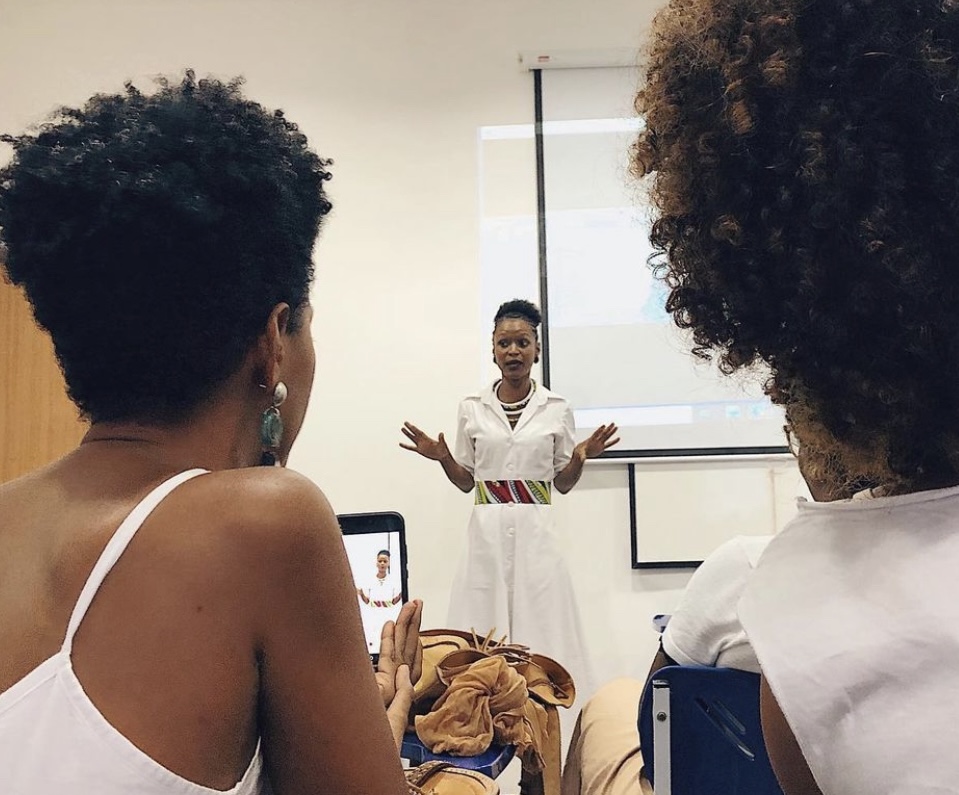
AA: Hello, welcome. Tell us about yourself, how do you identify, and the work you do.
KTD: My name is Karine Teixeira Damasceno, I’m a 44-year-old black woman, born and raised in Feira de Santana in Bahia, Brazil. I’m the eldest daughter of Raimundo Teixeira Damasceno and Josafá Damasceno, but we were raised by a single mother so I proudly say that I’m the fruit of a family headed by a Black woman. I have an undergraduate degree in History from the State University of Feira de Santana (UEFS), where I entered in 2001 when I was 23-year-old.
When I entered college, that’s when my experience as a Black militant began. I joined a student group called NENNUEFS (Nucleus of Black Women and Black Men Students of UEFS) which was fundamental in the struggle for affirmative action policies at the university. Affirmative action quotas were finally implemented at UEFS in 2007 and I have to tell you that this happened later than most of the other universities. Of course, our work wasn’t limited to the debate on quotas – not that this was a small problem – but we were the ones who were called for action on issues of education, racism, black people in the job market, the Black family and even racial discrimination on the University level. Along with denouncing injustices, we went out into the community to educate people in the neighborhoods, in public and private schools, in pre-university courses, and in residents’ associations… basically, anywhere we were called.
Reflecting on my political experience in undergrad, I decided that I would remain engaged in the political struggle against racism through organized black movement groups.
AA: What were some of the other movement groups you worked with?
KTD: Nearing the end of my undergraduate experience, I joined the local organization, “Frente Negra Feirense (FRENEF)” and the national “Movimento Negro Unificado (MNU)”. From 2005 on, I acted on both fronts, thinking locally and nationally, and I continue to be part of both today. I also need to say that NENNUEFS was fundamental to my personal development, like reaffirming my self-esteem as a Black woman, of assuming my hair, my Black body and feeling good, feeling beautiful about myself.

AA: It seems that this student organization was fundamental to your identity as a political activist and an intellectual…
KTD: Absolutely! The NENNUEFS and the community we built with those young Black people, the debates, the formation, and the sociability while doing politics contributed in this sense to my life and to my growth. This helped me to graduate and I have no doubt that it inspired me to pursue my master’s and doctoral degrees, and now I’m doing a post-doctorate. So the choice to continue academic life had a lot to do with the conversations I had with those colleagues, those sisters, and brothers at that time.
AA: Graduating with your undergraduate degree and your political experience opened up a new world for you. Tell us about it.
KTD: So, in 2006 I graduated and was selected for an international scholarship program from the Ford Foundation. At the same time, I joined the master’s program at The State University of Campinas (Unicamp) in Sao Paulo. After I finished my master’s degree and returned to Feira de Santana, I re-entered the local political struggle and contributed, for example, to the coordination of a political campaign for a great activist here in the city, Ivannide Santa Bárbara. Unfortunately, we weren’t able to elect her for counselor but it was an important experience to strategize power from another position – not only as a voter.
AA: Is this when you became more involved with the Black Women’s movement?
KTD: In 2013, I was working in education, I was invited to participate in a meeting of Black women that would take place in Salvador. I was invited by Suely Santos, an important figure in the black women’s movement in Brazil.
She came to tell me about the possibility of a women’s march that would happen. There – knowing that I already admired many Black feminists – during the process of building the march, I began to have contact with several Black feminists. Black feminists from the academic field, such as Ana Cláudia Pacheco, Vilma Reis and so many others I began to meet as well as other Black feminists from outside the academic environment.
Since that moment, I have politically positioned myself as a Black feminist. Carrying out the political struggle, and building my academic research, it’s all from this place that I also present myself. So after the march unfolded we continued to build a network of Black women that continues to exist and is very powerful. So that’s what I do. I am fighting against racism, sexism, and class oppression.
AA: Brazil is highly misunderstood. What, do you think, are some sources of this problem? Have you experienced this in your interactions with black people outside Brazil?
KTD: Brazil, like other countries, has its particularities as a state. I’ve witnessed this in my experiences inside and outside Brazil. During my graduate studies, I also had my first experiences in the United States. I had an exchange experience at the University of Arkansas in 2010 and in 2017 I did Ph.D. studies at Howard University in Washington D.C. These experiences not only put me in contact with Americans but also with other people who weren’t born there but just like me they were in the United States to study. During my exchange time, I had more contact with foreigners than with African Americans, I had contact with Peruvians, Mexicans, Japanese, Middle Eastern, Russians, Mozambiquians, Kenyans, etc. So the impression I have of these people – mostly men (I suppose the immigration process favored them…) is that they knew little about Brazil.
I remember that I did one workshop and we had to share information about the personalities of our countries. I remember that the expectation of the people in that class was that I would introduce the famous soccer player Pelé or our former president, Lula because these were the two Brazilian figures they had in mind at that moment or perhaps the only references they knew. Instead, I spoke about Zumbi dos Palmares, the great Bantu military leader who fought the Portuguese colonists and built free Black societies long before the abolition of slavery in Brazil in 1888.
At the time, I felt that it was important to talk about Zumbi and the importance that he has for us but maybe if I were doing that workshop today, I would choose a Black woman. I think very little is known, but there is a lot of disinformation. For example, some information such as the hypersexualization of the black woman’s body is very harmful. I remember the day I arrived I ended up being late for a social event that the residents had organized themselves. It was a moment just for students – and I shared the house with a Russian woman, so I also remember that there was a very high expectation about my presence at that party. It took me a little time to understand why there was all that interest in my presence, I wasn’t used to it in Brazil. I’m not used to being so “desired”, especially by men. I don’t have this emblematic experience in Brazil, so it took a while to understand what was happening- when they pulled my arm, insisted that I had to dance, that they wanted to “see me dance”. I remember there were a few white women in that space – who were less shy than me – but the guys didn’t treat them the same way.
AA: What did you think was their motivation?
KTD: At first I wasn’t sure, but then I came to understand that their expectation was to see me dance, to see my “Brazilian” body moving. All the interactions after that moment made me believe that they didn’t treat me that way just out of consideration for me as a Black woman but because there was a fantasy that I was the woman of hypersexualization. A woman the men would be free to touch, a woman for pleasure but not to date or to go out holding hands. I experienced many things there, so I can say from my experience that was their image of the black woman. After all, they didn’t know me.
When I came back later for a longer stay, I had contact with other foreigners, many Latinos, and some Africans. The impression I had is that the Africans mostly identified me as someone from probably a country in Africa, but never Brazil. My features are not the image that they have of a Brazilian woman, you know… The image they have of the Brazilian woman is a whiter image, with long, straight hair that swings, so I didn’t fit on that pattern.
AA: This is a dominant stereotype about Brazilians, through entertainment and tourism…
There is also the fact that people don’t understand why a majority Black population like us can still experience such oppression. Just as the “variety of colors” that can be identified in Brazil does make sense to others, especially the African Americans with whom I had contact. They live an experience in a country where they are a minority, so while in the United States they are 14% of the population, we are 56%. Then how is it possible to suffer so much?
You see, the inequality, exclusion, and violence are so rampant, both here and in the U.S. I have no doubt about that. But one thing to consider is that in Brazil we have this unique social concept, which is the myth of racial democracy popularized by Gilberto Freire. I think this creates great confusion between us. I think the myth of racial democracy was really a very successful white project for those who embraced the ideas defended by Freire in his book and it was really a very well done strategy.
They just didn’t win because we are here, because Black people continue to exist. But in fact, there is even greater confusion among us about this identification. The white minority still benefits from this myth today allowing them to stay in power and manipulating African descendants to adopt the discourse that in Brazil there are no Black people- that no one here is Black or white, that we are a “mestiço” (mixed-race) people. They were very successful in that sense and that’s why it makes it difficult for us to position ourselves as people.
In Brazil, we have difficulty positioning ourselves as a people to face racism, to understand what is really happening to that person with lighter skin than mine or darker than mine. People have difficulty understanding that violence, the negligence of the public power in public and private institutions- that this is happening because the victims of violence are Black. This makes it difficult for us to give the right answers but it doesn’t mean that answers have not been apparent in various ways throughout history. The debate on racism is sometimes lost and for those outside of Brazil, it’s difficult to understand this level of oppression.
Another thing that needs to be said is that white people in Brazil have always understood, even with the diversity and difference of ideas and interests among them, they knew that it was important to unite to face, dominate, to control Black people. Whether the Africans at the time of slavery, those who were later born free, or after the abolition of slavery… Although they think differently in many aspects today, when it comes to facing us in the fight for power and in the division of wealth in the country, they know they need to be united to beat us. So this is a different issue from the Black struggle in the United States. I don’t dare to speak for the experience of African American oppression, but this is the experience in Brazil…
We will continue this dialogue next week…
Translation Services provided by Dante Freire