




Black funerals—what we call homegoing services—are beautiful precisely because they hold everything at once. Grief and gossip. Reverence and reckoning. Hymns and side-eye. All this is braided together in the sacred work of remembering a life.
The choir sings. The preacher thunders. Folks cry into folded programs. Because if you grew up around Black church culture, you already know that the real conversation doesn’t end with the benediction. It starts afterward, in the fellowship hall, on the church steps, in the parking lot, and now, apparently, all over social media.
“This one didn’t show.”
“Why wasn’t she on the program?”
“Why didn’t they put him in the obituary?”
“Did you see what so-and-so had on?”
“They didn’t even mention his name.”
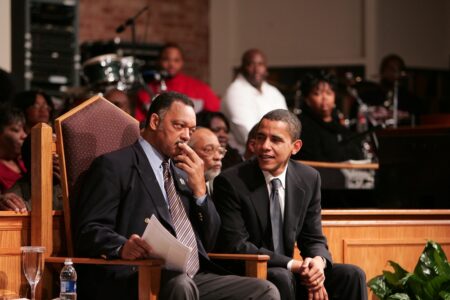
That’s why the debate now bubbling across social media about Barack Obama and his former pastor Rev. Jeremiah Wright at Rev. Jesse Jackson’s funeral feels so familiar to many Black folks. What you’re seeing right now is a familiar kind of storm. Screenshots are circulating, timelines are filling up with commentary, and people are arguing about what did or did not happen at the service. This kind of commentary is part of how Black communities process relationships that were never fully resolved while the person was alive.
Some posts insist that Barack Obama deliberately failed to acknowledge Rev. Wright even though Wright was sitting in the room. Others are pushing back, saying the outrage is misplaced. They’re saying that Obama’s role was to eulogize Jackson, not to call the roll of every Chicago pastor present. Still others claim they were in the sanctuary and saw Obama greet Wright off camera.
The debate has already taken on the tone that these debates usually do. There’s accusations of disrespect, defenses of protocol, and a lot of commentary about loyalty, history, and gratitude. To understand why this moment is hitting such a nerve, we have to go back almost two decades.
In 2008, as Obama was running for president, the country was suddenly introduced to Rev. Wright’s sermons, Obama’s longtime pastor at Trinity United Church of Christ in Chicago. Wright had baptized Obama’s daughters and officiated his wedding. For 20 years, Obama had sat in Wright’s pews and absorbed the rhythms of Black prophetic preaching.
In that tradition, the pulpit is not just a place for gentle consolation. It is a place where scripture meets the headlines. Where the Exodus story sits beside the evening news. Where Pharaoh has many modern names and the promised land is still unfinished business. The preacher’s voice rises and falls like music. It’s part sermon, part history lesson, and part moral indictment reminding the congregation that faith is not meant to anesthetize the pain of injustice but to name it, confront it, and imagine a world beyond it. In that sanctuary, the Bible is not distant ancient text but a living mirror held up to America itself.
As Obama was running for the presidency, cable news began looping clips from Wright’s sermons. The most famous line, “God damn America,” was ripped from its theological and historical context and blasted across TV screens. The backlash was immediate and ferocious. Obama was forced to publicly distance himself from the man who had been his pastor for decades. The rupture became one of the defining dramas of that campaign.
Obama responded with the speech that would become known as “A More Perfect Union,” an attempt to contextualize Wright’s anger within the long history of American racism while still rejecting the rhetoric that had ignited the firestorm. But the political damage had already been done. Within weeks, Obama formally severed ties with Wright.
In the years that followed, both Barack and Michelle Obama revisited the episode in their memoirs, and their reflections reveal a relationship that was far more complicated than the cable news caricatures suggested.
Barack had written about Jeremiah Wright long before the controversy erupted. In Dreams from My Father, he described Wright as the pastor who helped him understand the Black church as a place where faith, history, anger, humor, and hope could all live in the same sermon. Wright’s preaching, Obama wrote, spoke directly to the contradictions of Black life in America. Sitting in those pews helped Obama see his own personal story as part of a much larger historical struggle.
But years later, in A Promised Land, Obama reflected on the rupture with a more sober tone. He acknowledged Wright’s influence on his spiritual and political formation, yet he also described the moment when the relationship began to unravel. As the controversy exploded during the 2008 campaign, Obama wrote that Wright’s later defiant press conferences and speeches that seemed to lean into the spectacle, made it impossible to contain the political damage. Watching those moments unfold, Obama suggested that the pastor he had known began to feel different from the man who had once guided his spiritual journey.
Michelle Obama’s account in Becoming carries a different emotional register. She wrote about the shock of watching a pastor who had baptized their daughters and preached at their wedding suddenly transformed into a national villain on cable news. Wright, she explained, was part of their church family. Seeing him reduced to a handful of incendiary clips felt like watching a complex human relationship flattened into a political spectacle. At the same time, she acknowledged that the controversy created a crisis that threatened to consume Barack’s presidential campaign.
In both memoirs, the tone is neither dismissive nor sentimental. It is something more human. Gratitude for the role Wright played in their lives sits alongside disappointment about how the relationship ultimately collided with the unforgiving realities of presidential politics. In other words, the relationship was never simple. It was part mentorship, part spiritual formation, part political liability, and part unresolved heartbreak.
Years passed.
Obama left the White House. Wright faded from the national spotlight. The two men’s names rarely appeared in the same sentence anymore.
And then came the homegoing for Rev. Jesse Jackson.
When a figure as large as Rev. Jackson dies, the service becomes more than a memorial. It becomes a gathering of generations: civil rights veterans, pastors, politicians, organizers, disciples, critics, and protégés all under the same roof. People come to mourn, but they also come to witness history closing a chapter. That’s why moments like this draw so much scrutiny.
But here’s the part that people outside Black communities often misunderstand: Black funerals, especially for movement figures, are never simply ceremonies of mourning. They are also about narrative. They are public rituals where communities revisit history, renegotiate relationships, and decide how a life will be remembered. That means people are always paying attention to the details.
The homegoing becomes a kind of courtroom of memory. For a few hours, an entire political, religious, and community ecosystem gathers under one roof. People listen closely to who speaks, who gets named, who doesn’t, who sits where, and who is photographed with whom. None of that is trivial in Black communal culture. It’s how communities read power, loyalty, and history.
That’s why some people are reacting strongly. For them, the relationship between Obama and Wright still carries emotional weight. Wright represents a particular tradition of Black prophetic Christianity that shaped Obama early in his career. When the two men were forced apart during the 2008 campaign, many people understood the political necessity. But necessity doesn’t erase the symbolic loss.
So when both men are in the same sacred space at a funeral for someone like Rev. Jackson, people naturally wonder whether that rupture will finally soften. If it doesn’t appear to, some people read that as confirmation that the distance remains.
But the other side of the conversation is just as important. Many people believe that turning a funeral into a referendum on old political wounds distracts from the purpose of the moment, which is to honor the life of the deceased. That’s what you see in the pushback posts saying the outrage is petty. What makes this moment so revealing is that both instincts are real.
So the conversation about Obama and Wright isn’t just internet drama. It’s part of a familiar ritual that happens after many Black homegoing services. People replay the program like game film. And that’s where the deeper meaning of this moment comes in.
Funerals are one of the few social spaces where folks quietly hope for symbolic reconciliation. When tensions exist between prominent figures, people often look to the funeral as a moment where the story might be repaired. Not necessarily through a dramatic speech or apology, but through subtle gestures like a handshake, a hug, a mention from the pulpit, a shared memory, a nod to someone’s influence. These gestures can function like a public closing of the circle.
Black people need that.
We have lived through centuries of relationships fractured by power, politics, exile, and the brutal math of survival. Movements splinter. Leaders fall out. Strategies collide. And too often the people doing the work of freedom are forced to part ways in public, under the pressure of a country that has always been eager to magnify our divisions. A funeral can feel like one of the last places where those fractures might soften, where people who once walked together can acknowledge the shared road, even if they didn’t finish the journey side by side.
And in this moment especially, that kind of symbolic repair carries extra weight. We are living through a period of open backlash, attacks on Black history, Black institutions, voting rights, education, books, and the very idea of racial justice itself. In times like these, people instinctively look for signs of unity among the figures who shaped the struggle. They want to believe that the elders who carried the movement through its hardest chapters can still stand in the same room without the past hanging too heavily in the air.
That’s why people watch so closely. Not because they expect a perfect reconciliation, but because they are searching for small signals that the circle of the community, fractured as it may be, can still hold.
Thanks for reading. If this piece resonated with you, then please consider becoming a paid subscriber. Paid subscriptions help keep my Substack unfiltered and ad free. They also help me raise money for HBCU journalism students who need laptops, DSLR cameras, tripods, mics, lights, software, travel funds for conferences and reporting trips, and food from our pantry. You can also follow me on Facebook!