
Close Menu
TheHub.news

    Did You Know Author and Abolitionist, Olaudah Equiano, Died on This Day?

    By Shayla Farrow

    In Class with Carr: “Six/Seven”

    By TheHub.news Staff

    “No Kings,” No Risk, No Change. The Protest Ritual That Lets America Feel Brave Without Doing Anything

    By Dr. Stacey Patton

    Subscribe to Updates

    Get the latest creative news from FooBar about art, design and business.

    X (Twitter) Instagram YouTube
    X (Twitter) Instagram YouTube
    TheHub.news
    Support Our Work
    • Home
    • Our Story
      • News & Views
        • Politics
        • Injustice
        • HBCUs
        • Watch
      • Food
        • Cuisine Noir
        • soulPhoodie
      • Passport Heavy
      • Travel
      • Diaspora
      • This Day
      • Entertainment
      • History
      • Art
      • Music
    • Health
    • Money
      1. Copper2Cotton
      2. View All

      How to Fight Inflation and Win

      December 9, 2025

      August 2018 Net Worth Update

      December 9, 2025

      Dividend Update: August 2018

      December 9, 2025
      Passive Income

      Be Passive About Your $

      November 17, 2025

      Economic Empowerment Has Always Been a Part of Black History

      February 12, 2026

      August 2018 Net Worth Update

      December 9, 2025

      More Blacks Needed On Corporate Boards

      December 9, 2025

      How to Fight Inflation and Win

      December 9, 2025
    • Books
    • Business
    • Sports
      1. First and Pen
      2. View All

      The 60th Anniversary of Texas Western’s Title Reminds Us That Black History Must Be Protected, Learned and Taught

      March 25, 2026

      All The Smoke Productions Launches “All The Smoke Baseball”

      March 24, 2026

      Justin Fields Deserves His Baker Mayfield, Sam Darnold Moment

      March 19, 2026

      NY Point Gods Are Now Successfully Leading DI Basketball Programs

      March 18, 2026

      The 60th Anniversary of Texas Western’s Title Reminds Us That Black History Must Be Protected, Learned and Taught

      March 25, 2026

      All The Smoke Productions Launches “All The Smoke Baseball”

      March 24, 2026

      Justin Fields Deserves His Baker Mayfield, Sam Darnold Moment

      March 19, 2026

      NY Point Gods Are Now Successfully Leading DI Basketball Programs

      March 18, 2026
    • Tech
    • Podcasts
      1. Karen Hunter is Awesome
      2. Lurie Breaks it Down
      3. Human(ing) Well with Amber Cabral
      4. Financially Speaking
      5. In Class with Carr
      6. View All

      Did You Know Author and Abolitionist, Olaudah Equiano, Died on This Day?

      March 31, 2026

      In Class with Carr: “Six/Seven”

      March 30, 2026

      “No Kings,” No Risk, No Change. The Protest Ritual That Lets America Feel Brave Without Doing Anything

      March 30, 2026

      The Federal Government Might Finally Start Sending More Research Money to HBCUs

      March 30, 2026

      Did You Know Author and Abolitionist, Olaudah Equiano, Died on This Day?

      March 31, 2026

      In Class with Carr: “Six/Seven”

      March 30, 2026

      “No Kings,” No Risk, No Change. The Protest Ritual That Lets America Feel Brave Without Doing Anything

      March 30, 2026

      The Federal Government Might Finally Start Sending More Research Money to HBCUs

      March 30, 2026

      Did You Know Author and Abolitionist, Olaudah Equiano, Died on This Day?

      March 31, 2026

      In Class with Carr: “Six/Seven”

      March 30, 2026

      “No Kings,” No Risk, No Change. The Protest Ritual That Lets America Feel Brave Without Doing Anything

      March 30, 2026

      The Federal Government Might Finally Start Sending More Research Money to HBCUs

      March 30, 2026

      Did You Know Author and Abolitionist, Olaudah Equiano, Died on This Day?

      March 31, 2026

      In Class with Carr: “Six/Seven”

      March 30, 2026

      “No Kings,” No Risk, No Change. The Protest Ritual That Lets America Feel Brave Without Doing Anything

      March 30, 2026

      The Federal Government Might Finally Start Sending More Research Money to HBCUs

      March 30, 2026

      Did You Know Author and Abolitionist, Olaudah Equiano, Died on This Day?

      March 31, 2026

      In Class with Carr: “Six/Seven”

      March 30, 2026

      “No Kings,” No Risk, No Change. The Protest Ritual That Lets America Feel Brave Without Doing Anything

      March 30, 2026

      The Federal Government Might Finally Start Sending More Research Money to HBCUs

      March 30, 2026

      In Class with Carr: “Six/Seven”

      March 30, 2026

      In Class with Carr: “Slavemasters Without Slaves”

      March 2, 2026

      Karen Hunter Questions Why BAFTA Let the Slur Air

      February 26, 2026

      In Class with Carr: Black History in Times of Trouble

      February 2, 2026
    TheHub.news
    Diaspora

    Black Lives Matter: #VidasNegrasImportam

    By SedJuly 15, 20237 Mins Read
    Share Email Copy Link
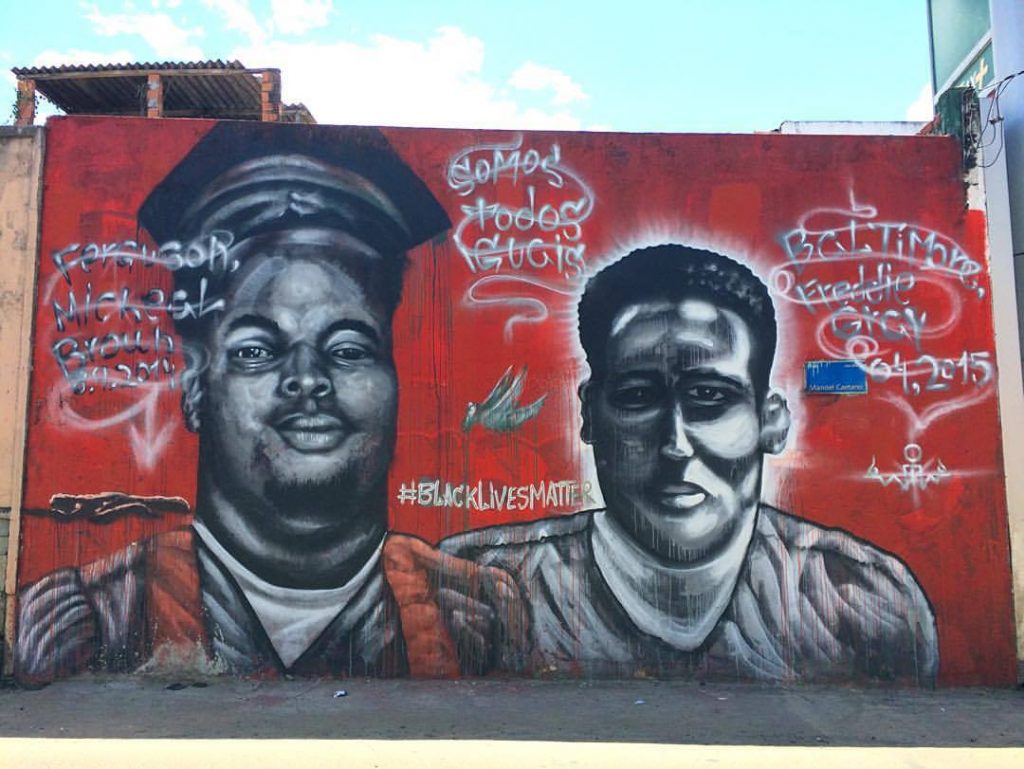
    #blacklivesmatter mural in Salvador Bahia Brazil. From the Atlantic Archives | Sed Miles Studio
    #blacklivesmatter mural in Salvador Bahia Brazil. From the Atlantic Archives | Sed Miles Studio
    Share
    Facebook Twitter LinkedIn Email Copy Link Threads

    I love walking through neighborhoods in Salvador. It’s a city of hills with surprises beyond each slope. During the summer of 2015, I took an alternative route on my walk to a shabby photography studio I was renting in Santo Antônio, two kilometers from my apartment in the neighborhood of Liberdade. Translating to “Freedom,” my home at the time was a historic area which began as a settlement for newly freed Africans following the abolition of slavery in 1888. 

    My destination, Santo Antônio, is known for a historic fort-turned-prison which housed the Africans captured at the end of the Malê revolt (Revolta dos Malês) in 1835. Led by a group of Yoruba Muslims descended from the Kingdom of Dahomey,  and inspired by the Haitian revolution, 600 warriors attacked the Brazilian colonial forces. Before the rebellion was ultimately quelled, Brazil’s ruling class was permanently affected. They began to fear that they would share the same fate as the French in Haiti, setting in motion a public debate that would result in the abolishment of the slave trade in 1851.  

    Between these two barrios is Barbalho. To my knowledge, the neighborhood (named after a 17th-century Governor) is not known for much, except for a high level of crime. This shortcut to my studio led me to the mural pictured above. While snapping the photograph, I was surrounded by a sensation which has become a familiar one during my travels through the Black diaspora. A feeling of reorientation, irony and rhythmic pulsation in moments that feel like crossroads between my identity as a Black man raised in the struggle-nation we call America, and citizen of a larger, older body politic.  


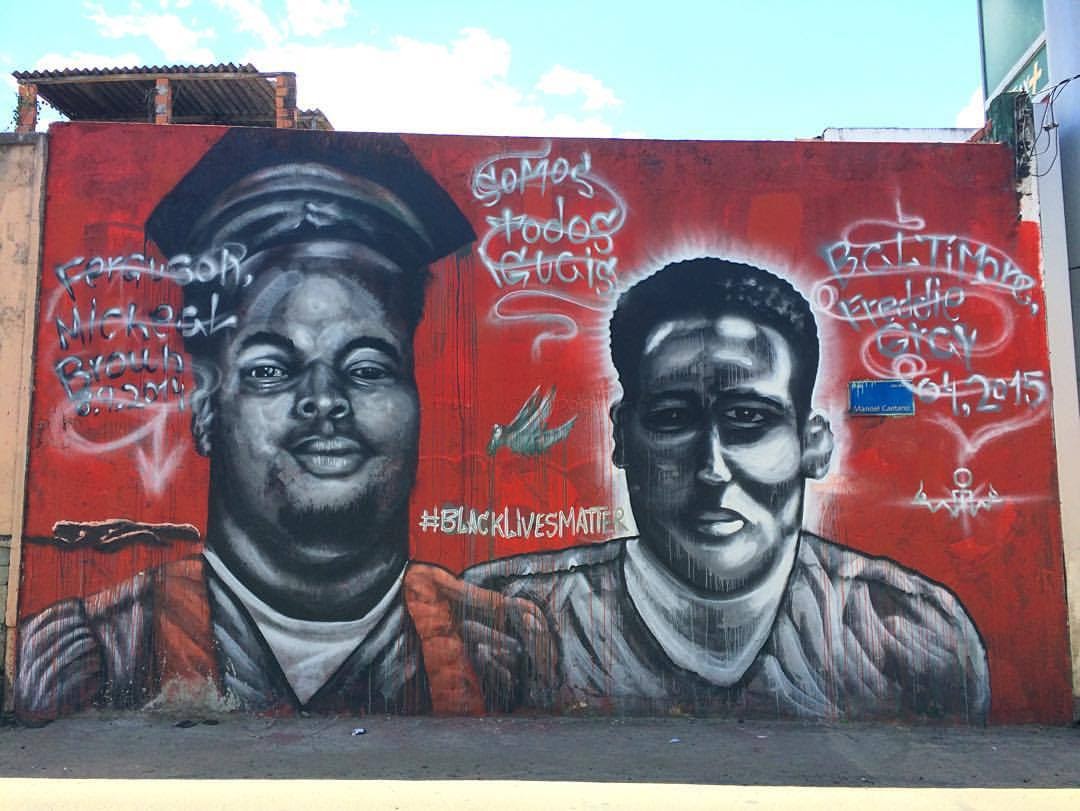
    The mural is the creation of Brazilian street artist, Bruno Wiw.  On a red background are the faces of Mike Brown and Freddie Gray, along with the dates of their murders by police and their cities Ferguson, MO and Baltimore, MD, respectively. 

    The black and white portraits are referenced from Mike Brown’s graduation photo, highlighting his red tassel matching the background. Gray’s image was referenced from a grainy photo circulating news and social media outlets at the time. In the mural, Wiw adds what appears as a white scarf or neck brace, undoubtedly symbolizing the fatal spinal injuries from the murderous “rough ride” while in the illegal, terroristic custody of the Baltimore Police department. Between Michael and Freddie are the words “Somos Todos Iguais”. This translates to “We are all equal.” Under this is a dove floating above the hashtag #blacklivesmatter. 

    Dikran Junior / AGIF (via AP)

    Not the first or last transnational marker I would witness, but it is one that resonates with me in its direct show of solidarity, curiosity and respect for the very struggle that unfortunately defines modern life for me and most people I know and care about.

    On a random alley in the middle of a Brazilian hood, it stands to this day as proof of just how hot the flames have burned on the streets of U.S. cities since the murder of Trayvon Martin by George Zimmerman. But murals like this one are more than a show of solidarity with the BLM movement in the States. They exist to not simply await the random chance that someone like me might pass it and post it up on my Instagram. It is a message to Afro Brazilians that their long struggle with police brutality is not one they must fight in isolation.   

    A frequently used term in the Vidas Negras Importam (Black Lives Matter) movement in Brazil is NECROPOLITICS. Popularized by Cameroonian postcolonial theorist, Joseph Achille Mbembe, it is the systematic policies promoted by the State which result in the death of certain groups in order to sanitize a society. His 2019 book of the same name was published in Portuguese and spread around Brazilian activist and intellectual circles like a travel guide for the violent State fantasy awaiting Afro Brazilians in the upcoming pandemic. Mbembe describes necropolitics as the State wielding the literal power of death over a society by giving State agents like the police the power to kill at will or reducing certain groups to ‘the living dead’ who are doomed to reside in ‘death worlds’ i.e. environments with subhuman living conditions barely fit for human survival. 

    https-//www.youtube.com/watch?v=0QX0y1jctxg

    In a country where police are responsible for 25% of murders and 80% of the victims are Black, it is clear why Necropolitica has become a dominant framework for analyzing the current political and social reality of Brazil. Brazilian police and private retail security killed nearly 6000 people in 2019 after the presidential election of a notorious right-wing populist- the openly racist, homophobic and sexist Jair Bolsonaro. He is often referred to as the “Tropical Trump”. Police killings under his administration have reached five times the amount of killings by police in the United States. 

    Whenever I pass the mural, a part of the disorientation comes from the trouble I have recalling if I’ve ever seen a mural in the States dedicated to the life of the many Blacks killed by police in Brazil. 

    In the midst of the global 2020 protests, in the city of Porto Alegre, a 40 year old father of four was murdered in a Carrefour grocery store by policemen.

    João Alberto Silveira Freitas was strangled to death the night before Dia da Consciência Negra (Black Awareness Day) by policemen whose social media pages displayed their support for Bolsanaro. A year before on Valentine’s Day, security officers in another Brazilian supermarket, Hipermercado Extra, choked 19-year-old Pedro Gonzaga to death while his mother watched. 

    The same month, police attacked 34-year-old Crispim Terral while waiting in line at a local bank only a few minutes from my apartment. They nearly choked him to death while his screaming daughter recorded the horror. Video and photos of both killings and near killing spread across social media and were in a dreadful dialogue with the tragedies of Eric Gardner and George Floyd. 

    Crispim Terral being attacked by military police in the Caixa Bank lobby February 2019. Video still recorded by his daughter.

    Afro-Brazilians have resisted racial oppression since the very beginning when we were all one people disembarking from the same boats but at different stops in the Americas. And since the access of popular media they have been saying “Vidas Negras Importam.”  In her book, “Freedoms Given, Freedoms Won,” historian Kim Butler translates a 1920 article by José Benedito Correia Leite. While in his early twenties, Leite was a leader in the Black Press Movement and cofounder of the civil rights organization Frente Negra Brasileira (The Black Brazilian Front ) and the newspaper O Clarim d’Alvorada.  

    “… through history, the sublime courage of a race which, though enslaved, did not let itself be dominated in the struggle for its rights . . . The good name of our people depends on our actions. It is our responsibility to introduce the value of our race into the development of society …”

    In other words,#VIDASNEGRASIMPORTAM.  Searching that hashtag will feed you a steady flow of Black faces, many of whom you will recognize and many you won’t. In 2019 I began an ongoing art participatory art project inspired by the mural.  I contacted Crispim Terrel and invited him to my studio to create life-affirming images together. We ate dinner and talked about his life. He spoke about the moment he thought he would die in front of his daughter and how he never imagined the community support that would follow.

    After the shoot, we discussed how his traditional African spirituality guided him through the trauma. I told him that as a Black (North) American, I want my art to reflect shared identities in the Black Atlantic diaspora. It’s my way of reconnecting, remapping, remembering our scattered Black selves. The images we created reflect a sense of healing, power, and a collective black future. 

    Crispin Terral in Studio 2019 . From the Atlantic Archives | sedmiles.com

    Black Lives Matter brazil Crispim Terrel João Alberto Silveira Freitas
    Sed
    • Website
    • X (Twitter)
    • Instagram

    An expat now living in Northeast Brazil, Sed Miles works hand in hand with working-class, Afro-Brazilian artists, activists and intellectuals fighting against Brazil’s systematic racial and class barriers using a Pan-African, intersectional pedagogy. Each week they will present dispatches from the archives that will bridge communities and be a resource for the future. The mission of the Archives is to help unite the Black diaspora through documenting, preserving, and sharing stories that represent the shared themes and experiences of working class Black people. The series will focus on Brazil and the United States, societies built and held together by generations of Africa’s unshakable children.

    Related Stories

    Atlantic Archives: Day of Black Consciousness

    October 2, 2024

    Brazil’s Bolsonaro Refuses to Back Down: ‘Only God Removes Me’

    May 3, 2024

    Luiz Gama: Self Made Man, Lawyer, Writer and Abolitionist

    December 3, 2023

    Black Consciousness Day: Black Culture Festivals in Brazil and the Connection Between Afro-Brazilians and African Americans

    November 27, 2023

    The Steve Biko Institute: Making Historically Black Connections from Brazil to the United States

    October 22, 2023

    Atlantic Archives: Locating Afro-Brazil in the Global Struggle

    September 2, 2023
    Recent Posts
    • Did You Know Author and Abolitionist, Olaudah Equiano, Died on This Day?
    • In Class with Carr: “Six/Seven”
    • “No Kings,” No Risk, No Change. The Protest Ritual That Lets America Feel Brave Without Doing Anything
    • The Federal Government Might Finally Start Sending More Research Money to HBCUs
    • This Day in History: March 30th

    Did You Know Author and Abolitionist, Olaudah Equiano, Died on This Day?

    By Shayla Farrow

    In Class with Carr: “Six/Seven”

    By TheHub.news Staff

    “No Kings,” No Risk, No Change. The Protest Ritual That Lets America Feel Brave Without Doing Anything

    By Dr. Stacey Patton

    The Federal Government Might Finally Start Sending More Research Money to HBCUs

    By Veronika Lleshi

    Subscribe to Updates

    A free newsletter delivering stories that matter straight to your inbox.

    About
    About

    TheHub.news is a storytelling and news platform committed to telling our stories through our lens.With unapologetic facts at the center, we document the lived reality of our experience globally—our progress, our challenges, and our impact—without distortion, dilution, or apology.

    X (Twitter) Instagram YouTube

    Did You Know Author and Abolitionist, Olaudah Equiano, Died on This Day?

    By Shayla Farrow

    In Class with Carr: “Six/Seven”

    By TheHub.news Staff

    “No Kings,” No Risk, No Change. The Protest Ritual That Lets America Feel Brave Without Doing Anything

    By Dr. Stacey Patton

    The Federal Government Might Finally Start Sending More Research Money to HBCUs

    By Veronika Lleshi

    Subscribe to Updates

    A free newsletter delivering stories that matter straight to your inbox.

    © 2026 TheHub.news A 501(c)(3) tax-exempt organization.

    Type above and press Enter to search. Press Esc to cancel.