

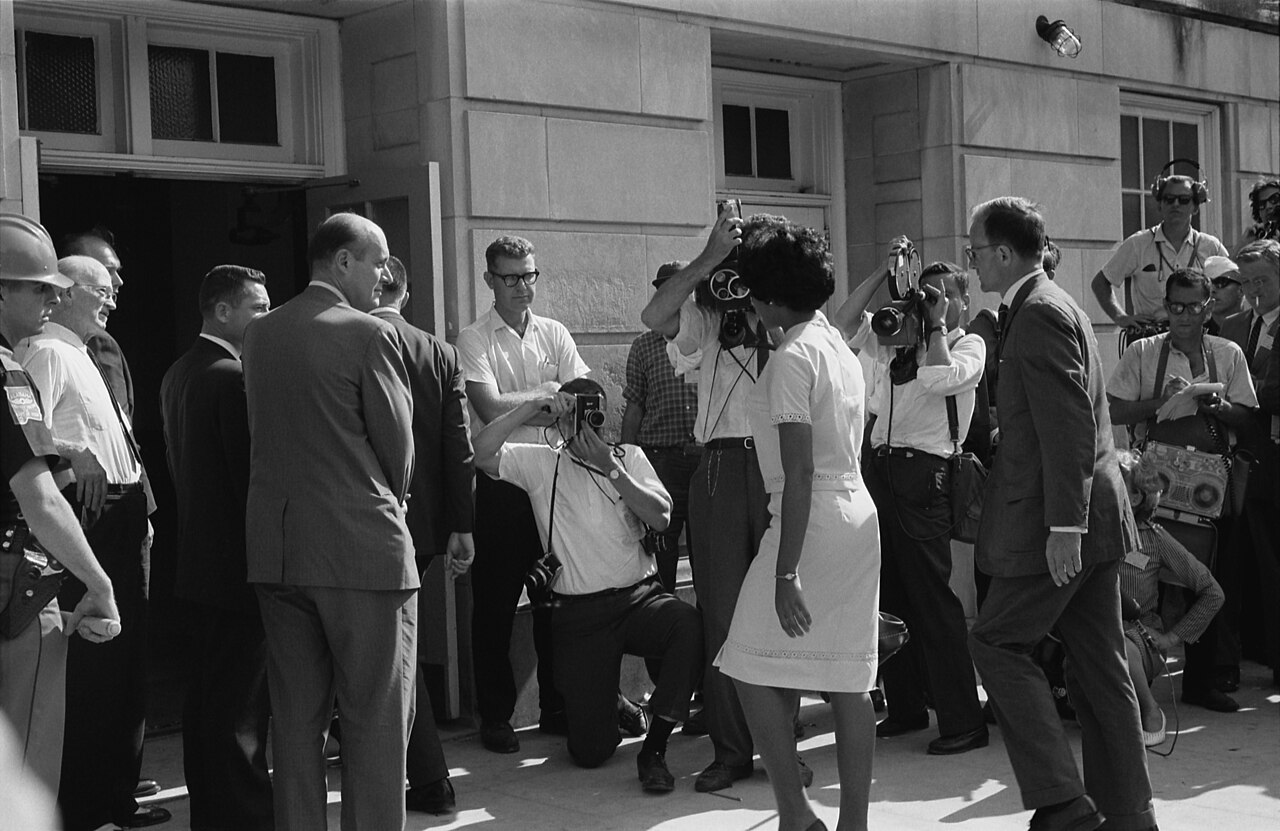
On this day in 1963, the University of Alabama was officially desegregated.
Approximately 63 years ago, students Vivian Malone Jones and James Hood became the first two Black students to enroll in classes at the learning institute. Despite being academically gifted, both students were denied admission to the University of Alabama on the grounds of “class size” and “enrollment” issues. In high school, Malone Jones was a member of the National Honor Society and Hood himself was already becoming ingrained in the civil rights movement, following Rev. Dr. Martin Luther King Jr’s advice to apply to the University of Alabama.
An estimated 230 Black students were said to have had their applications denied as the university found other reasons besides race to deny them access to enrollment.
Once they were denied admission, both Malone Jones and Hood decided to take legal action. With the help of the Legal Defense Fund, they filed a lawsuit against the University of Alabama, alleging racial discrimination. Although a district judge ruled in their favor after two years of deliberation, their admission to the higher-learning institution was publicly blocked by then-governor of Alabama, George Wallace.
Upon arriving at the building to enroll in classes, Wallace held his “Stand in the Schoolhouse Door” event, preventing the pair from physically entering the college. His refusal to let Malone Jones and Hood in stemmed from a political promise he made in January, pledging to uphold segregation in the state.
After four and a half hours of a physical blockade overseen by Wallace, federalized guard troops arrived at the scene. Only after federal troops, including General Henry Graham, spoke to Wallace and his aides were both students allowed to enroll in the university.
While attending the school, both students were victims of violence and were ostracized. While bombs were thrown near Malone Jones dormitory, Hood received threatening phone calls and dead animals in his mail. While Hood left the university in 1963, Malone Jones became the first Black student to graduate from the University of Alabama in 1965. She went on to work for the United States Justice Department and the Environmental Protection Agency. In the 2000s, she was presented with a doctorate by the University of Alabama.
Four years earlier, Wallace presented her with the Lurleen B. Wallace Award of Courage, telling her that he had made a mistake in 1963.
On the same day as the enrollment of Malone Jones and Hood, after having troops accompany the students for their first day, President John F. Kennedy also gave an address on civil rights.
In his speech, he announced that he would be sending civil rights legislation to Congress for passage. The legislation would soon develop into the Civil Rights Act of 1964.
“This is not a sectional issue…Nor is this a partisan issue…This is not even a legal or legislative issue alone. It is better to settle these matters in the courts than on the streets, and new laws are needed at every level, but law alone cannot make men see right,” said Kennedy.
“We are confronted primarily with a moral issue. It is as old as the scriptures and is as clear as the American Constitution.”
Delivered to the nation on both television and radio, the landmark address is considered a pivotal part of the civil rights movement, marking the beginning of Kennedy’s strong support for civil rights.
In response to the address, Rev. Dr. King congratulated the then-president, calling his speech “one of the most eloquent, profound pleas for justice and the freedom of all men ever made.” A leading force in the civil rights movement, he decided to pivot the focus of the “March on Washington for Jobs and Freedom,” calling on Congress rather than the Kennedy administration for change.
Held on August 28, the March on Washington drew over 200,000 protestors as they marched toward the Capitol to protest discrimination and draw attention to the need for legal protection. The march also expressed vocal support for the legislation Kennedy drafted on June 19.
At the event, Rev. Dr. King delivered his famous “I Have A Dream” speech, calling for civil and economic rights.
On July 2, 1964, President Lyndon B. Johnson, who succeeded Kennedy following his murder, signed into law the Civil Rights Act of 1964.
The Civil Rights Act of 1964 was proposed by Kennedy and was drafted to outlaw discrimination based on race, religion, sex and national origin. Championed by the Leadership Conference on Civil Rights and the NAACP, it was passed by the Senate after a 75-day filibuster. With its passage, the law helped dismantle segregation and achieve employment equality across the U.S.
A year later, the Voting Rights Act of 1965 was also signed into law by Johnson, ensuring that no voter is denied the right to vote on account of race and banning literacy tests.