
Individual talent is requisite. But when manufacturing a winning NBA roster, the time-tested truth is that chemistry supersedes everything.
THE PERIODIC TABLE
That damn chart! If you’ve enrolled in a chemistry course, you either loved it or loathed it. To excel in this particular science, especially in a laboratory setting, a baseline knowledge of this document is compulsory. Without it, the individual at the wheel puts him or herself and all in proximity in peril. Amalgamations formed haphazardly or on a whim can induce a detonation, or worse.
Analysis of the periodic table reveals 118 different squares. Each contains a substance known as an element. Within that space, there is a symbol representing the material, along with its name, atomic mass, atomic number, and weight. Some elements, when mixed with others, result in an ominous, toxic brew. Other combinations, when executed with precision, preparation and foresight, merge, react correctly and make the world go round.
The Periodic Table of Chemical Elements. (IMAGE: Courtesy of The American Chemical Society)
It’s actually no different than an NBA scouting report.
As in chemistry, a player transaction gone astray can only be remedied by trade or release, but can be further convoluted by salary caps, discontent and veto power. The periodic table is divided into blocks: S block, F block, D block and P block. In the NBA, it’s analogous to the types of ballers available in the league: S for scorers, F for flexible (or positionless), D for defenders (or enforcers), P for playmakers (or point guards). The athletes depict the elements (their stats and characteristics are tantamount to atomic numbers, and other data within the square), full of energy and possibilities. Some are luminous beings destined to become lottery picks; some are unpolished gems; and others are ashy and unrefined, prone to volatility yet essential. Team management, entrusted and authorized to make franchise selections (via draft, trade, or free agency), should thoroughly understand the components before blending them. Some form covalent and cohesive bonds, making the team and the emulsions flow like running water. Other alliances—without proper strategic planning—can blow up a locker room, decimate a roster, or constrain a franchise to the cellar of its division or conference.
The New York Knicks have encountered it all.
NEW YORK, NEW YORK
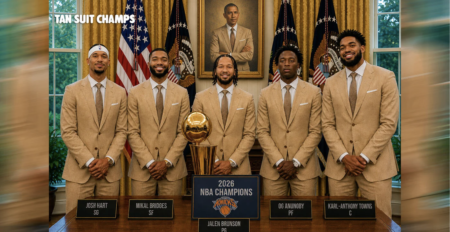
For the first time since 1973, when Madison Square Garden was still esteemed “Eden,” the New York Knicks have ascended to the summit of the National Basketball Association. The newly crowned champions, over their 50-plus-year title drought, have always been competitive, feisty, hard-nosed and highly skilled. Many star players and renowned coaches have come and gone. Yet this latest assemblage of individuals makes a roster composed of uber-talented ballers, all of whom have bought into the concept of team-first. They represent the all-inclusive yet elusive coalescence of brilliant, unselfish on-court maestros.
Times are different now, or are they? The New York Knicks claimed NBA titles in both 1970 and 1973. With a little luck (knee and shoulder injuries to team captain Willis Reed slowed the locomotive), NYC could have conceivably won again in 1971 and 1972. In that timeframe, the nation was inundated with social and racial issues, inflation, skepticism and misgivings regarding our own government. While the establishment obsessed on taking “small steps for man” on the moon, the country was deluged by the machinations of President Richard Nixon (Watergate), upheaval and violence on college campuses (Jackson State, Cornell, Kent State), war (Vietnam), along with rumors of conflicts elsewhere. History, without a shadow of a doubt, tends to rhyme.
As this avant-garde Knicks version has scaled its way to the acme of professional sports, our present-day national milieu, alarmingly, remains patently reminiscent of the “Johnson-Nixon” era—if not worse.
BRASS CONSTRUCTION: THE BUILD-UP
In the early to mid-60s, the Knicks were a genteel box-office draw, but across the board, they were going through some things. Between 1960 and 1966, the organization never won more than 31 regular-season games. In 1967, they finally made the postseason for
the first time that decade, with a fourth-place finish (36-45 record) in the Eastern Division. A perennial powerhouse from “Beantown,” the defending-champion Boston Celtics, eliminated New York in the opening round, 3-1.
Over time, management began to bring in first-rate personnel; that often happens when one’s regular-season record is mediocre to lame. New draft picks should, in theory, yield positive results. Sometimes the scouts got it right, and on other occasions, wrong, but the cumulative effect sent the Knicks aloft. Thus, the roster incrementally became a problem for competitors in the Eastern Division.
While the Philadelphia 76ers and Boston Celtics were astronomical favorites anywhere east of the Nevada border, the tandem of 6’9” Willis Reed from Grambling State University (1964) and 6’11” Walt Bellamy from the Baltimore Bullets (1965) made Gotham City rugged and intimidating up front. In addition, via trade or through the draft, high-caliber hoopers who would play a part in their dynasty were added to the team: Dick Barnett (from the Lakers), Bill Bradley (Princeton), Cazzie Russell (Michigan), Dave Stallworth (Wichita State), Walt Frazier (Southern Illinois), Mike Riordan (Providence), Phil Jackson (North Dakota).
Other solid talent came, contributed, and exited: Dick Van Arsdale (Indiana), Emmette Bryant (DePaul), Johnny Green (Michigan State), Darrall Imhoff (California), Jim Barnes (Texas Western/UTEP), Freddie Crawford (St. Bonaventure), Bob Boozer (from the Cincinnati Royals).
DAVY-D & THE PEARL
By the start of the postseason in 1968, New York had improved to a 43-39 record under the guidance of new coach Red Holtzman (who supplanted Dick McGuire after McGuire’s 15-23 start). Again, they would face the defending league champs in the opening playoff round, this time the Philadelphia 76ers. The Knicks fought valiantly, but lost the series 4-2. Bellamy, Reed, Dick Barnett and Cazzie Russell each averaged over 20 points per game in those six matchups. Even so, something was missing.
For the Knicks, buoyed by their progress, the pinpoint light at the end of the tunnel was about to materialize into a supernova. The chief acquisition (and, by chance, the most substantial until Jalen Brunson in 2022) occurred on December 18, 1968. Cast-iron power forward Dave DeBusschere, who had been an All-Star for the Detroit Pistons as well as a major league pitcher for the Chicago White Sox, was coveted by opposing teams. After a dispute with the head coach (Paul Seymour), Detroit made it clear that he was on the trade block, and Dave came very close to being dealt to Baltimore. But in the eleventh hour, New York swooped in, bartering center Walt Bellamy along with guard Howard Komives for the 6-foot-6, 235-pound Dave “D.”
During his time in Detroit, DeBusschere, thanks to his consistent blue-chip and blue-collar performances, enjoyed the benefits of being a native of the “Motor City.” When the lights went down and the ball was not in play, Dave (before getting married) was allegedly known for running the streets. He did this with a crew he’d hung out with since high school (Detroit Austin Catholic) and college (University of Detroit) and sometimes fell out of favor (re. “We talkin’ ‘bout practice…not a game!”), with his employer’s management. His stellar gameplay—for a long time—provided adequate cover for those few occurrences where a hangover was conjecturally part of the equation.
But another quagmire unfolded around the time of his wedding (1968). Dave invited several of his Pistons teammates, but none of the Black ones. While he had a reputation as a good-natured guy, this ultimately fractured the roster and led to tense moments during and after practice, as well as a handful of players-only meetings. [1] The chemical components had imploded and mushroomed. It was time to move on.
To DeBusschere’s credit, no such issues came to light during his tenure with the New York Knicks. For the most part, he was a model citizen off the court, a mainstay in the NBA Players Union, and considered a team leader. On the hardwood, Dave’s arrival was key in allowing the talented Reed (an NBA All-Star every season of his career to that point) to move back to the center position where he had played in college and periodically as a pro before Bellamy’s arrival. Dave “D” could rebound with the nastiest big dudes under the glass and in the paint. He could consistently shoot the jumper from way downtown. DeBusschere assumed the role of power forward, was named an NBA All-Star and to the All-Defensive teams for five consecutive seasons in NYC, and his appearance catalyzed the Knicks’ metamorphosis from pretenders to bona fide contenders for the next six seasons.
The Knicks took off. In the 1968-69 season, after improving to a 54-28 record, they came close. The Baltimore Bullets were hot, entering the postseason as the number-one seed. Regardless, New York crushed them via a four-game sweep. However, they came up short against the old, established group from Boston and were eliminated 4-2 in the Eastern Division Finals. The silver lining was that the league was on notice: this amended edition of the Knicks was coming. Their surge coincided fluently with the opening of the upgraded version of Madison Square Garden (at Pennsylvania Station) in February ‘68, which seated close to 20,000 folks.
The following season (1969-70), with Bill Russell retired in Boston and Wilt Chamberlain playing in the Western Division with the Los Angeles Lakers, the Knicks surged to the zenith with a league-best 60-22 regular-season record. Still, to get out of the East, they had to go through seven spine-tingling games against archrival Baltimore, featuring Wes Unseld, Earl Monroe, and Gus Johnson, and then navigate through a relatively young Milwaukee Bucks squad led by rookie phenoms Lew Alcindor [Kareem] and Bobby Dandridge, and vets Flynn Robinson and Jon McGlocklin. Ultimately, they prevailed over the Los Angeles Lakers (Chamberlain, Jerry West, Elgin Baylor) in seven games for their first NBA title.
The 1970 World Champion New York Knicks starting five celebrate their win over the Los Angeles Lakers. Seated left to right: Dick “Skull” Barnett, Walt “Clyde” Frazier, “Dollar” Bill Bradley, Dave “D” DeBusschere, “The Captain” Willis Reed. All five players were eventually enshrined in the Pro Basketball Hall of Fame. (PHOTO CREDIT: Associated Press)
After reaching the Finals again in 1972 versus the Lakers, without the services of the injured Willis Reed (Jerry Lucas filled in admirably at center), New York lost four straight after winning the opener at the L.A. Forum in a blowout. This time, the Lakers garnered their first championship (4-1) since moving to California from Minneapolis. Wilt Chamberlain, playing with a fractured hand in Game 5, destroyed Lucas and the Knicks, scoring 24 points, snagging 29 rebounds and blocking 9 shots to take MVP honors.
The Knicks and Lakers would meet again for the NBA Championship in 1973. Each of the first four games was decided by four points or less. New York prevailed 4-1; Reed would shine (named series MVP), as would the steady Walt Frazier and the always dependable DeBusschere. The big boost came from the acquisition of Earl Monroe from the Bullets the season prior (1971-72). Earl was partially excited about being in New York, but somewhat apprehensive because the Knicks were considered his former team’s sworn enemy. Fittingly enough, it was Dave “D,” an all-world newcomer just a few years previously, who warmly greeted him first as he walked into the locker room, followed by the rest of his new teammates.
Fully acclimated and healthy, the “Pearl” picked up his first and only championship hardware by besting Lakers shooting guard Gail Goodrich (who had schooled him in the ‘72 playoffs) and led the Knicks with 23 points in the 102-93 series-clincher. As the Knicks were leaving the floor, headed toward another locker room celebration, fellow guard Dean Meminger lauded the “Pearl,” stating, “Earl, you were a bad motherf****r tonight! You were your old self, and you took it to their asses!“ [2]
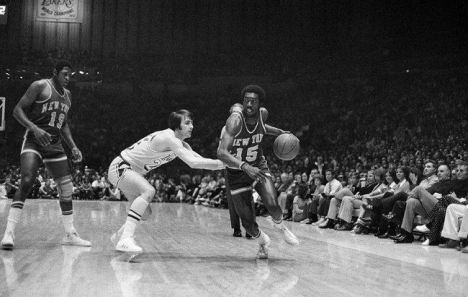
All five New York Knicks starters averaged double figures in scoring during the five-game series. Dave “D” led the team in rebounding. Bradley led the team in scoring. That night, no one could have fathomed that their next league championship celebration was several decades away: 53 years, 1 month, and 3 days to be exact.
THE BREAKDOWN & THE SOLOISTS
Around 1974, the stars of yesteryear and the axis of the Knicks’ mini-dynasty embarked upon a losing battle with Father Time. Reed, long betrayed by his knees, retired, supplanted by a prospect from Pacific University named John Giannelli. A few years later, Willis would actually be named head coach. Jerry Lucas, who played both forward and center (and was a champion at every level since high school), ended his storybook career. Walt “Clyde” Frazier—who had lost a step—was traded to Cleveland despite his iconic status in 1977.
Dick Barnett, the loquacious sharp-shooter (and dresser) from Tennessee A&I (now Tennessee State), went on to earn his MBA (NYU) and a PhD in education (Fordham). Dave DeBusschere, who had always been part of the NBA Players Union, brought his administrative and leadership skills to the ABA, where he became league commissioner in 1975. Earl “The Pearl” Monroe, part of the 1973 title team after coming over from Baltimore in 1971, retired as a Knick (1980).
“Dollar” Bill Bradley called it quits, entered the political realm, and ultimately became Senator Bradley. Cazzie Russell, the sixth man on the 1970 championship roster, on the brink of superstardom, took one for the team but simmered on the bench behind Bradley. He became an All-Star when he went to San Francisco/Golden State in 1971 (traded for a very valuable Jerry Lucas), And did so immediately. Russell was traded to Los Angeles and Chicago before retiring, then coached in the CBA (Continental Basketball Association) and eventually became a member of the clergy. Dean “The Dream” Meminger, who played a key role in the Knicks’ advancement out of the Eastern Conference Finals in 1973 (vs. Boston), eventually joined the Atlanta Hawks before returning to New York for his final season. Reserve forward Phil Jackson went on to become a well-decorated head coach in the NBA (11 titles) after also completing an apprenticeship in the CBA and in Puerto Rico.
Many men on each of the New York title-winning rosters could have been elevated to higher heights individually elsewhere on the league circuit, but valued the camaraderie and benefits of playing team ball under Coach Holtzman.
The mid-70s were a failed chemistry experiment for New York. A deal was in the works to sign ABA superstar George McGinnis, a two-time champion with the Indiana Pacers who had just won the 1975 Co-MVP with Julius Erving in the rival league. At a press conference in late May, Big George was all smiles as he held up his Knicks jersey alongside coach Red Holtzman while the cameras flashed incessantly. The hoopla was short-lived. Commissioner Larry O’Brien promptly voided the deal, claiming (correctly) that his NBA rights belonged to the Philadelphia 76ers. O’Brien was not done: he fined the Knicks $400,000 and stripped the franchise of its next first-round draft pick.
To add insult to injury, George signed with the division rival Sixers. As that opportunity circled the drain and Milwaukee Bucks center Kareem Abdul-Jabbar signed with the Lakers, the franchise grew nervous. They desperately needed frontcourt help. For several months, the Knicks even made overtures toward the recently retired Wilt Chamberlain, who politely declined.
The addition of all-world power forward Spencer Haywood (acquired in October of 1975 from the Seattle SuperSonics), paired with a still-maturing scoring champ and former league MVP, Bob McAdoo (from the Buffalo Braves in December of 1976), looked tremendous on paper.
Problem solved? No.
First, there weren’t enough basketballs to go around. McAdoo continued to put up astral stats, but was still a “shoot first and ask questions later” center. Second, Spencer, still a noteworthy force, dropped off somewhat and was just stumbling upon the nascency of his odyssey with powdered cocaine.
At one point, with the Knicks posting run-of-the-mill won-loss records and unable to match their earlier successes, one couldn’t help but notice that many of the white players had been traded or retired. The local press, unimpressed with and disconcerted by the confluence of Brothers, revealed their racial animus by infamously dubbing them “The New York Ni—erbockers.” No mea culpa would follow. As the roster hue arched toward sienna and indigo, season-ticket holder totals plummeted.
Man, this was New York City! These were the Knicks; as a result, other stars and proficient players showed up in waves. Opportunities for acclaim, notoriety and potential Madison Avenue endorsements loomed large. Michael “Sugar Ray” Richardson (drafted in 1978 out of Montana) ran the show at point guard and was an electrifying talent, but he had his demons to conquer. During his time, veterans like Maurice Lucas (a champion with the Portland Trail Blazers), Paul Westphal (a champ in Boston and a star in Phoenix), and Campy Russell (part of the upstart Cleveland Cavs) all came together to make something happen. Once again, it wound up being a conglomerate of guys in which one or two individuals were more concerned with taking shots and scoring 20 points than with actually winning. There was no scarcity of capability. There was only a paucity of chemistry.
Nearly 15 years ago, Knicks All-Star forward Campy Russell told me personally that, “The offense flowed when ‘Sugar’ [Richardson] was present and running the point. Otherwise, other guys [i.e., Maurice Lucas] were focused on stats.”
Richardson was a four-time All-Star who also battled a cocaine addiction before being ultimately banned from the NBA in 1986. There is no dearth of superlatives or commendations when Richardson’s name arises.
“‘He had it all as a player, with no weaknesses in his game,’” former Detroit Pistons guard Isiah Thomas, a Naismith Basketball Hall of Famer, told Andscape. ‘He is the player who gave me the most problems playing against him. He was taller, just as fast, and could shoot from 3 and midrange. His post-up game was elite. Offensively, he had it all.’” [3]
“Back when he played in the NBA, the best guards were Magic [Johnson] and then Sugar,” former NBA guard Quinn Buckner said. [3]
Brooklyn native Bernard King, acquired from Golden State in a deal for Richardson in 1982, brought hope and excitement with his downright spectacular play. But new quartets of talent assembled in Philly (Erving, Moses, Toney, Bobby Jones), Boston (Bird, Parrish, McHale, Ainge) and Milwaukee (Lanier, Moncrief, Marques Johnson, Junior Bridgeman), waiting for New York each spring as the NBA playoffs commenced. During his tenure with the Knicks, he made the NBA All-Star team and the First Team All-NBA twice. In 1984, King was magnificent, battling Boston’s Larry Bird to a standstill in the Eastern Division Semifinals. Boston was victorious after the seven-game duel. During the 84-85 season, King averaged a shade under 33 points per game, but a devastating knee injury stunted his career.
In 1985, the essence of the Big Apple was on a lofty echelon after the NBA draft. The Knicks had selected 7-foot Patrick Ewing of Georgetown University as a new big man to be the franchise savior. NYC had some excellent seasons during Ewing’s term; however, a title was not in the cards. New York, a perennial contender, could not get past the Boston Celtics, Detroit Pistons, or Chicago Bulls until Michael Jordan’s first retirement. Still, they lost to the Houston Rockets in the 1994 NBA Finals in seven games, and again to the San Antonio Spurs in a strike-shortened 1999 season (Patrick was injured). Ewing was a pillar of the Knicks franchise for 15 seasons, running alongside players such as Bill Cartwright (talented but oft-convalescent), Rory Sparrow,
Charles Oakley, Mark Jackson, John Starks, Xavier McDaniel, Anthony Mason, Derek Harper, Rod Strickland, Doc Rivers, Allan Houston, Latrell Sprewell and Larry Johnson.
The iconic Patrick Ewing celebrates with Knicks center Karl Anthony-Towns in the immediate aftermath of the series-clinching Game 5 victory in San Antonio. Ewing, as an official Ambassador/Advisor for the franchise, will receive his first NBA Championship ring. On July 4, 2026, Ewing signed with the Washington Wizards as an assistant coach. (PHOTO CREDIT: New York Post/Charles Wenzelberg)
Over the next quarter century, more talent (Carmelo Anthony, Amar’e Stoudmire, Tyson Chandler, J.R. Smith) donned the blue and orange, leading to lackluster (and at times horrid) regular seasons, but not league titles. It was the same old story for the Knicks: solid and sometimes great point guards, super scorers, more enforcers, big men, slashers and sharpshooters. Still, championship rings were a pipe dream. The chemical equation was moderately askew.
HURRY UP AND WAIT, SONN!
In the 25 years leading up to this postseason, the New York Knicks had advanced to the Eastern Conference Finals once, losing to the Indiana Pacers in six games in 2025. They had reached or exceeded the 50-win mark during the regular season three times.
During the 2025–26 season, spearheaded by new head coach Mike Brown and sorcerer-like guard Jalen Brunson, the Knicks went 53-29, finishing second in the Atlantic Division and third in the Eastern Conference (trailing top-seeded Detroit and division-rival Boston).
Lakers Hall of Fame guard and long-time New York antagonist Jerry West once quipped that, in the NBA, “the playoffs are the real season.” Point taken. As the postseason stanza commenced, the Knicks were peaking as they tore through Atlanta 4-2 (taking game six via a 140-89 rout in ATL), bested Philly via a four-game sweep, and swept again to eliminate the Cleveland Cavaliers, advancing to the NBA Finals. The Western Conference winners, the young and loaded San Antonio Spurs, fresh off dethroning the defending champion OKC Thunder, awaited them.
Chemistry class was about to begin.
The series opened down in the Lone Star State. New York astonished the Spurs and the sellout crowd (18,000-plus) at Frost Bank Center by winning on the road, 105-95 in game one and 105-104 in a game two nail-biter. In the second contest, the New Yorkers got 20 or more points each from Mikal Bridges, Jalen Brunson, and the center Karl-Anthony Towns, who added 13 rebounds. OG Anunoby contributed 17 points for the Knicks.
After a stunning 115-111 home loss at Madison Square Garden in game three (snapping a 13-game winning streak), the Knicks found themselves trailing again in the crucial game four matchup. The Spurs scorched the hoop, scoring 76 points in the first half while holding New York to 49 points. At this juncture, the young Spurs coaching staff and players made a colossal error. Rather than run the clock, San Antonio seemed content to launch (and miss) from the three-point range with plenty of time left on the 24-second timer during each possession. This strategy backfired. The Spurs—at one point—led by 29.
San Antonio shooters went subzero, while New York thawed out and cooked, roaring back to catch up and seize the victory (107-106). Jalen Brunson scored 36. However, the equally undaunted Anunoby made a play for the ages, winning it at the buzzer with a spectacular tip-in, and chipped in 33 points. In addition, OG shot 66% from the field (10/15) and an amazing 78% from the three-point range (7/9). The Spurs—down 3-1 — were bewildered and dismayed.
The Knicks wrapped up the series with a 94-91 win in game five to become the 2026 NBA Champions on San Antonio’s home court. Again, New York pulled off a dramatic comeback after falling behind by sixteen points.
TITLE REIGN, G.O.A.T. RUMINATION, & ICON STATUS
By no means is this rocket science. It’s not physics, nor is it linear algebra. In its purest form, it’s Chemistry 101 in New York City. In the Big Apple—at long last—the New York Knicks seem to have dredged up and implemented the inerrant, critical formula for the crown. All of the atoms, ions, molecules, and human beings have aligned and coalesced, allowing the beloved Knicks to make the quantum leap into the winner’s circle.
Jalen Brunson (11) puts in work while being hotly contested by Spurs guard Dylan Harper in Game 1 of the NBA Finals. Brunson tallied 30 points in leading the Knicks to a 105-95 road win. The former Villanova guard played through most of the playoffs with a nagging soft-tissue/ligament injury on his left wrist. Brunson underwent successful surgery on July 7 and has already resumed light workouts. (PHOTO CREDIT: Associated Press Photo/Eric Gay)
Understandably, many plaudits will go to Finals MVP Jalen Brunson. Nevertheless, it was a team effort. The bench players were indispensable at both ends of the floor. Josh Hart played with his usual toughness, as did Mitchell Robinson (now a Celtic). Karl-Anthony Towns paid titanic dividends, averaging in double figures in both scoring and rebounding while frustrating and outmuscling the giant Victor Wembanyama. OG Anunoby, critical at both ends of the floor, raised his scoring/rebounding totals higher when the occasion arose: 16.7/5.2 (regular season), up to 20/6.3 (playoffs). Brunson, who signed as a free agent after coming over from the Dallas Mavericks, was mind-boggling in the clutch, posting the following scoring totals over the five games: 30, 20, 32, 36 and 45.
It was a sweet redemption of sorts for Knicks head coach Mike Brown. Much maligned and criticized at virtually every stop, he had coached and had a few squabbles with Spurs’ guard DeAaron Fox while the Sacramento Kings employed both. During this season’s finals, Fox was moderately kept in check, to say the least, by New York defenders, shot a dismal 34% from the field and 25% from 3-point range, and committed more than a handful of critical missteps under duress.
Regarding the inevitable reflections about the “Knick G.O.A.T.,” one must not be swayed by recency bias. While Willis Reed will always get credit for walking onto the court, shot up on local anesthetics and anti-inflammatories, basically playing on one leg in the game-seven clincher (1970), the real hero that night was Walt Frazier. “Clyde” scored 36 points and added 19 assists, 7 rebounds and 5 steals while shooting 70% from the field!
For that 1970 series, Frazier averaged 17.6 points per game, 7.7 rebounds as a guard, and 10.4 assists per night. If one looks at their peak, he was the glue and stimulant for several seasons. Throughout that era, Walt was as smooth as silk in the clutch. During the next ill-fated trip without Reed in the 1972 NBA Finals, he averaged 23 points per night while being matched up against “The Logo” Jerry West of Los Angeles. The following season, the fully bearded icon went to work as 1/2 of the so-called “Rolls-Royce Backcourt” alongside Earl Monroe, providing generalship, velcro-like defense, and ball care throughout the playoffs, ultimately leading them to their second world championship in four seasons.
Willis Reed was one of the most intense competitors ever to step onto hardwood or asphalt. The 1970 NBA MVP was the New York Knicks’ enforcer, infamous for beating down half the Lakers in 1966 (scoring K.O.s and breaking an adversary’s nose); he did a similar job on a quarter of the Atlanta Hawks in 1969. Reed was rough and tumble in the paint and also had a shooting touch that drew opposing big men away from the basket, thus opening up the lanes for his teammates to drive. In both Finals against the Lakers, he was so successful against Chamberlain, who would come out to guard him at times and back off to protect the paint at others. Before Brunson’s 45-point outburst in San Antonio, the previous Finals scoring record for any New York Knick was held by none other than Willis Reed. The Bernice, Louisiana, native scored 38 points against the Lakers in Game 3 of the 1970 NBA Finals. In the series opener, five days earlier, Reed set the tone by scoring 37.
Nonetheless, the 70s Knicks–albeit loaded with future Hall of Fame talent on the roster–would not have been as potent and effective without Walt Frazier. Brunson is sterling, but when the euphoria subsides, it will take more than a single championship for him to eclipse the exploits of previous Knicks legends.
A noteworthy aspect in the aftermath of the Knicks’ 2026 win is the Villanova connection. It had to be the coup de grǎce for Jalen Brunson, Mikal Bridges, and Josh Hart to win an NBA title. The trio had garnered an NCAA Championship, and after Hart departed for the NBA, Brunson and Bridges went on to annex another.
“While most of the New York Knicks and generations of the team’s fans were getting first thirsty, then parched, waiting out the franchise’s 53-year drought between NBA championships, a core of essential players were drinking. Jalen Brunson, Josh Hart, and Mikal Bridges were teammates at Villanova, learning to do in the NCAA with their eventual NBA destination, had such trouble doing since way back in the days of leisure suits and 8-track tapes: win. In 2016, the three of them helped an underdog Villanova squad beat North Carolina 77-74 in the Final Four in Houston. Two years later, Brunson and Bridges led the favorite Wildcats to a more thorough 79- 62 victory over Michigan, and what do you know, San Antonio.” [4]
For the time being, the fans of New York City and those Knicks die-hards from points beyond can take solace in knowing that they are—once again—world champions. It’s long overdue. There have been ebbs and flows, but currently, the wave of success is only beginning to crest. They flat-out lorded over the 2026 ESPY Awards and are in demand everywhere.
So while there may be spirited deliberations about the G.O.A.T. of New York pro basketball, or about whether the players will show up at the White House (Mr. Dolan was out of line, and, in the words of a great cleric, “[Dolan] should be quiet!”), All of that can be put aside, at least for the moment. Presently, there’s no need to worry about Giannis signing with the Miami Heat, or LeBron James and Jalen Brown going to Philadelphia. Each of those entities (rivals) will have complex chemical equations of their own to balance and sustain. Some of those variables, beyond raw talent, include adjustment, attrition, load management and ego.
Regarding the Knicks, it’s time to let this borough-wide (and points elsewhere) rhapsody marinate to the fullest.
The New York Knicks are honored at the 2026 ESPY Awards on July 15, 2026, as ‘Best Team.’ Overall, Jalen Brunson was selected as ‘Best Male Athlete,’ ‘Best NBA Player,’ and ‘Best Championship Performance.’ OG Anunoby took honors for ‘Best Play’ after his game-winning tip that sealed game four in the NBA Finals. (PHOTO CREDIT: Associated Press/Frank Franklin II)
Brunson–duly dubbed “Captain Clutch” for his late-game heroics–along with his brethren, has now encroached rarefied air in the annals of NYC basketball. No one on the 2025-26 New York Knicks roster will ever pick up the tab in the metropolitan area, whether at a multi-Michelin-starred restaurant in Manhattan, a pizza parlor in the Bronx, or while partaking in the finest “street meat” from a vendor. It’s time to bask in the corollary of long-envisioned title glory. NBA Championships are indeed hard to come by.
The chemistry is precise. The table is set. Periodically, franchises catch lightning in a bottle, and for the Knicks, it’s their time. The wait is over. Rings are being designed and will soon be en route. The moniker “Defending Champs” will apply until June 2027. All the elements and bonds necessary for winning are in place, catalyzed by an efficacious coaching staff, a fervid fan base and a “little” Captain marshaling a group of towering gentlemen with a tempered élan for triumph.
NYC, pause and enjoy.
REFERENCES
1. Spitz, Bob. “Shoot Out the Lights: The Amazing, Improbable, Exhilarating Saga of the 1969-70 New York Knicks.” Harcourt, Brace, & Company. New York. (1995). P. 22
2. Monroe, Earl & Troupe, Quincy. “Earl, the Pearl: My Story.” Rodale Publishing. New York. (2013). Pg. 355
3. Spears, Marc J. “Former NBA star Michael Ray Richardson dies at age 70.” ESPN. (espn.com). November 11, 2025
4. Aschburner, Steve. “‘Nova Knicks step up to help the franchise and its 53-year championship drought.”(NBA.com/news). June 14, 2026