

Close Menu
TheHub.news

    “No Kings,” No Risk, No Change. The Protest Ritual That Lets America Feel Brave Without Doing Anything

    By Dr. Stacey Patton

    The Federal Government Might Finally Start Sending More Research Money to HBCUs

    By Veronika Lleshi

    This Day in History: March 30th

    By Shayla Farrow

    Subscribe to Updates

    Get the latest creative news from FooBar about art, design and business.

    X (Twitter) Instagram YouTube
    X (Twitter) Instagram YouTube
    TheHub.news
    Support Our Work
    • Home
    • Our Story
      • News & Views
        • Politics
        • Injustice
        • HBCUs
        • Watch
      • Food
        • Cuisine Noir
        • soulPhoodie
      • Passport Heavy
      • Travel
      • Diaspora
      • This Day
      • Entertainment
      • History
      • Art
      • Music
    • Health
    • Money
      1. Copper2Cotton
      2. View All

      August 2018 Net Worth Update

      December 9, 2025

      Dividend Update: August 2018

      December 9, 2025

      How to Fight Inflation and Win

      December 9, 2025
      Passive Income

      Be Passive About Your $

      November 17, 2025

      Economic Empowerment Has Always Been a Part of Black History

      February 12, 2026

      How to Fight Inflation and Win

      December 9, 2025

      August 2018 Net Worth Update

      December 9, 2025

      More Blacks Needed On Corporate Boards

      December 9, 2025
    • Books
    • Business
    • Sports
      1. First and Pen
      2. View All

      The 60th Anniversary of Texas Western’s Title Reminds Us That Black History Must Be Protected, Learned and Taught

      March 25, 2026

      All The Smoke Productions Launches “All The Smoke Baseball”

      March 24, 2026

      Justin Fields Deserves His Baker Mayfield, Sam Darnold Moment

      March 19, 2026

      NY Point Gods Are Now Successfully Leading DI Basketball Programs

      March 18, 2026

      The 60th Anniversary of Texas Western’s Title Reminds Us That Black History Must Be Protected, Learned and Taught

      March 25, 2026

      All The Smoke Productions Launches “All The Smoke Baseball”

      March 24, 2026

      Justin Fields Deserves His Baker Mayfield, Sam Darnold Moment

      March 19, 2026

      NY Point Gods Are Now Successfully Leading DI Basketball Programs

      March 18, 2026
    • Tech
    • Podcasts
      1. Karen Hunter is Awesome
      2. Lurie Breaks it Down
      3. Human(ing) Well with Amber Cabral
      4. Financially Speaking
      5. In Class with Carr
      6. View All

      “No Kings,” No Risk, No Change. The Protest Ritual That Lets America Feel Brave Without Doing Anything

      March 30, 2026

      The Federal Government Might Finally Start Sending More Research Money to HBCUs

      March 30, 2026

      This Day in History: March 30th

      March 30, 2026

      Did You Know Former US Ambassador, Will Mercer Cook, Was Born on This Day?

      March 30, 2026

      “No Kings,” No Risk, No Change. The Protest Ritual That Lets America Feel Brave Without Doing Anything

      March 30, 2026

      The Federal Government Might Finally Start Sending More Research Money to HBCUs

      March 30, 2026

      This Day in History: March 30th

      March 30, 2026

      Did You Know Former US Ambassador, Will Mercer Cook, Was Born on This Day?

      March 30, 2026

      “No Kings,” No Risk, No Change. The Protest Ritual That Lets America Feel Brave Without Doing Anything

      March 30, 2026

      The Federal Government Might Finally Start Sending More Research Money to HBCUs

      March 30, 2026

      This Day in History: March 30th

      March 30, 2026

      Did You Know Former US Ambassador, Will Mercer Cook, Was Born on This Day?

      March 30, 2026

      “No Kings,” No Risk, No Change. The Protest Ritual That Lets America Feel Brave Without Doing Anything

      March 30, 2026

      The Federal Government Might Finally Start Sending More Research Money to HBCUs

      March 30, 2026

      This Day in History: March 30th

      March 30, 2026

      Did You Know Former US Ambassador, Will Mercer Cook, Was Born on This Day?

      March 30, 2026

      “No Kings,” No Risk, No Change. The Protest Ritual That Lets America Feel Brave Without Doing Anything

      March 30, 2026

      The Federal Government Might Finally Start Sending More Research Money to HBCUs

      March 30, 2026

      This Day in History: March 30th

      March 30, 2026

      Did You Know Former US Ambassador, Will Mercer Cook, Was Born on This Day?

      March 30, 2026

      In Class with Carr: “Slavemasters Without Slaves”

      March 2, 2026

      Karen Hunter Questions Why BAFTA Let the Slur Air

      February 26, 2026

      In Class with Carr: Black History in Times of Trouble

      February 2, 2026

      The Rise of the “Righteous Whites” and the Collapse of Plausible Deniability

      January 24, 2026
    TheHub.news
    Entertainment

    “No Kings,” No Risk, No Change. The Protest Ritual That Lets America Feel Brave Without Doing Anything

    By Dr. Stacey PattonMarch 30, 20268 Mins Read
    Share Email Copy Link
    Image credit: ShutterStock
    Share
    Facebook Twitter LinkedIn Email Copy Link Threads

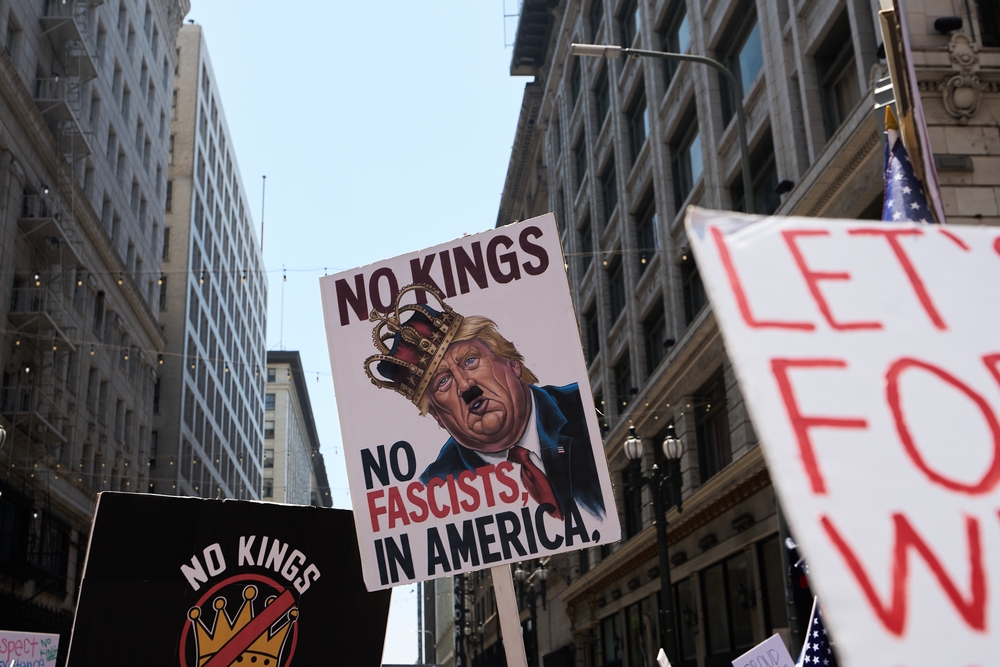
    Every few months now, like clockwork, millions of people pour into the streets chanting the same refrains. Holding the same signs. And reposting the same slogans with a fresh coat of urgency.

    “No Kings!”

    “Democracy Now!”

    “Protect Freedom!”

    The energy surges, thick and electric, pulsing through the crowds as voices collide into a single roar. Signs rise like offerings. Phones lift higher. The selfies go up. The drones hover overhead and harvest images of bodies packed tight and moving as if motion itself could become meaning.

    For a few hours, it feels undeniable. It feels like something is shifting under people’s feet. Like history is cracking open. Like power can feel the heat and might, finally, be forced to listen.

    And that’s the moment where the illusion locks in. Right at the peak. When the sound is loudest and the bodies are closest. When it all feels too big to ignore. The crowd itself and the noise starts to feel like proof. Visibility starts to masquerade as consequence.

    In that swell, it becomes easy, almost irresistible, to believe that presence alone is pressure and that numbers can bend systems designed to absorb far more than noise. And so people leave carrying that feeling in their bodies, convinced they’ve participated in disruption, when what they’ve actually experienced is something far more contained and far easier for power to survive.

    And then, everybody goes home. And the system exhales. Because it was never actually threatened.

    Now, today and tomorrow you’re probably gonna see and hear a lot of think pieces that either celebrate the protest uncritically or dismisses them entirely. I want us to move beyond that conversation and interrogate the psychological need behind it. Because this isn’t just about politics, this is about how people cope with fear, powerlessness, and uncertainty.

    What we are watching is not revolution. It’s ritual. And like all rituals, these No Kings protests serve a psychological function. They soothe and regulate. They give people the feeling of agency without requiring the substance of it. You don’t have to overthrow anything when you can perform resistance. You don’t have to sacrifice anything when you can attend. You don’t have to fundamentally disrupt your life when you can show up for three hours on a Saturday, chant, and go get brunch.

    This is conditioning, Y’all.

    A population trained over generations to obey, to comply, to stay within sanctioned boundaries does not suddenly develop the instincts required for real revolution. That kind of instinct, be it risk tolerance, strategic disruption, and a willingness to lose something tangible, has to be cultivated. It has to be modeled. It has to be practiced. And most Americans have been trained in the opposite direction.

    From childhood, people are taught to follow rules, respect authority, trust institutions, and measure “goodness” by how well they stay within the lines. Even dissent gets structured. Raise your hand. File a complaint. Vote. March peacefully. Now go home. So when people feel the pressure building, the political anxiety, economic precarity, and fear about the future, they don’t know how to channel it into actual disruption.

    They channel it into something that feels safe, predictable, and contained. They channel it all into a protest that has a permit. A protest that has a route. A protest that ends on time. That ain’t rebellion. That’s choreography. And psychologically, it works.

    Because what these protests actually provide is emotional relief. They offer people a way to metabolize fear without confronting it. To convert anxiety into motion. To stand shoulder to shoulder with strangers and feel, if only for a moment, that they are not alone, not powerless, not invisible. It gives them hope. And there is a deep human need for that.

    Collective gatherings regulate the nervous system. They create a sense of belonging. They produce what psychologists call “collective effervescence,” which is that surge of shared emotion that makes people feel connected to something larger than themselves. That feeling is real, but it is also deceptive.

    Because the body leaves thinking something has shifted when structurally, nothing has. The policies remain. The institutions remain. The power dynamics remain intact. What changes is the feeling. And for many people, that feeling is enough to get them through another week, another news cycle, another wave of outrage, until the next protest.

    This is where it becomes dangerous. Because the ritual starts to replace the reality. Folks begin to confuse participation with impact, attendance with transformation, and visibility with power. And the system is more than happy to accommodate that confusion. In fact, it depends on it.

    A protest that is predictable is a protest that can be absorbed. A protest that is symbolic is a protest that can be ignored. A protest that does not threaten economic flow, political stability, or institutional control is not a protest. It is a pressure valve that releases just enough steam to keep the machine running.

    Think about it, Y’all.

    What is actually at risk when thousands of people, or millions of people gather for a few hours with signs? Whose money is threatened? Whose power is destabilized? What material conditions are disrupted?

    If the answer is none, then what you’re looking at is not resistance. It’s performance. And not in a cynical, dismissive way, but in a deeply revealing one. Because performance tells us something about what people believe is possible. And right now, what people believe is possible is incredibly limited. They believe they can show up, be counted, be seen, be heard. But not that they can fundamentally alter the structure they are protesting.

    That gap, between expression and transformation, is where obedience lives. And it’s not because people are stupid. It’s because they have been shaped and conditioned into a narrow bandwidth of acceptable dissent.

    Real revolution is not clean. It ain’t convenient. It don’t fit neatly into a Saturday afternoon. It disrupts economies. It forces institutions into crisis. It demands sustained, coordinated pressure that makes it impossible for power to continue functioning as usual. And it comes with cost.

    Real cost.

    People lose jobs. They lose status. They lose safety. Sometimes, they lose even worse. That kind of sacrifice requires not just anger, but a completely different relationship to risk, to comfort, and survival itself. And most people, understandably, are not prepared for that. So they do what they can. They show up. They chant. They hold the line as they understand it.

    And again, that impulse is human. It is rooted in a need to do something in the face of helplessness. But we have to be honest about what that something actually is.

    Because if we mistake it for more than what it is, we end up trapped in a cycle of symbolic action and material stagnation. A cycle where people feel politically engaged but remain structurally powerless. Where outrage becomes routine. Where resistance becomes aesthetic. And where the system learns, over time, that it can withstand anything that looks like this.

    The system learns that it can wait it out. That it can absorb the noise. That it can count on people going home. Because they always do.

    So the question is not whether these protests matter emotionally. They do. The question is whether they matter materially, whether they change outcomes, whether they force power to respond in ways it otherwise would not. And if the answer keeps coming back as no, then we have to confront something uncomfortable.

    That what feels like courage might actually be containment. That what feels like resistance might actually be obedience in a different outfit. And that a population trained to gather, to chant, and disperse on schedule may not yet know what it means to truly threaten power.

    Until that changes, the system doesn’t need to crush dissent. It only needs to host it. Umph.

    Thanks for reading. If this piece resonated with you, then please consider becoming a paid subscriber. Paid subscriptions help keep my Substack unfiltered and ad free. They also help me raise money for HBCU journalism students who need laptops, DSLR cameras, tripods, mics, lights, software, travel funds for conferences and reporting trips, and food from our pantry. You can also follow me on Facebook!

    We appreciate you!

    • Did You Know the NAACP Organized a Silent March for Civil Rights on This Day?
    • California Math Teacher Suspended Over Offensive Native Headdress Dance Video
    • Wellness Wednesday: Fight the Resistance!
    • Take Advantage of the Resistance
    • A Coffee Party Movement Is Brewing at Black-Owned Cafes
    No Kings protest Thehub.news Trump
    Dr. Stacey Patton

    Dr. Stacey Patton is an award-winning journalist, author, historian and nationally recognized child advocate whose research focuses on the intersections of race and parenting in American life, child welfare issues, education, corporal punishment in homes and schools, and the foster care and school-to-prison pipelines. Her writings on race, culture, higher education, and child welfare issues have appeared in The New York Times, Washington Post, BBC News, Al Jazeera, TheRoot.com, NewsOne, Madame Noire, and The Chronicle of Higher Education. She has appeared on ABC News, CNN, MSNBC, Al Jazeera, and Democracy Now. Dr. Patton is the author of That Mean Old Yesterday, Spare the Kids: Why Whupping Children Won't Save Black America, and the forthcoming books, Strung Up: The Lynching of Black Children in Jim Crow America, and Not My Cat, a children's story. She is also the creator of a forthcoming 3-D medical animation and child abuse prevention app called "When You Hit Me."

    Related Stories

    Calling Donald Trump ‘Stupid’ Is the Easiest Way to Miss His Deliberate Strategy

    March 24, 2026

    The Real Reasons Why So Many White Women Watch That Melania Documentary

    February 13, 2026

    Republican Senators Split With Trump Over Funding Freeze for Blue States

    October 21, 2025

    What Part of Slavery Was Good?

    August 22, 2025

    Rich Diddy, Poor You

    July 8, 2025

    ‘One of Them Days’ Doesn’t Need a Thinkpiece: But Here’s Mine Anyway

    April 4, 2025
    Recent Posts
    • “No Kings,” No Risk, No Change. The Protest Ritual That Lets America Feel Brave Without Doing Anything
    • The Federal Government Might Finally Start Sending More Research Money to HBCUs
    • This Day in History: March 30th
    • Did You Know Former US Ambassador, Will Mercer Cook, Was Born on This Day?
    • A Sunday Sermon On What the Bible Says About Waiting for Certain People to Die

    “No Kings,” No Risk, No Change. The Protest Ritual That Lets America Feel Brave Without Doing Anything

    By Dr. Stacey Patton

    The Federal Government Might Finally Start Sending More Research Money to HBCUs

    By Veronika Lleshi

    This Day in History: March 30th

    By Shayla Farrow

    Did You Know Former US Ambassador, Will Mercer Cook, Was Born on This Day?

    By Shayla Farrow

    Subscribe to Updates

    A free newsletter delivering stories that matter straight to your inbox.

    About
    About

    TheHub.news is a storytelling and news platform committed to telling our stories through our lens.With unapologetic facts at the center, we document the lived reality of our experience globally—our progress, our challenges, and our impact—without distortion, dilution, or apology.

    X (Twitter) Instagram YouTube

    “No Kings,” No Risk, No Change. The Protest Ritual That Lets America Feel Brave Without Doing Anything

    By Dr. Stacey Patton

    The Federal Government Might Finally Start Sending More Research Money to HBCUs

    By Veronika Lleshi

    This Day in History: March 30th

    By Shayla Farrow

    Did You Know Former US Ambassador, Will Mercer Cook, Was Born on This Day?

    By Shayla Farrow

    Subscribe to Updates

    A free newsletter delivering stories that matter straight to your inbox.

    © 2026 TheHub.news A 501(c)(3) tax-exempt organization.

    Type above and press Enter to search. Press Esc to cancel.