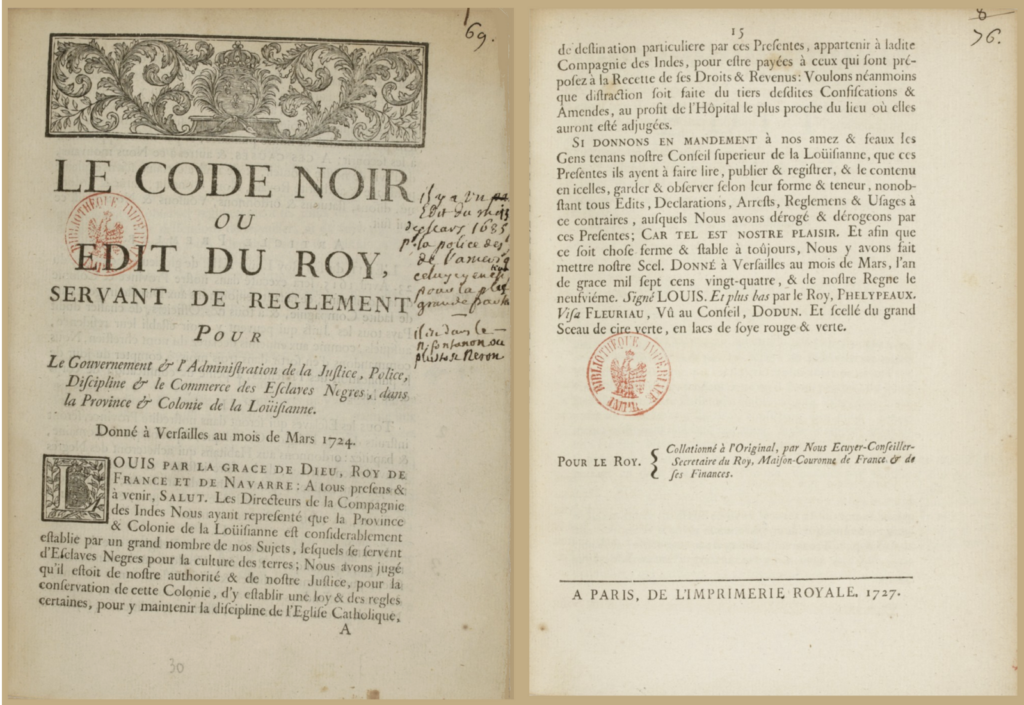




Late last week, the French parliament voted to explicitly overturn a 17th-century law that regulated enslavement in the country’s colonies.
In a unanimous vote of 254-0, the National Assembly voted to adopt a bill dedicated to repealing Code Noir, a decree made by King Louis XIV in 1685. Article 44 of the law declared that enslaved people were “movable property” and, if they escaped, they would face amputation or even death. The decree also forced Catholicism on all enslaved people and permitted violence against children.
President Emmanuel Macron publicly expressed support for removing these laws, saying that the legislation should not have been allowed to survive until present-day. It will head to the Senate where it will be considered before passing. If the bill is successfully adopted, the government will need to report on the effects of colonial law, including the effects on French overseas territories, the effects on French society and how enslavement is discussed in schools.
Greens lawmaker Steevy Gustave, whose father was born in Martinique, said that the vote on overturning the decree was personal.
“I’m thinking of my great-grandmother, Mama Bebelle. She was the grand-daughter of Ambroise Zerambe, born in Africa, then reduced to slavery under the number 336,” said Gustave per Euronews. “We are not descendants of slaves. We are descendants of human beings who were born free, then reduced to slavery.”
From 1551 to 1875, an approximate estimate of nearly 1.4 million people from Africa were forced to leave their homes on ships carrying the French Flag, per the Bibliotheque Nationale De France.
After Portugal and Great Britian, the country was the third most involved nation in the transatlantic Slave Trade, making 11% of the 4,118 voyages involved. Over 12.5 million men, women and children were impacted by the French’s actions.
The nation became most involved in the transatlantic Slave Trade during the 1630s when King Louis XII issued patents to multiple companies to operate in West Africa, eventually legalizing the French Atlantic slave trade in 1642. Through enslavement, production in sugar allowed the empire to expand to four continents.
In 1794, enslavement was abolished for the first time, although no measures were taken to prevent it. Under Napoleon’s rule, he once again reinstated enslavement. By April 27, 1848, it was definitively abolished.
Last week, President Macron addressed a need for reparations for the country’s role in the transatlantic Slave Trade, although no proposals were officially made.
“We must have the honesty to say that we can never fully repair this crime, because it is impossible,” said Macron per the Guardian. “You will never one day be able to put a number on it, or find words that would bring this history to a close.”