

Little One,
A few days ago in Natchez, Mississippi, you were laid on the ground beneath a car. You are four months old, soft, new, and still learning the shape of air.
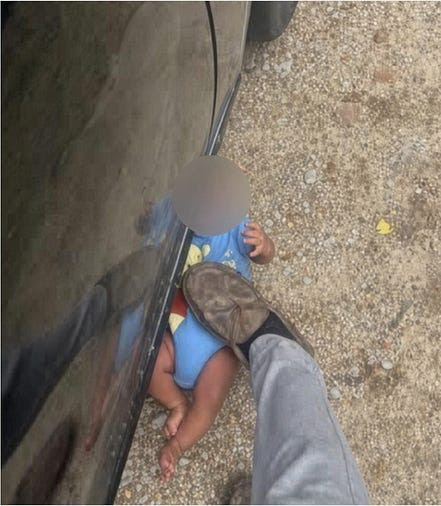
In that moment your precious body is pressed against pavement that does not know your name. In the photograph, you are small, your limbs are open, and your face is drawn tight with a cry that is searching for something it expects to find. Above you is the undercarriage of a car. All that metal is dark, unyielding, close enough to eclipse the sky, and close enough to remind you how easily something larger can press down and end everything.
On you, is your 27-year-old mother’s foot, steady, planted, and holding you in place while she lifts her phone and takes the photo to send to your father.
You did not crawl there. You did not choose that space.
She put you there.
Then there is the video.
In it, you are not under the car at first. You are bright-eyed. Beautiful. Innocent. There is a softness in your face, the kind that belongs to a child who has not yet learned what the world can do. For a brief moment, it looks like any other baby video. Your eyes open, your body is alert, your mouth is almost forming something that could become a smile.
And then her voice cuts through it.
“You finna die, my n—!”
“Yo’ daddy don’t want you, my n—!”
Your face changes. Not because you understand the sentence, but because you understand the sound, the shift in tone, and the absence of warmth. At four months old, your brain is still wiring itself through sensation. The parts that process language are barely online, but the parts that detect tone, threat, and safety are already active and learning fast. Your nervous system is listening for rhythm, for softness, for danger. It is mapping the world through voice, touch, and breath to decide whether you are safe or not.
You begin to cry. At first, it is open and full. It’s the kind of cry that calls out, that expects to be answered, that believes somebody will come. Your chest rises and your body reaches.
Then her hand comes down over your mouth and nose. It presses and the sound changes. It tightens and breaks. Your breaths come shorter, sharper, and interrupted. The cry turns into a half sob and half gasp, as if your body is trying to hold onto air that keeps slipping away. The rhythm collapses and the sound stutters.
And I feel it too.
My own breath catches. My chest tightens. My heart starts to race in a way that has nothing to do with me and everything to do with you. I press stop because I can’t watch this anymore. I sit there crying, trying to steady myself, but your cry is still in me. I can still see your eyes, wide and searching, trying to find somewhere to rest. It doesn’t leave when the video stops. It lingers, settles, and echoes in my chest like something my body refuses to forget.
I’m still thinking about you this morning, Little One.
Not as a headline. Not as a child welfare case. But as a tiny godling that had to make sense of something it should have never known. The sharpness of your mother’s voice cussing at you and calling you a n— still lingers in my head and cuts through the quiet of a new day. Morning light is supposed to feel different. It’s supposed to be a gentle reset.
But you are still here, in my mind . . . under that car. And I keep thinking about how early it is for you to be carrying something horrible like that. How your body is still learning, still forming, still deciding what the world is. And this is what it was given.
You will not remember this moment in your mind, but your body will hold onto it for the rest of your life. This kind of experience settles as sensory memory that is felt, not spoken. It may show up later in how you startle at sudden sounds, how your breathing shifts when something feels off, or how your body tightens before you even know why. It may live in your vigilance, in how you read tone, or how quickly your nervous system moves to protect you. It will live not as a story you can tell, but as a feeling your body remembers. Your body will keep the score, Little One.
So I sit with you in it, even now.
Before the photo and the video, your mother picked up her phone and began sending text messages to your father. In those messages, she said she could not care for you. She said she was not stable enough and was working. She said she had asked for help to buy diapers and wipes that cost “under twenty dollars.” According to the text messages, your father had not been helping to take care of you. She told him to come get you. To raise you. She said she would call CPS and sign over her rights.
And then her words hardened, got scary, and crossed a line you can’t uncross. In the messages she sent your father, she said she would kill you. She said she would choke you, put you in the tub and drown you, throw you in the trash, throw you in the river. The threats came over and over, stacking, until there was no mistaking what she was saying.
Your father called 911 from wherever he was, trying to reach you through a phone while you were already in danger. By the time help arrived, the story had already been written into your body. Your mother was arrested and charged with attempted murder. You were taken from that place and put into the foster care system.
And now, another Black family is pulled into the machinery of intervention and punishment. One adult is absorbed into the prison system. One child is absorbed into the foster care system. Both now moving through institutions that arrive only after something has already broken. And you, at only four months old, are beginning your life inside that rupture.
I had a similar beginning, Little One.
My mother didn’t try to kill me. But her rights were terminated, and I spent the first five years of my life in foster care. I know what it means to be carried by a system instead of a family. I know what it feels like to have your life rearranged before you can understand what was lost. I know what it feels like to move through hands and spaces that are supposed to keep you safe but can’t replace what should have been there from the start.
So when I look at you, I am not just seeing what happened. I am seeing what comes after. The part people don’t write about. And I have to about write it. Because if I don’t, your story will be taken from you. It will be reduced to a headline, a charge, a case file, something people scroll past and forget. It will become about what she did, what he didn’t do, or what the system did next.
And you, the one who felt it, will disappear.
I can’t let that happen, Little One. Because I know what it means for your story to be told without you at the center. I know what it means for people to talk around you, to explain the adults, to diagnose the situation, and debate everything except what your body lived through.
So I am writing this to hold onto the truth of you. Not the spectacle or the shock. But you.
April has been a terrible month for Black children in this country. And now you have been pulled into that roll call of headlines. Just days before you were laid under that car, two Black teenagers lost both of their parents in a Virginia murder-suicide that shattered their home and rewrote their lives in a single moment. They are still here, carrying the sound of it, the aftermath of it, and the weight of something no child should ever have to understand.
And then, there were the eight children murdered in Shreveport, Louisiana. Eight. Eighteen months to fourteen years old. They were hunted down by the man who was supposed to protect them. Their lives ended inside someone else’s breaking point and their bodies were caught in a violence they did not create and could not escape.
And now you.
Four months old. Under a car. Your body became the place where adult crisis, absence, and despair all collided.
Different cities. Different stories. But the same truth keeps surfacing. Black children are the ones left to absorb it all. And I refuse to let your life become just another moment people move past. Because while all of this has been happening, the conversations have gone somewhere else entirely.
Grown folks have been arguing in circles. The gender wars have spiraled into blame and counter-blame. “Not all men.” “What about women who kill?”
Threads and timelines are filled with folks trying to win arguments instead of sitting with what has actually happened to children like you. There is a frantic need to locate fault in a way that feels safe enough to keep the horror at a distance and make it feel like this belongs to somebody else’s life.
And then the explanations begin.
People will say postpartum depression. They will say your mother was overwhelmed, unraveling, and pushed past her limits. They will say she was angry at your father. They will say your father failed you, didn’t send money, didn’t show up, didn’t carry his weight. They will call him negligent and a deadbeat. They will widen the frame even further and talk about poverty, racism, and about the slow, suffocating smog that settles over Black families and poisons relationships long before a moment like this ever happens.
All of that may hold pieces of truth. But none of it holds you. Because while people are explaining her, explaining him, explaining the system, and explaining the conditions, your body was still under that car. Your breath is still being interrupted. Your cry is still breaking in a way it should never have to.
The explanations will stack up the same way her messages did. One on top of the other. Postpartum depression. Rage. Neglect. Poverty. Structural racism. Each one trying to account for how a moment like this comes into being.
And people will look away from you. They’ll say the photo is too traumatic to look at. They will scroll past it, close the tab, and protect themselves from the weight of what it asks them to feel.
But looking away doesn’t protect you. It protects us. Because when we turn away, the urgency disappears. The story softens and becomes something abstract and something we can explain instead of confront. The focus drifts back to the adults, back to their motives, their pain, their diagnoses.
And you disappear again.
But what gets buried underneath all of that is the simplest, most devastating truth. You were there. You felt it. And no explanation, no matter how accurate, can undo what your body learned in that moment.
So I will end here, with you.
Little One, I wish you a life that feels nothing like that Monday when she put you under the car.
I wish you arms that hold you without threat. Voices that soften when they reach you. Hands that protect instead of press. I wish you rooms where your body can finally exhale, where your breath comes easy, and where no part of you has to brace for what might happen next.
I wish for your nervous system to learn something new. To be taught, over and over again, that the world is not always sharp, loud, and not always dangerous. That there are places where you can rest. That there are people who will come when you cry, not silence you.
I wish for someone to look at you and see not what happened to you, but who you are beyond it. I wish for your body to remember something other than fear. I wish for your story to stretch far beyond this moment, far beyond that car, that video, those text messages, and into something softer, steadier, and something that does not begin and end with survival.
And most of all, I wish you the kind of love that does not have to be explained. The kind of love that does not hurt. The kind that stays.
And like me, one day you will become an adult who has to make meaning out of a beginning you did not choose. When that day comes, I hope you do not mistake what was done to you as a reflection of who you are. I hope you do not internalize the rejection, the absence, and the rupture as something that lives inside you.
Because it doesn’t belong to you.
You don’t have to forgive this moment to move forward from it. You are allowed to feel it. To cry. To be angry. To sit with the truth of what was taken from you. None of that makes you broken. It makes you honest. But I hope, in time, those feelings do not become the only story you tell yourself about your life. Because there is soooo much more, godling.
And I hope you come to understand something that took me time to learn: sometimes the best and only gift a parent can give is to be the vessel that brought you here. Not the safety. Not the stability. Not the love you deserved. Just the passage into a world where, if you are fortunate, you will find those things elsewhere.
And when you do, I hope you learn how to give one of those gifts to yourself. Because learning to love yourself, gently and deliberately, can become a kind of corrective genius and a way of rewriting what your body was first taught. It can become a way of offering yourself the steadiness, softness, and safety that did not meet you at the beginning.
I hope you find them.
And I hope they find you, Little One.
Thanks for reading. If this piece resonated with you, then please consider becoming a paid subscriber. Paid subscriptions help keep my Substack unfiltered and ad free. They also help me raise money for HBCU journalism students who need laptops, DSLR cameras, tripods, mics, lights, software, travel funds for conferences and reporting trips, and food from our pantry. You can also follow me on Facebook!
We appreciate you!