



Here they go again, Y’all.
Same old move, predictable as sunrise. The minute the state looks dirty after killing somebody, they go digging around in the archives to soil the dead until the question shifts from “Why did they kill him?” to “What can we use to say the killing was earned?”
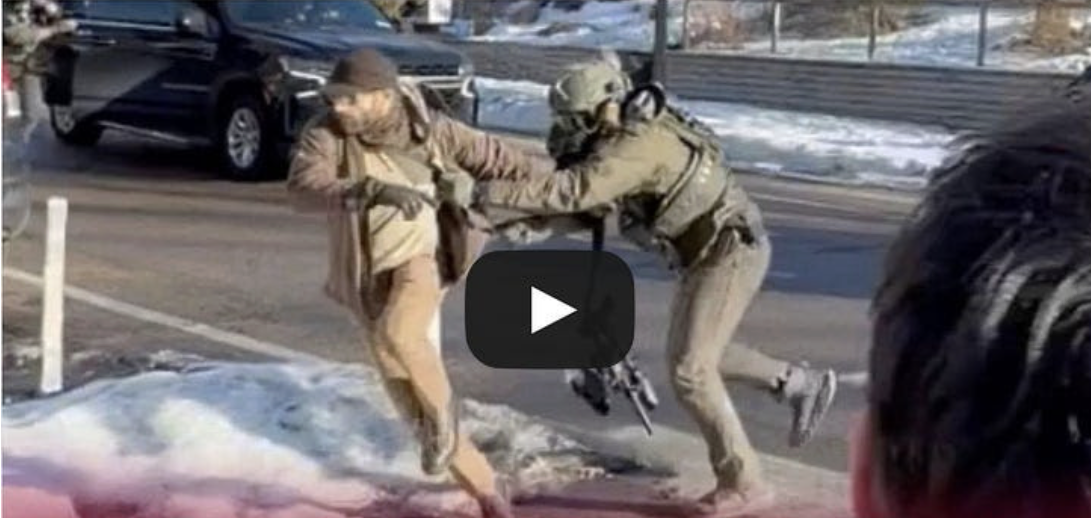
A newly released bystander video show Alex Pretti, the 37-year-old Minneapolis intensive care nurse who was shot and killed by ICE agents on January 24, in an earlier altercation with federal agents 11 days before his death. In the footage, he appears to shout and cuss at agents, spit on them, and kick the taillight off a federal vehicle, after which officers tackle him to the ground during a protest in Minneapolis. A handgun is visible in his waistband in the video, though he never reaches for it in the clip, and it’s not clear whether agents saw it.
The implication is thick and familiar. See … he was volatile. See … he was defiant. See … he wasn’t calm enough, or polite enough, or docile enough in his protest. See … he wasn’t the kind of person you’re supposed to mourn without caveats.
Mkkkkay. So he was mad. So he yelled and cussed. So he spit. So he kicked out a taillight. So being human, angry, defiant, and messy means you forfeit the right to not be riddled with bullets by the government?
They really want us to believe that a man spitting and kicking a taillight eleven days earlier retroactively makes it reasonable to put ten bullets into his body? We’re supposed to agree that property damage and an attitude are now capital offenses? That the state gets to reach back in time, rummage through a dead man’s heated moments, and hold them up like a receipt that says, “See? He had this coming?”
This is how the machine works when a death threatens to expose it. This is the oldest hustle in the book. If you can’t justify the killing, assassinate the character. If you can’t defend the shots, smear the corpse and put the victim on trial. The question stops being “Why did armed agents execute that man?” and becomes “Was he respectable enough to deserve to live?”
And the timing is the tell. The footage isn’t about what happened when he was killed. It’s about what the narrative needs now. And you release it at the precise moment public sympathy begins to lean the wrong way. The goal is not about telling the truth or getting justice. The goal is permission to turn an execution into a cautionary tale instead of a crime.
We have seen this movie so many times the beats are muscle memory. Remember Trayvon Martin?
Before the country could even sit with the image of a 17-year-old boy dead on the pavement, they went rummaging for “context.” Out came the school suspensions. The photos where he wasn’t smiling. The whispers about marijuana. The suggestion that he was “suspicious,” “no angel,” “looked older than he was.” They turned a bag of Skittles and an iced tea into props in a courtroom drama about menace. They let a neighborhood watchman’s fear be framed as reasonable, and a tall child’s presence be framed as provocation.
And then came the questions that always arrive right on time, like a chorus trained by the state: Why was he there? Why was he wearing a hoodie? Why didn’t he just comply? Why didn’t he run differently, speak differently, exist differently?
Do Y’all remember when Mike Brown Jr. was shot in Ferguson? The question on the street was why an unarmed teenager lay dead for hours baking in the sun in front of his family and community? The answer the system offered was a convenience-store video. They looped the grainy footage of him in a shop, froze the frame, and let the public stare. They let “alleged theft” stand in for “threat.” They let a minor, unrelated moment be alchemized into a moral prequel. The point was never whether the clip explained the bullets. The point was to make the bullets feel legible.
The same ritual followed Tamir Rice. A twelve-year-old child killed within seconds while playing in a park. What arrived first was not a reckoning but a re-description. A judge said this boy should have known better because he was “big for his age,” the toy “looked real,” he had a “history at school.” Language did the work of age-up, menace-up, culpability-up. Before the public could settle into grief, they were coached into calculation: would you have been afraid? would you have done the same? The child’s body was barely cold before his innocence was put on probation.
Eric Garner’s last words, “I can’t breathe,” were audible to the world, and still the counter-narrative came right on time. His size. His health. His prior arrests. The suggestion of aggression. A man selling loose cigarettes was re-scripted as a looming figure, a threat that justified a chokehold the law itself prohibited. The question of policy evaporated under a fog of biography.
Philando Castile told the officer he was legally armed. He complied. He died anyway. The story that followed was not about the terror of being shot while following the rules; it was about marijuana in the car, about past stops, about anything that could blur the clean lines of “law-abiding.” The Second Amendment did not protect him from becoming, in the public mind, a problem.
George Floyd’s murder was so naked, so slow, so inescapable that the apparatus had to dig deeeeeep. Old mugshots, old struggles, a toxicology report, the insinuation that his own body betrayed him. The officer’s attorneys argued that Floyd killed himself. The aim was not to refute the video, it was to erode the sanctity of the victim, to suggest that a past could be weighed against a present suffocation and found wanting.
Breonna Taylor was asleep in her own home. The response was to flood the zone with stories about an ex-boyfriend, vague talk of packages, whispers of drugs that were never found. The architecture of doubt was erected so that the raid could be framed as tragic but understandable, the home reframed as suspect, and the woman reframed as adjacent to danger.
Over and over, the pattern holds. A killing shocks the conscience. Public empathy swells. Then comes the corrective: a clip, a record, a rumor, a phrase like “newly obtained.” It arrives not to clarify the moment of death but to contaminate the moment of mourning. It teaches the audience how to read the body on the ground: not as a life taken, but as a life that somehow summoned its own taking.
What’s striking in the Pretti case is how seamlessly the script transfers when the victim is white. For a brief moment, gun-rights groups and civil-liberties talk bubbled up. For a brief moment, the shield that usually insulates federal force wobbled. And then, right on cue, the past appeared. A week earlier. A different scene. A different encounter. A different set of behaviors. Spliced into the present to stabilize the story. The implication is that if he once spat, if he once kicked, if he once bristled, then the later bullets begin to look less like an overreach and more like an inevitability.
This is the alchemy of state storytelling. Aggression is retroactively discovered. Noncompliance is broadened to include attitude. Threat is stretched to cover history. The public is invited to perform a moral calculus that ain’t got shit to do with the legal standard and everything to do with emotional conditioning. You are taught, gently and then not so gently, that the line between “citizen” and “suspect” is thin, movable, and ultimately at the discretion of the people with guns.
It is not an accident that these releases are framed as journalism’s due diligence. “Context,” we are told. “Full picture, people.” But the full picture somehow always tilts in one direction, and that’s toward the state’s need to be understood and toward the victim’s need to be scrutinized. The camera pans backward in time not to establish facts about the incident but to harvest fragments that can be arranged into a story of deservedness.
And the effect is cumulative. A public trained, case after case, to ask the wrong first question. Not: what authority was exercised, and was it lawful? Not: what policies and cultures produce split-second lethal decisions? But: what did the dead do, once, somewhere, that might make this feel less like a scandal and more like a consequence?
This is why the comparison to the killings of Black adults and children are relevant here. The convenience-store tape, for example, did not explain Darren Wilson’s bullets any more than a taillight kick explains a federal shooting. What it did was shift the emotional burden. It moved the weight from power to personality, from structure to story, from the act to the actor. It taught the nation to litigate the victim’s character as a way to acquit the system.
Call it character assassination as crowd control. Call it narrative triage. Call it the state’s oldest trick: when the use of force risks looking naked, clothe it in a backstory. When the killing risks looking excessive, make the victim look excessive. When the law risks looking cruel, make the dead look complicated enough to quiet the crowd.
The Pretti footage is not a revelation about what happened when he died. It is a reminder of how the story of a death is managed. It is the machinery whirring to life, searching the past for anything that can be repurposed as a moral anesthetic. And it is a warning, as old as this country’s policing and as current as tonight’s headlines, that innocence is not a prerequisite for being killed, but it is always a prerequisite for being mourned without qualification.
The ritual is simple and ruthless: first the body falls, then the archive opens. Then comes the footage, the records, the rumors, the carefully selected “context” arranged to make state violence feel reasonable, necessary, and inevitable.
If we have learned anything from Ferguson to Cleveland to Minneapolis to Louisville and now to a white ICU nurse caught in the gears of federal force, it is that the strategy and script does not change. Only the casting does. Different face, same function, which is to launder an execution into a lesson. To turn a killing into a warning. And to drill into the public, over and over, who is required to justify their own murder and who is granted the luxury of killing without ever having to justify a damn thing.
Thanks for reading. If this piece resonated with you, then please consider becoming a paid subscriber. Paid subscriptions help keep my Substack unfiltered and ad free. They also help me raise money for HBCU journalism students who need laptops, DSLR cameras, tripods, mics, lights, software, travel funds for conferences and reporting trips, and food from our pantry. You can also follow me on Facebook!
We appreciate you!