

There is a reflex in American political commentary that fires off almost instantly when a Black woman candidate loses an election or a racist white man wins. Before anybody opens the precinct data, before turnout patterns are examined, before campaign strategy is evaluated, a familiar accusation appears: Misogynistic Black men are to blame.
I don’t know about Y’all, but I’m sick of this pattern of scapegoating that has quietly hardened into conventional wisdom. In liberal political discourse, Black men are increasingly treated as the explanation for outcomes they do not have the numerical power to determine on their own.
We saw this script play out after the electoral victories of Donald Trump. The results had barely settled before pundits and commentators began circulating the narrative that Black men were drifting toward Trump in numbers large enough to swing the election.
Never mind that Black voters overall remained one of the most consistently Democratic voting blocs in the country. Never mind that Black men make up a relatively small share of the national electorate. And never mind that roughly three-quarters of them still voted for Kamala Harris anyway according to exit polls and post-election analyses.
The storyline was simply too convenient to resist, because it allowed people to smuggle their own anecdotal grievances into intellectual praxis and political theory. Instead of examining data, electoral math, or coalition dynamics, people project their personal experiences, social-media encounters, and interpersonal frustrations onto national politics, and then treat those anecdotes as if they explain the behavior of millions of voters.
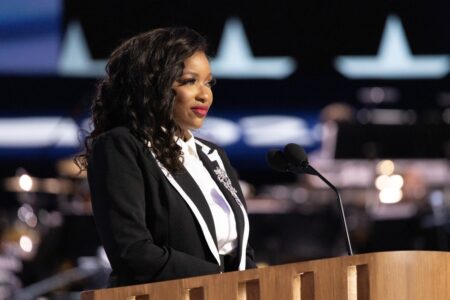
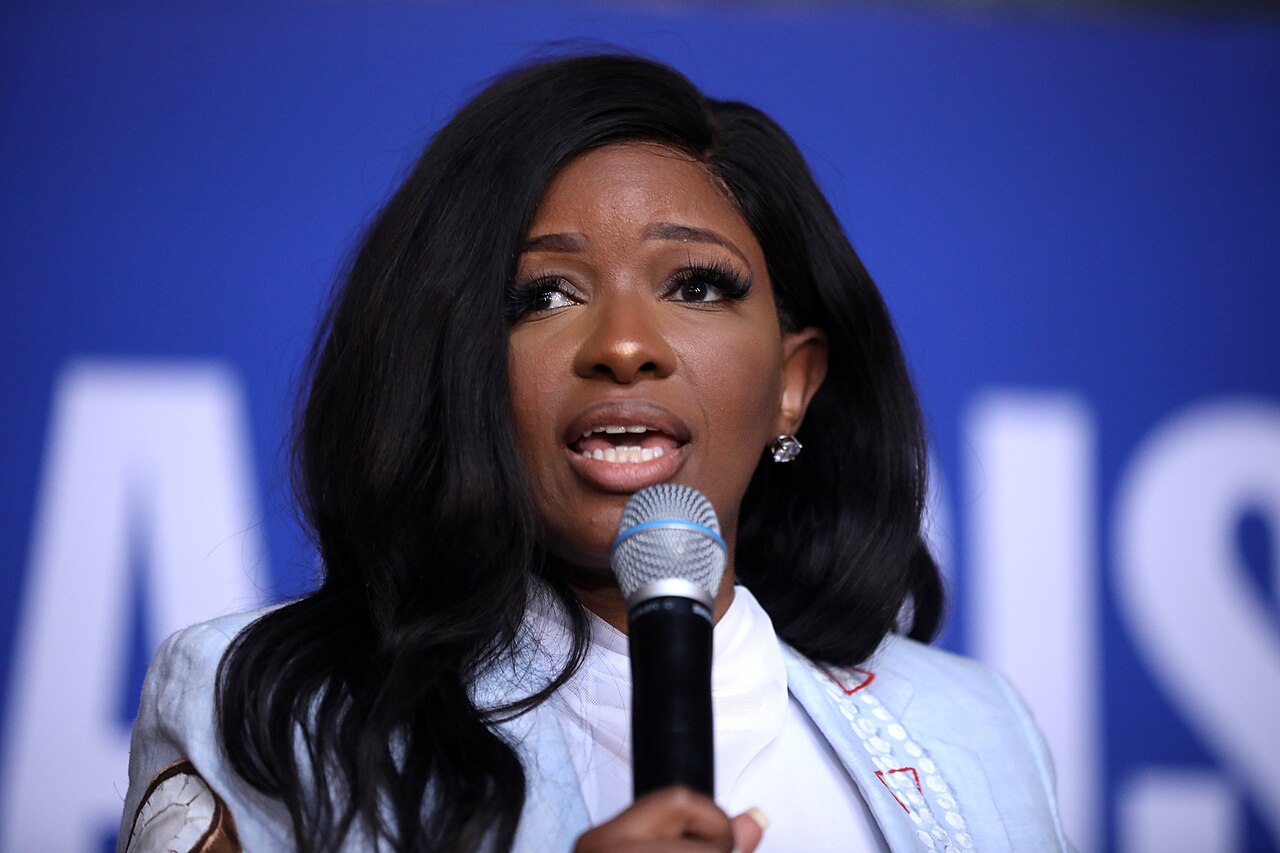
Now the same reflex is being deployed again in discussions surrounding the defeat of Jasmine Crockett.
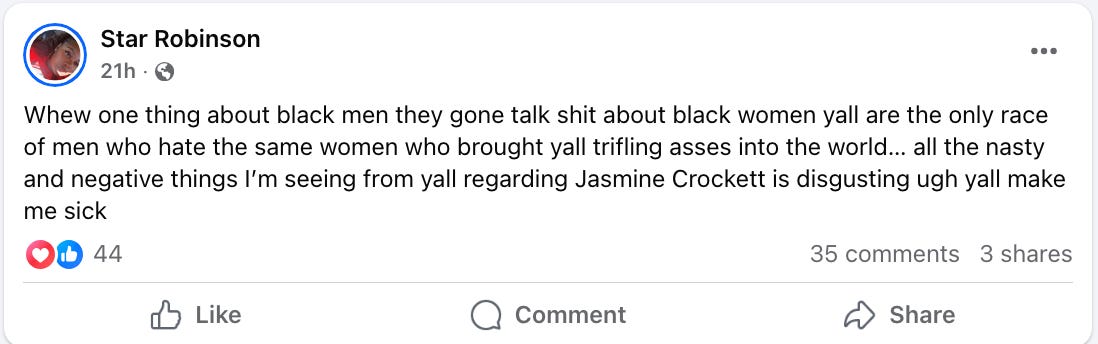
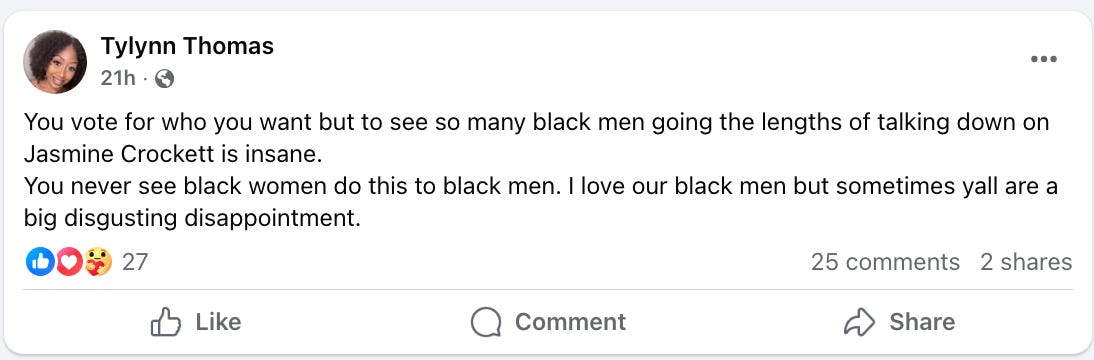
Crockett’s loss was barely digested before folks started declaring that Black men sabotaged her because they hate Black women. It has become such a predictable script that you can practically set a stopwatch to it.
Now let me be clear before we go any further. Misogyny exists. Full stop. The internet is full of ugly shit-talking about Crockett across race lines. White racists stay in her comments calling her the N-word, bitch, and the C-word. I’ve seen Black folks calling her “ghetto” and making comments about her appearance. So anyone pretending that misogyny or racism doesn’t exist in American political culture is living in a fantasy.
But acknowledging that misogyny exists is not the same thing as claiming that misogyny explains an election result. Those are two completely different levels of analysis. One describes social behavior on the internet. The other explains how tens or hundreds of thousands of people actually voted. Conflating the two is not political analysis. It’s intellectual laziness.
The first problem with the “Black men did it” narrative is mathematical. Black people make up roughly 13 percent of the U.S. population. Black men are roughly half of that. In most Democratic primaries, the most reliable voting bloc is actually Black women, not Black men. If a candidate loses across the broader electorate, there is simply no plausible scenario where Black men alone have the numerical power to tank the race.
That ain’t ideology, Y’all. That’s math mathing.
So if we’re gonna talk seriously about why Crockett lost, we have to talk about the things that actually determine election outcomes.
The first factor is coalition building. Winning elections requires assembling support that extends beyond a single demographic group. Candidates need older voters and younger voters, moderates and progressives, suburban voters and urban voters, along with issue-based constituencies like labor or civil rights organizations. A candidate can be enormously popular with one segment of the electorate and still lose if that popularity does not translate into a broader coalition.
Jasmine Crockett is extremely strong within a particular lane of the Democratic electorate, especially younger voters, highly online progressives, and urban Black voters who appreciate her combative style and willingness to publicly challenge Republicans. Those qualities have made her a powerful communicator and quickly elevated her to national prominence. But national visibility and coalition building are not the same thing.
In Texas politics especially, successful candidates often have to build bridges across multiple blocs: older Black church voters, Latino communities, suburban moderates, organized labor, and Democratic donors who tend to be more cautious about political messaging. When a candidate becomes strongly identified with a single ideological lane, expanding that coalition becomes much harder.
There is also the difference between media popularity and institutional support. Crockett has become famous for viral congressional moments and television appearances. That kind of visibility can energize activists and online audiences, but elections are still won through relationships with local political organizations, endorsements from community leaders, and turnout operations that mobilize people who are not living on social media or watching cable news. When those institutional networks are divided or lukewarm, it becomes much harder to assemble the broad coalition needed to win a larger race.
Another factor we need to consider is generational style. Crockett represents a newer, more confrontational political style that resonates strongly with younger voters and progressive activists. But older voters, who turn out at much higher rates in primaries, often prefer candidates who project stability, coalition-building, and institutional relationships. That generational difference doesn’t show up in simplistic narratives about misogyny, but it can significantly shape voting patterns.
Once you actually look at the polling and reporting around the race, the story becomes even more complicated and even less flattering to the lazy misogyny narrative. Surveys of Texas Democratic voters suggested that Crockett’s strongest support came from Black voters across age groups, while her opponent performed significantly better among white and Latino Democrats. Some polling even showed younger voters splitting toward her opponent while older voters remained solidly in Crockett’s camp.
In other words, the decisive issue wasn’t Black men suddenly sabotaging a Black woman candidate. It was coalition breadth. Crockett appears to have consolidated a strong base among Black voters, particularly in urban areas, but struggled to expand that support across the broader Democratic electorate in a state where Latino and white Democrats make up a large share of the primary vote. When those voters break heavily toward another candidate, even overwhelming support from Black voters cannot carry the race.
That’s how elections actually work. They are decided by coalition math, meaning who shows up, who crosses racial and geographic lines, and who builds the broadest alliance across the electorate. But coalition math is far less satisfying to pundits than a viral narrative about misogyny. So instead of doing the work of political analysis, people reach for the easiest explanation available: blame Black men. The data tell a different story. And the data matter more than the narrative.
Foreign policy has also become a quiet dividing line inside Democratic politics. Issues related to Israel and Gaza have split progressive activists, older Democratic voters, Jewish voters, and parts of the party’s donor class. A candidate’s perceived stance on that issue can affect endorsements, fundraising, and enthusiasm across different segments of the electorate. That kind of coalition tension rarely appears in social-media explanations of election results, but it can have real consequences.
The broader point is that none of these dynamics have anything to do with Black men supposedly sabotaging a Black woman candidate. They are the same structural challenges that every candidate faces: building alliances across ideological factions, maintaining relationships with local political institutions, balancing national visibility with local credibility, and navigating internal party divisions.
In Crockett’s case, that tension was serious. She has voted in favor of U.S. aid packages supporting Israel during the Gaza war, including legislation authorizing billions in military assistance to the Israeli government. For many progressive activists and younger voters who view Israel’s military campaign in Gaza as collective punishment or genocide, those votes have become a serious point of anger. That doesn’t mean every voter made their decision based on foreign policy. But it does mean that Crockett’s position placed her at odds with a growing faction of the Democratic base that has become far more critical of U.S. support for Israel than the party establishment has traditionally been.
That kind of intra-party tension matters. Foreign policy positions can influence grassroots enthusiasm, activist mobilization, and donor networks in ways that rarely show up in quick election-night narratives. A candidate can simultaneously be admired for their rhetorical skill and criticized for specific votes that activists view as morally unacceptable.
The broader point is that none of these dynamics have anything to do with Black men supposedly sabotaging a Black woman candidate. They are the same structural challenges that every candidate faces: building alliances across ideological factions, maintaining relationships with local political institutions, balancing national visibility with local credibility, and navigating internal party divisions.
When analysts skip over those factors and jump straight to misogyny as the explanation, they aren’t just simplifying the story. What the misogyny narrative does, intentionally or not, is replace structural analysis with moral accusation. Instead of examining campaign strategy, voter turnout, ideological divisions, or demographic math, the conversation becomes a scolding lecture about the supposed psychological failures of Black men.
And that move does two damaging things at once.
First, it erases the agency of other voters. White voters, Latino voters, Asian voters, and suburban moderates suddenly disappear from the conversation. The electorate becomes a morality play starring Black men as the villains.
Second, it treats Black men as a political scapegoat for outcomes they do not have the numerical power to determine on their own.
Ironically, the narrative also ignores one of the most consistent facts in American electoral politics: Black men and Black women vote for the same party at some of the highest rates of any demographic groups in the country. Their voting patterns are far more aligned than different.
So when analysts leap immediately to misogyny as the explanation for Crockett’s defeat, what they are really doing is avoiding the harder work of political analysis. It is easier to moralize than to examine precinct returns. It is easier to accuse than to study coalition dynamics.
But elections are not decided by social media arguments and rants. They are decided by turnout, demographics, strategy, messaging, and alliances.
People reach for the misogyny narrative so quickly because the human brain prefers simple moral stories over complicated structural explanations. Elections are messy as hell. They involve turnout patterns, coalition math, ideology, geography, campaign infrastructure, and voter behavior. Sorting through all of that takes time and data. But saying “misogyny did it” collapses that complexity into a single, emotionally satisfying explanation with a clear villain.
Not to mention, folks like confirmation bias. Folks regularly encounter misogynistic comments about women like Jasmine Crockett online. When people see them repeatedly, the brain starts treating those loud online voices as representative of the entire electorate. Personal observation gets mistaken for population-level evidence. And if somebody spends hours scrolling through social media where misogynistic commentary is visible via the algorithm, it becomes easy to assume misogyny must explain the election outcome. But social media is not the electorate. It’s an emotional highlight reel of the loudest voices.
Also, when people strongly identify with a candidate, accepting that the candidate failed to build a broad enough coalition can feel uncomfortable. So blaming misogyny protects the candidate, and the supporters, from having to examine strategy, messaging, or coalition weaknesses.
And finally, the misogyny narrative travels faster than real analysis. “Misogyny cost her the race” fits neatly into a tweet or headline. Explaining coalition math does not. It requires numbers, context, and nuance.
So the misogyny explanation persists not because it’s always accurate, but because it’s psychologically convenient for folks. It’s much easier to tell a moral story than to analyze an election.
Lazy narratives don’t just misinterpret one race, they distort how people understand political power. When the blame for electoral outcomes is reflexively placed on Black men, it obscures the role of other voters who make up the majority of the electorate: white Democrats, Latino voters, suburban moderates, donors, party institutions, and ideological factions. So let’s re-center those dynamics and stop treating elections as morality plays. They are coalition-building exercises.
If people genuinely care about the future of Black women in politics, then they should want better analysis than this. Folks need to move from anecdote to analysis. From social media impressions to coalition math. From personal grievance to structural explanation.
Because lazy narratives don’t strengthen campaigns. They don’t build stronger coalitions. They don’t help candidates understand where support is strong and where it needs to grow. And if we are serious about political strategy, we should be demanding something far more rigorous in our analysis.
In other words, if folks genuinely want to understand why a candidate lost, the answer isn’t hiding inside Black men’s psychology. It’s hiding in THE MATH. Everything else is projection from people who need better friends, better lovers, better social media feeds, or a good therapist.
Thanks for reading. If this piece resonated with you, then please consider becoming a paid subscriber. Paid subscriptions help keep my Substack unfiltered and ad free. They also help me raise money for HBCU journalism students who need laptops, DSLR cameras, tripods, mics, lights, software, travel funds for conferences and reporting trips, and food from our pantry. You can also follow me on Facebook!