
Close Menu
TheHub.news

    Cannabis Equity in Minnesota Puts Repair at Center of Legalization

    By Insight News

    This Day in History: October 3rd

    By TheHub.news Staff

    In Their Hands: Restoring Citizenships and Giving Fair Chances

    By Jeremy Busby

    Subscribe to Updates

    Get the latest creative news from FooBar about art, design and business.

    X (Twitter) Instagram YouTube
    X (Twitter) Instagram YouTube
    TheHub.news
    Support Our Work
    • Home
    • Our Story
      • News & Views
        • Politics
        • Injustice
        • HBCUs
        • Watch
      • Food
        • Cuisine Noir
        • soulPhoodie
      • Passport Heavy
      • Travel
      • Diaspora
      • This Day
      • Entertainment
      • History
      • Art
      • Music
    • Health
    • Money

      Cashflow Coach: I Planted a Money Tree!

      August 4, 2026

      Breaking Down the 2 Different Types of Income

      July 7, 2026

      Black Americans Are Already Living Through a Recession

      July 6, 2026

      You Must Be an Owner to Win 

      June 23, 2026

      Economic Empowerment Has Always Been a Part of Black History

      February 12, 2026
    • Books
    • Business
    • Sports
      1. First and Pen
      2. View All

      DHS Shamelessly Uses Brian Dawkins Footage Without Permission to Tout Fear

      September 30, 2026

      Carlan Gay Traveled the World to Build a Sports Career Very Few Are Built to Forge

      September 25, 2026

      Texans’ Aziz Al-Shaair Shows How Humanity Can Exist in Sports

      September 22, 2026

      Jalen Brunson Launches Family-run Management Group

      September 18, 2026

      DHS Shamelessly Uses Brian Dawkins Footage Without Permission to Tout Fear

      September 30, 2026

      Carlan Gay Traveled the World to Build a Sports Career Very Few Are Built to Forge

      September 25, 2026

      Texans’ Aziz Al-Shaair Shows How Humanity Can Exist in Sports

      September 22, 2026

      Jalen Brunson Launches Family-run Management Group

      September 18, 2026
    • Tech
    • Podcasts
      1. Karen Hunter is Awesome
      2. Lurie Breaks it Down
      3. Human(ing) Well with Amber Cabral
      4. Financially Speaking
      5. In Class with Carr
      6. View All

      Cannabis Equity in Minnesota Puts Repair at Center of Legalization

      October 3, 2026

      This Day in History: October 3rd

      October 3, 2026

      In Their Hands: Restoring Citizenships and Giving Fair Chances

      October 2, 2026

      ICE Is Still Targeting the Haitian Community in Springfield

      October 2, 2026

      Cannabis Equity in Minnesota Puts Repair at Center of Legalization

      October 3, 2026

      This Day in History: October 3rd

      October 3, 2026

      In Their Hands: Restoring Citizenships and Giving Fair Chances

      October 2, 2026

      ICE Is Still Targeting the Haitian Community in Springfield

      October 2, 2026

      Cannabis Equity in Minnesota Puts Repair at Center of Legalization

      October 3, 2026

      This Day in History: October 3rd

      October 3, 2026

      In Their Hands: Restoring Citizenships and Giving Fair Chances

      October 2, 2026

      ICE Is Still Targeting the Haitian Community in Springfield

      October 2, 2026

      Cannabis Equity in Minnesota Puts Repair at Center of Legalization

      October 3, 2026

      This Day in History: October 3rd

      October 3, 2026

      In Their Hands: Restoring Citizenships and Giving Fair Chances

      October 2, 2026

      ICE Is Still Targeting the Haitian Community in Springfield

      October 2, 2026

      Cannabis Equity in Minnesota Puts Repair at Center of Legalization

      October 3, 2026

      This Day in History: October 3rd

      October 3, 2026

      In Their Hands: Restoring Citizenships and Giving Fair Chances

      October 2, 2026

      ICE Is Still Targeting the Haitian Community in Springfield

      October 2, 2026

      Black Girl Vitamins’ New Podcast Is Creating Space for the Health Conversations Black Women Deserve

      September 30, 2026

      In Class with Carr: “Cross Colors”

      September 29, 2026

      In Class with Carr: Whose Labor? Which Stories?

      September 7, 2026

      In Class with Carr: King Me: Africana Governance and Purpose in a Changing World

      August 31, 2026
    TheHub.news
    Beauty

    Black Activism and Denim: America’s Most Overlooked Fashion Revolution

    By Danielle BennettJanuary 13, 20236 Mins Read
    Share Email Copy Link
    Image Credit: ShutterStock
    Share
    Facebook Twitter LinkedIn Email Copy Link Threads

    Before becoming a hairdresser, I majored in business and worked in corporate fashion, developing ready-to-wear clothing for well-known women’s wear brands. My years spent there weren’t glamorous (unlike those movies and TV shows where the gorgeous, well-heeled maven saves the world one designer handbag at a time), but I learned a lot and am grateful for the relationships I fostered. 

    Although I wouldn’t trade in that time for anything in the world, it was hard to ignore how the mostly all-white industry would comfortably whitewash and dismiss egregious design appropriation.

    Black people are rarely acknowledged for fashion’s more universal styling; the recognition typically doesn’t go beyond hip-hop culture and so-called “urban” trends like streetwear. It’s an old, ingrained practice.

    Consequently, it’s also no surprise we don’t receive credit for one of America’s most iconic and far-reaching garments: blue jeans. 

    After all, considering how America was built and is upheld, it’s hardly groundbreaking news. But what this has to do with why the world loves jeans so much is actually a big deal.

    Image Credit: ShutterStock

    From its early inception for workwear uniforms to one of today’s fashion staples, denim’s journey has a particularly unique place in the Black experience. The truth behind its popularity did not come from the “edited” stories created to suit some of the industry’s largest, white-owned American manufacturers. In fact, denim’s present-day, mainstream appeal was shaped by Black activism.

    Denim – The Prequel (Spoiler Alert: Levi Strauss had nothing to do with it)

    Before the invention of man-made dyes, if you wanted to make anything blue, you needed indigo. An organic compound, indigo is found in the leaves of certain plants like the Indigofera tinctoria. And while it can be traced back to Dungri, India and parts of Africa, the African slave trade made it exceedingly lucrative.

    According to a revealing PBS documentary, Riveted: The History of Jeans, the knowledge to cultivate indigo for consumption came from enslaved Black people. During the 1700s, when West Africans were relocated to America against their will with them, they brought the intelligence of how to cultivate indigo and turn it into an oxidized vat of blue dye. Profits skyrocketed, outpacing those of sugar and cotton at the time, directly benefiting white, slave-owning families.

    Additionally, the indigo boom of the mid-18th century ramped up the import of African slaves. In the book, Indigo: In Search of the Color that Seduced the World, author Catherine McKinley explains how indigo’s value became more powerful than the gun. It was literally used as a currency: one length of naturally indigo-dyed cloth was traded for one human body. And during the Revolutionary War, when the dollar had no value, indigo cakes helped to finance it.

    Not only were the enslaved preparing the indigo dye, but they also picked the cotton, dyed it, spun it into the fabric we now know as denim and assembled garments such as blue jeans…for free. And just like this country, along with other popular products, these contributions were written over. Levi Strauss and tailor Jacob Davis are credited with having created jeans in 1873, but waist overalls, as they were originally called, were around for many decades prior.

    A Symbol of Black Activism

    As denim made the voyage from slavery to runway staple, its popularity significantly increased during the civil rights movement in the 1960s, as noted in the recorded livestream, The History of Protest Fashion, for PBS.org. However, this important piece of American history was glossed over and instead, offensive sartorial references to slavery prevailed. 

    The racist perspective weaponized white supremacy. Not only did slave owners buy and sell denim for the enslaved because the material was functional and sturdy, they also deemed it unfit for whites and used as a tool to deliberately erode Black humanity. Keeping the slaves dressed in “Negro cloth” (for jeans, overalls, work shirts and trucker jackets) was an intentional, striking contrast to the “lordly” clothing made from fabrics like white linen and lace, as worn by plantation families. 

    Young activists, specifically members of the SNCC (Student Non-Violent Coordinating Committee, made up of mostly Black college students who practiced peaceful, direct action protests, founded in 1960), wore denim (overalls in particular) as an identifier to condemn racist stereotypes to pay homage to Black laborers and to symbolize equality among the sexes. Its uniform (or “SNCC skin,” as they proudly called it) consciously highlighted and evaluated the politics of respectability.

    When we think of the clothing of the civil rights movement, crisply tailored suits, slim neckties and bespoke trench coats often come to mind, like those worn by Dr. Martin Luther King, Jr. and other notable heroes of the time. The look represented a dignified, nonviolent viewpoint of the movement. Still, denim represented a different, not-so-subtle way of thinking, one that demonstrated the idea that Blacks didn’t have to prove themselves as worthy to white society. It also inspired an anti-establishment spirit, often worn as a political statement in antiwar protests, the fight for women’s rights and in the hippie culture.
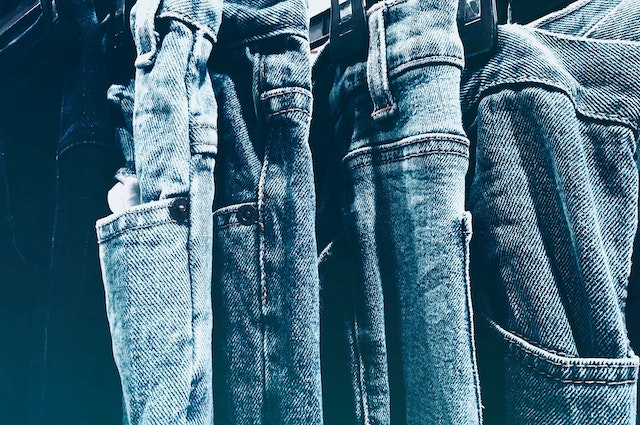
    Image Credit: Pexels

    Black Reimagination 

    1970s Blaxploitation films like the classics Foxy Brown, Shaft and Superfly continued to serve as the voice of young and revolutionary ideals; and launched denim styling forward in bold ways. Functional features like quilting and patchwork were elevated to more tailored and sexy silhouettes like customized blazers and hip-hugging, midriff-baring bell-bottom pants, topped off with matching accessories. And although the relationship between denim and the Black community was swept under the rug at that time, its tremendous impact remains evident today.

    Image Credit: Pexels

    Remembering True Legacy

    It is said that at any given moment, half the world’s population is wearing jeans. I believe we can all attest the estimation is not far off because the global jeans market is worth over $70 billion. However, it’s important to remember that denim’s strong connection to Civil Rights has everything to do with its success. 

    Those brave crusaders didn’t want to be style icons. They wanted a seat at the table. And they used denim’s association with oppression and inequality to do it. 

    It just so happens that in doing so, they laid the groundwork for a future style revolution we still embrace today.

    Denim Fashion
    Danielle Bennett
    • Instagram

    Danielle Bennett, a hairstylist of 20 years, is the owner of The Executive Lounge, a hair salon that caters to businesswomen, located in the Chelsea neighborhood of New York City. She specializes in natural hair care, haircuts, color, hair weaving and is certified in non-surgical hair replacement. Danielle partners with her clients to provide customized services, while she pampers them with luxury products and professional, private accommodations. “The Executive Lounge is your home away from home; it is a tranquil, modern sanctuary where you matter. Your time is valued and your opinion counts. Why? Because you deserve it.” - Danielle Bennett

    Related Stories

    Diddy Wants to Buy Back Sean John From Owner Who Went Bankrupt

    October 23, 2024

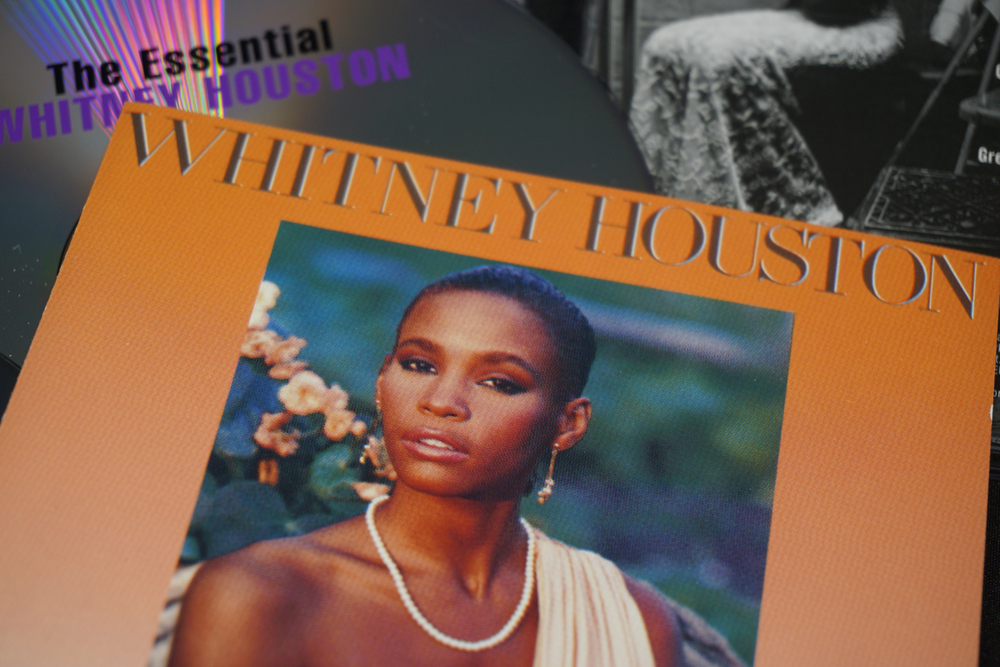
    Whitney Houston was the Ultimate Style Icon, and We Have the Receipts

    August 9, 2023

    The Cultural Significance and Origins of Waist Beads

    July 30, 2023

    Dermatology Has a Race Gap: We Need More Black Doctors to Fill It

    May 25, 2023

    Conscious Body Art: How Ink the Diaspora Is Redefining the Tattoo Industry

    April 6, 2023

    Black Culture Is Fashion History: Meet 3 Historians Who Course-correct and Preserve Its Stories

    March 9, 2023
    Recent Posts
    • Cannabis Equity in Minnesota Puts Repair at Center of Legalization
    • This Day in History: October 3rd
    • In Their Hands: Restoring Citizenships and Giving Fair Chances
    • ICE Is Still Targeting the Haitian Community in Springfield
    • Chicago’s Gary Comer Youth Center Grows Community With Urban Agriculture

    Cannabis Equity in Minnesota Puts Repair at Center of Legalization

    By Insight News

    This Day in History: October 3rd

    By TheHub.news Staff

    In Their Hands: Restoring Citizenships and Giving Fair Chances

    By Jeremy Busby

    ICE Is Still Targeting the Haitian Community in Springfield

    By TheHub.news Staff

    Subscribe to Updates

    A free newsletter delivering stories that matter straight to your inbox.

    About
    About

    TheHub.news is a storytelling and news platform committed to telling our stories through our lens. With facts at the center, we document the lived reality of our experience globally—our progress, our challenges, and our impact—without distortion, dilution, or apology.

    X (Twitter) Instagram YouTube

    Cannabis Equity in Minnesota Puts Repair at Center of Legalization

    By Insight News

    This Day in History: October 3rd

    By TheHub.news Staff

    In Their Hands: Restoring Citizenships and Giving Fair Chances

    By Jeremy Busby

    ICE Is Still Targeting the Haitian Community in Springfield

    By TheHub.news Staff

    Subscribe to Updates

    A free newsletter delivering stories that matter straight to your inbox.

    © 2026 TheHub.news A 501(c)(3) tax-exempt organization.

    Type above and press Enter to search. Press Esc to cancel.