




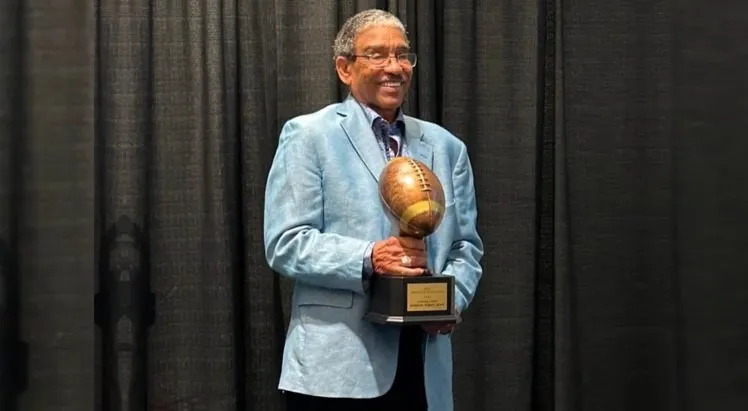
On Sunday, the football community sadly learned of the passing of long time assistant coach Sherman Lewis.
Lewis played collegiately at Michigan State, where he was an All-American running back and track and field star. He won three Big Ten titles in the latter and finished third in the 1963 Heisman Trophy voting in the former.
He was drafted by both the NFL and AFL in 1964 but chose to head north to play in the CFL with the Toronto Argonauts for two years before returning to the U.S. to play for the Jets in the AFL.
After finishing his pro career in 1969, he returned to his alma mater and began his coaching career.
He spent 13 years as a Spartans’ assistant before Bill Walsh of the 49ers hired him in 1983 as the wide receivers and running backs coach. After nine seasons in San Francisco, former 49ers assistant Mike Holmgren, named head coach of the Packers in 1992, hired him away as the Packers’ offensive coordinator.
That year, he and new Packers defensive coordinator Ray Rhodes were cemented in history as their hiring marked the first time an NFL team had two Black coordinators at the same time.
Lewis spent eight years in Green Bay, then moved to the Vikings for two years and then Detroit for two years, all in the same capacity. His final year of coaching came in 2009 as an offensive assistant with Washington.
Sherman Lewis was an amazing college athlete. He won four Super Bowls, three with the 49ers and one with Green Bay, and made NFL history.
Yet despite all of his accolades, accomplishments and talents, there’s one thing he never had.
An NFL head coaching job.
In 1989, the Raiders’ Art Shell became the first Black head coach in modern NFL history. Three years later, the Vikings made Dennis Green the second. They were followed by Lewis’ former history-maker, Ray Rhodes, who was hired by the Eagles in 1995, Tony Dungy (Bucs, 1996), Herm Edwards (Jets, 2001), Marvin Lewis (Bengals, 2003), Lovie Smith (Bears, 2004), Romeo Crennel (Browns, 2005), Mike Tomlin (Steelers, 2007), who stepped down after 19 years in Pittsburgh as the all-time winningest Black head coach in NFL history, and others.
Yet during all that time, Lewis never got his shot.
The usual reasons were probably offered about his absence from the head coaching ranks: “He doesn’t interview well”, “He wasn’t ready”, “It has nothing to do with race”, etc.
But those rationales have been used way too many times against Black head coaching candidates, so they’ve simply become stereotypical and lazy excuses.