
Hey Y’all,
I’m writing to you while riding the rails from NYC back to DC. This week I attended a small conference held at the Rockefeller estate in the Hudson Valley, sponsored by the NYU Brademas Center called “Foundations of Democracy.” The gathering brought together 23 scholars focused on democracy under stress in the United States, with particular attention to the role of the arts and humanities in shaping, sustaining, challenging, and defending democratic life.
It was the kind of conference where people were not simply asking, “What is happening to democracy?” They were asking the deeper questions like: What makes democracy possible in the first place? What kinds of narratives hold a society together? What happens when those narratives veer in profoundly anti-democratic directions? What role do artists, writers, historians, journalists, philosophers, educators, cultural workers, and public institutions play in helping people understand the past, confront the present, and imagine something beyond collapse?
Scholars also asked: Should we even be trying to save democracy? What does resistance look like? How do we imagine the future, particularly a post-imperial one after the fall of the American Empire?
The broader context, of course, is impossible to ignore. We are living through a moment of escalating authoritarianism, mass disinformation, book bans, attacks on universities, attacks on archives, journalists, libraries, Black history, DEI, on teachers, and on children’s ability to know the truth. That is not accidental. Authoritarian movements understand something many defenders of democracy still treat as secondary: whoever controls memory, culture, education, and childhood controls the emotional architecture of the future.
The panel I participated in this morning was called “Does History Repeat Itself?” The question was aimed at historians, journalists, and scholars of democracy and autocracy. How can we provide better context for public conversations? What lessons can we take from earlier movements that expanded or constricted democracy in America? How can those lessons be shared beyond the academy?
We were all asked to keep our remarks short. So I used my time to make one argument as directly as I could: History does not repeat itself because people forget. History repeats because children are taught.
My paper, “Democracy Repeats Where Historians and Journalists Rarely Look: Childhood,” argues that too many conversations about democratic collapse begin too late and they always start with adults and their institutions. But political life begins long before political participation. It begins in childhood.
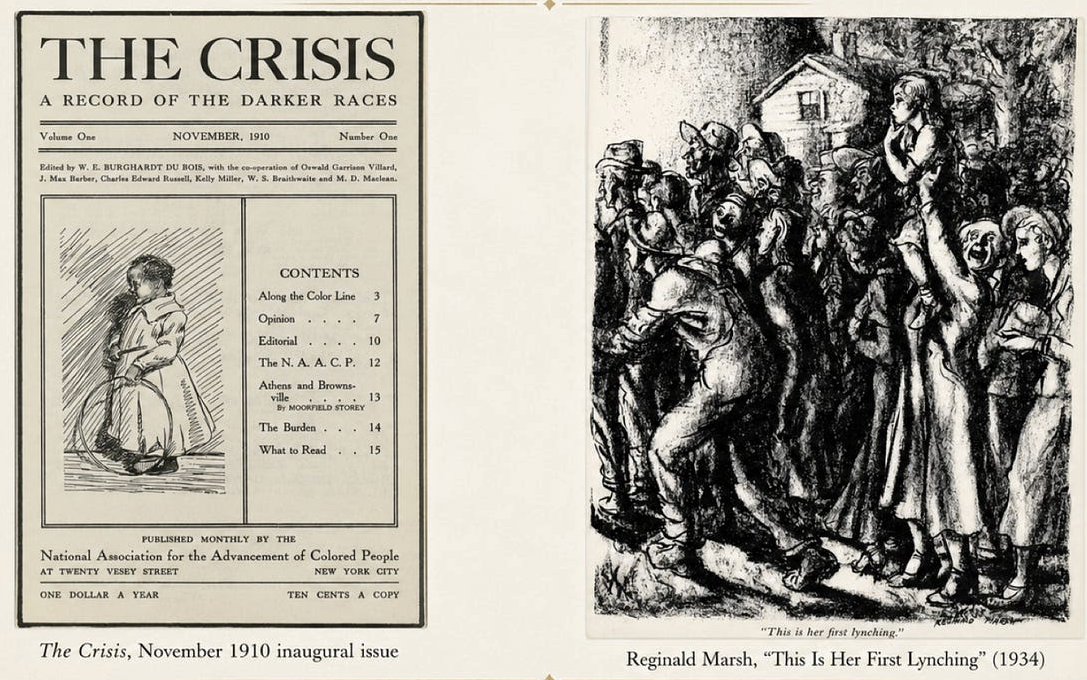
In the talk, I opened with two images: the cover of the inaugural November 1910 issue of The Crisis, edited by W. E. B. Du Bois, which placed a Black child at the center of a magazine devoted to confronting racial terror and white supremacy; and Reginald Marsh’s 1934 drawing, This Is Her First Lynching, which shows a white child being lifted above a crowd to witness racial terror as a civic ritual.
Those images make the argument many historians and journalists still avoid: children are not incidental to democracy. They are where democracy is either practiced or destroyed. Click the audio above to listen to the full paper.
Thanks for reading. If this piece resonated with you, then please consider becoming a paid subscriber. Paid subscriptions help keep my Substack unfiltered and ad free. They also help me raise money for HBCU journalism students who need laptops, DSLR cameras, tripods, mics, lights, software, travel funds for conferences and reporting trips, and food from our pantry. You can also follow me on Facebook!
We appreciate you!