



White people love a hanging. And if the victim is a Black child, even better. If those words make you uncomfortable, good. They should. Because Florida just reminded us why.
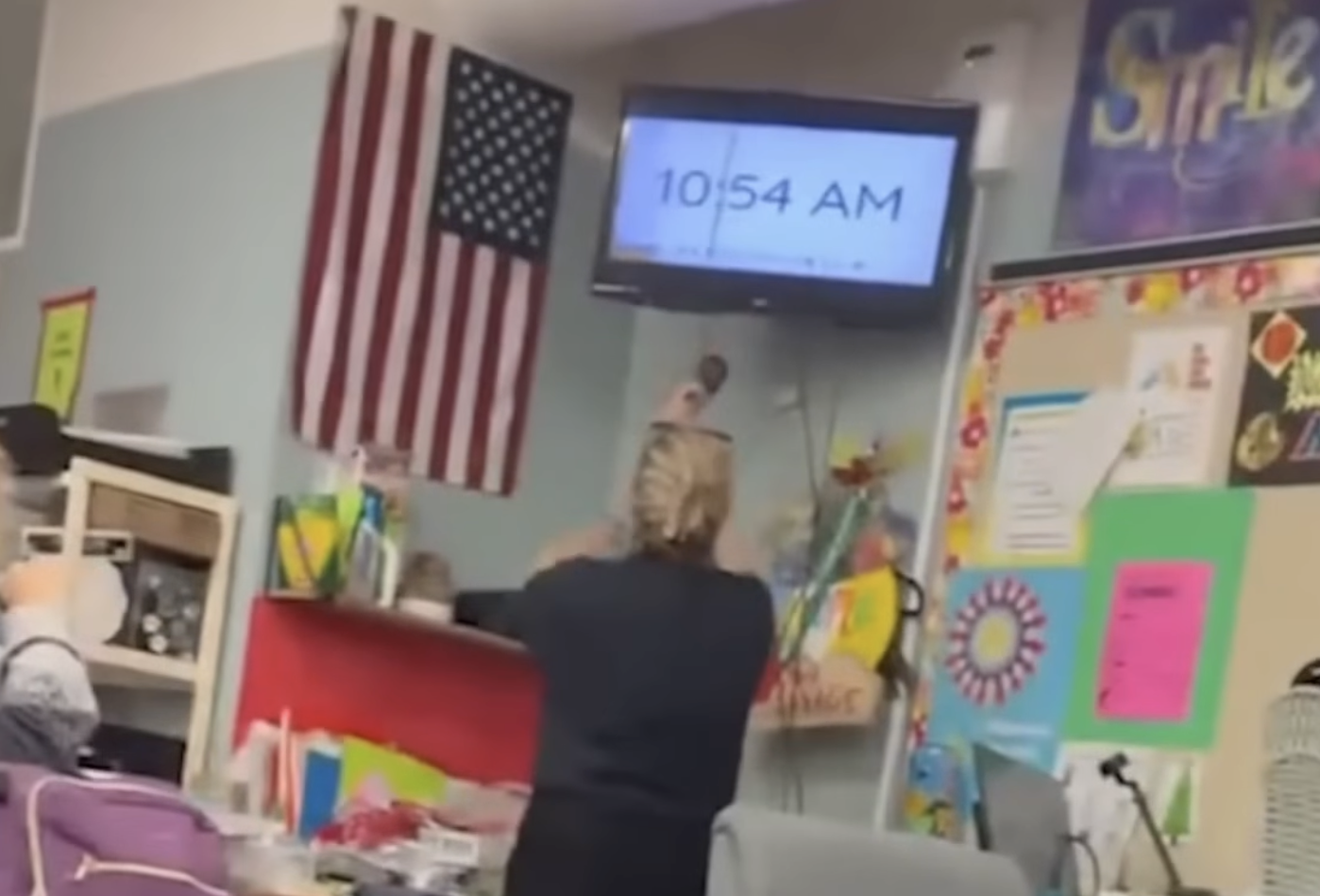
A Barrington Middle School teacher in Hillsborough County, Florida, was removed from campus after a viral video showed her hanging a Black baby doll by a cord from a classroom TV while middle school students watched. When the students objected and called it racist, she reportedly said it was “just a joke.” But this is not random, it ain’t isolated, not new, not merely offensive, not a “mistake,” and not a joke.
This wasn’t even the first time a Black doll has been turned into a lynching effigy in or around a school.
In 2017, at Coatesville Area High School in Pennsylvania, a dark-skinned baby doll was found hanging by a tie inside a locker room; officials called the incident “racially insensitive,” but not a hate crime, and local reporting described it as a “foolish crime” or prank.
At Roosevelt Middle School on Long Island in 2019, noose imagery was reportedly displayed in a classroom under the phrase “Back to school necklaces,” with CBS reporting that the image had allegedly been up for months.
In 2022, a white history teacher at Chicago’s Whitney Young Magnet High School was removed after he hung a Black doll by its neck from a cord at the front of his classroom and then argued with a Black colleague who objected. That same year, students at Saratoga High School in California found a Black doll hanging from a tree with a noose around its neck; authorities said a similar incident had happened at nearby Prospect High School, where another Black doll was tied to an exterior fence with rope around its neck.
The pattern keeps repeating: a Black doll, a rope or cord, a school space, a child audience, and then the rush to soften the violence with bureaucratic language. In each case, the Black body is symbolically hanged, the setting is educational, and the aftermath becomes a familiar American ritual of investigation, minimization, outrage, and institutional damage control.
Choosing a baby isn’t an accident. Because a baby is theeee purest symbol of innocence, dependence, and sacred vulnerability. They keep choosing baby dolls because the baby is the point. The image sends the message that Black life does not have to grow up, speak, resist, threaten, or even breathe before whiteness imagines it dangling from a noose.
That is why this latest Florida classroom incident cannot be treated as an isolated joke because it belongs to an archive.
That is the history people want buried beneath polite language like “incident,” “offensive display,” “poor judgment,” or “inappropriate classroom behavior.” But there was nothing vague about what happened. A Black child-body, even in doll form, was suspended by the neck in front of children. That image did not come from nowhere. It came from somewhere old and sadistic, somewhere practiced, and somewhere this country keeps pretending it has outgrown. This incident was a reenactment and a rehearsal.
In my forthcoming book, Strung Up: How White America Learned to Lynch Black Children, I argue that the lynching of Black children in America did not begin in this country. That violence crossed the Atlantic with white people who had already spent centuries teaching themselves how to turn white children’s pain into public spectacle, moral instruction, religious theater, civic punishment, and communal entertainment. Before white Americans gathered around trees, light posts, and bridges to watch Black children and adults be tortured, hanged, burned, castrated, photographed, and mocked, Europeans had already built cultures where children were whipped, mutilated, terrorized, executed, displayed, dissected, and trained to witness cruelty as a normal feature of public life.

Public hanging was not some spontaneous eruption of Southern barbarism. It was an inheritance, ritual, a public performance, and language of power learned over generations and then racialized with particular savagery in the colonies and the United States. White people did not arrive in America innocent and then suddenly invent the spectacle of racialized lynching. They brought with them a long history of anti-child violence, public punishment, religious sadism, and communal bloodlust. Then they aimed it at Black bodies, including infants and the unborn.
Which is why what happened inside a Hillsborough County, Florida, classroom in 2026 cannot be dismissed as a joke.
Now, I’m not trying to say that every white person is consciously eager to lynch Black children. I gotta write that sentence because somebody out there will say, “now wait a minute, not all white people . . .” I am not arguing that every white person is consciously eager to lynch Black children. I am arguing that white America has never fully deprogrammed itself from lynching as spectacle, discipline, warning, entertainment, and racial pedagogy.
White Americans have been “primed” to lynch as a result of conditioning, inherited symbols, cultural muscle memory, and reflex. The symbol of the noose is still available to that Florida teacher. The “joke” is still reachable to her. The Black child’s body is still imaginable as an object to hang, display, ridicule, and explain away. And the white adult can still perform the gesture in front of children and expect the room to understand it as humor rather than terror.
What went down in that classroom was a rehearsal. It was an old American reflex, an epigenetic tick. It was the visual grammar of lynching, miniaturized and performed before children in the year 2026, at the very moment this country is waging war against the teaching of slavery, Black history, racial violence, and anything else that might help children understand what they are looking at when whiteness shows its ass in public.
And that is the part we gotta sit with because the lie at the center of the anti-Black history movement is that white children must be protected from shame. But shame is not what these raicst people fear. Recognition is what they fear. They actually want to do this evil shit again!
They do not want children to know enough history to recognize the ritual when it returns. Nor do they want children to understand that a Black baby doll hanging by the neck is not random, not silly, not harmless, not a classroom gag gone wrong. It is an image with a lineage. They do not want children to know the history because they do not want young people to recognize the reenactment. They do not want children to have the language to say, “That is a lynching” and it belongs to a centuries-old grammar of white violence that has always depended on children watching, learning, laughing, obeying, and eventually participating.
The assault on history is not about protecting white children’s innocence. It is about preserving their ignorance and making sure they do not learn enough to interrupt the next ritual. It is about hiding slavery, resistance, rebellion, Nat Turner, John Brown, Harriet Tubman, Ida B. Wells, and all the children who were sold, whipped, hanged, burned, experimented on, disappeared, and buried under the national myth. It is about raising children who can look at a Black baby hanging from a cord and wait for an adult to tell them whether it is racist.
Folks need to understand that white supremacy does not only live in law books, campaign slogans, hateful words, Confederate flags, police departments, court rulings, or school board meetings. It lives in reflex, gesture, subconscious, and breath. It lives in the body and the nervous system of a culture that has spent centuries turning Black suffering into spectacle and then calling that spectacle entertainment, law and order, justice, Christian, tradition, and jokes.
Lynching was never just the act of killing. It was performance, classroom pedagogy, communal bonding, and yes, an expression of love between white parents and children. It was children being lifted onto shoulders to see Black bodies burn. It was pregnant white women caressing their pregnant bellies or nursing their newborns while attending lynchings.
It was postcards, souvenirs, jokes, songs, newspaper write-ups, picnic baskets, sermons, photographs, and white families teaching their children that Black pain was public property. The mob did not only murder the person at the center of the spectacle. It trained the children around the spectacle and built moral numbness into them. It taught them what to feel, what not to feel, when to laugh, when to look away, and when to call terror a joke.
So when a white teacher in 2026 hangs a Black baby doll in a classroom and calls it funny, we are not looking at an isolated lapse in judgment. We are looking at the survival of an old impulse.
But those students in that classroom give me hope! Because they didn’t just sit there and absorb the spectacle in silence. They did not wait for an adult to tell them whether a Black baby doll hanging by the neck was racist. They knew and named it. They objected!
And a special shout out belongs to Noah, the 14-year-old student who picked up his cell phone and recorded what was happening. That godling understood the assignment better than half the adults who will now try to explain this away. He knew that witnessing was not enough. He needed proof because children who tell the truth about racism learn early that the truth alone is often not enough when racist adults are involved.
What Noah did was not just “record a video.” He interrupted the old ritual. Lynching has always depended on spectators, on people watching and participating, on the crowd becoming part of the violence and children normalizing the terror because their brains are not yet developed enough to understand barbarism. But Noah turned the gaze around. He used the camera not to preserve the spectacle for pleasure, like lynching postcards once did, but to expose it, indict it, and make sure the adult in the room could not disappear behind intent, innocence, or “I was only joking.”
In a country trying desperately to hide Black history from children, these children recognized history when it entered the classroom with a cord in its hand. And they refused to play along. That is the subversive part that Trump and his MAGATs absolutely loathe. The children had already learned enough somewhere, either from their parents, their own moral sense, or from the culture despite the bans, to know that what they were seeing was wrong.
Jokes have histories, ancestors, and bodies beneath them. The lynching joke is one of America’s oldest forms of confession. It tells us what a culture has not healed from, what it has not repented for, what it still finds available for laughter. And when the joke is a Black child hanging from a cord, what we are hearing is the afterlife of the mob, the old pleasure still twitching in the culture, and the old impulse rehearsing itself in public and reminding us what it has done before and what evil it is still primed to do again.
Thanks for reading. If this piece resonated with you, then please consider becoming a paid subscriber. Paid subscriptions help keep my Substack unfiltered and ad free. They also help me raise money for HBCU journalism students who need laptops, DSLR cameras, tripods, mics, lights, software, travel funds for conferences and reporting trips, and food from our pantry. You can also follow me on Facebook!
We appreciate you!