


Governor Tim Walz asked a question that does not belong in a press conference. It belongs to a conscience.
“Do you have no decency?”
It is the kind of line that cuts through the usual noise because it is not about policy points or partisan advantage. It is about the moral boundary that keeps power from becoming a threat. It is about whether people who wield authority still remember that their job is to protect human life, not gamble with it. And it is about whether the rest of us are willing to accept cruelty as normal, as long as it comes wrapped in the language of enforcement.
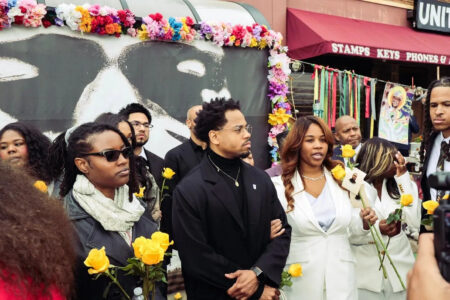
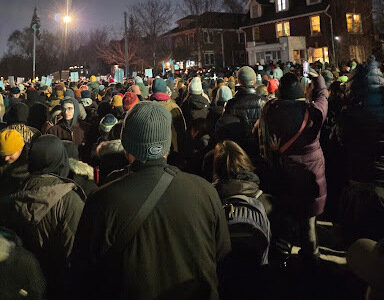
On this same night, I went to the vigil because I could not stay home. The anger did not feel abstract. It felt physical. The grief arrived with weight. And the fear, the kind that makes a community feel watched and cornered, was present in the way people held their shoulders, in the way they checked their phones, in the way they scanned for movement at the edge of the crowd.
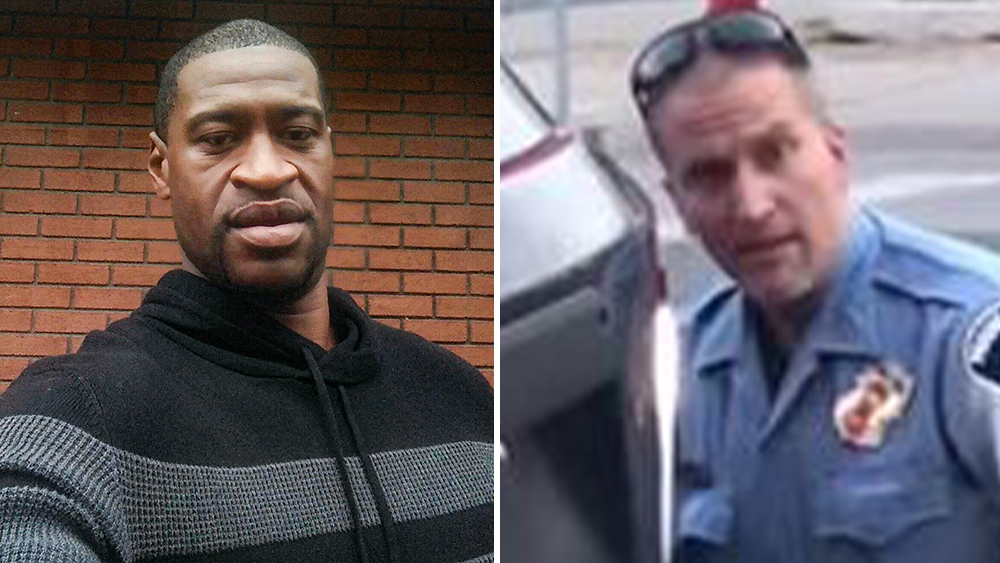
We were four blocks from where George Floyd was killed.
That fact is not a comparison. It is a reminder. It is the geography of Minnesota’s modern moral memory. Place remembers what power looks like when it stops being restrained. And when something happens this close to a site that already changed the world, the question is not only what happened, but also what we are becoming.
A community elder named Blanca said it plainly: “We are blocks away from where George Floyd was murdered. And that is not an accident, it’s a reminder that we did not finish the job when he was murdered.” Then she said the words that landed like a verdict, not on a legal case, but on a moral one: “Like others have said, this was another modern day lynching.”
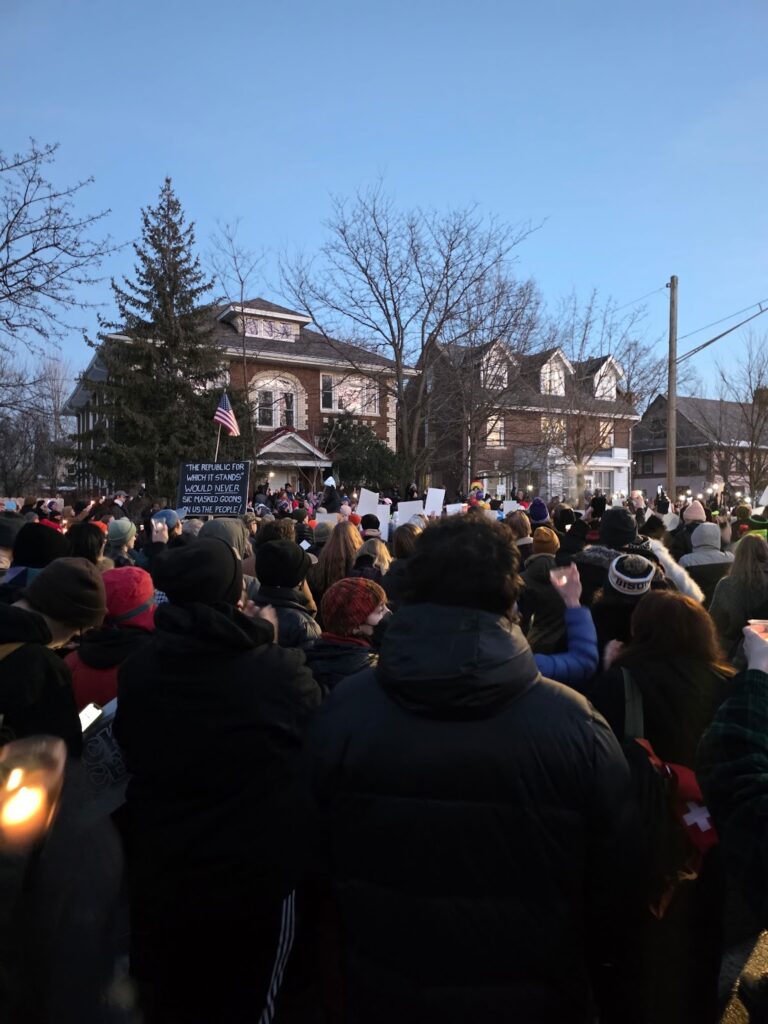
When a resident uses language that heavy, you do not treat it as rhetorical heat. You treat it as testimony. It is how people describe what it feels like to be on the receiving end of force that they believe was unnecessary, force that they believe was justified too quickly, force that leaves a body behind and then demands the public move on.
Walz’s question is a response to that feeling, not because it answers it, but because it names the line that has been crossed.
Decency is not a soft virtue. Decency is a hard boundary. It is restraint when a situation is volatile. It is humility when facts are still emerging. It is the refusal to turn a person’s death into a narrative contest. It is an insistence that authority does not equal righteousness. It is the discipline of power.
And on Wednesday evening, Secretary of Homeland Security Kristi Noem came to Minnesota to deliver the federal government’s official account. She said a “mob of agitators” surrounded federal agents, that Renee Nicole Good “weaponized her vehicle” and attempted to run a law enforcement officer over, and that an ICE agent fired “defensive shots” in response. Noem said the agent was struck by the vehicle, treated at a hospital and later released.
Those details may become part of an investigation and courtroom filings. But the larger point is already clear to anyone who has watched communities like this live through the gap between lived experience and official language. Words are how force is made to sound like inevitability. Words are how tragedy becomes justification. Words are how fear gets treated as strategy and then repackaged as safety. That is why Walz’s question landed the way it did. “Do you have no decency?” is not a request for better messaging. It is a demand for moral restraint, for humility in the face of a human death, and for the discipline to let truth outrun instinct.
At the vigil, a civil rights attorney, Nakima Armstrong, urged people to keep their eyes on leadership, not just on the street. “Pay attention to which elected officials use their voice,” she said. “Let’s hold them accountable.”
That is the part that matters after the cameras leave. Accountability is not a feeling, it is a practice. It is asking who is willing to speak clearly when it is costly. It is noticing who hides behind safe language, who rushes to justify, who treats public fear like collateral damage.
If the misuse of government power thrives anywhere, it thrives in the fog, in the distance between a community’s lived experience and an official story that tries to outrun it. That is why the fight is never only about what happened in a single moment. It is about whether ordinary people still have the right to say, I saw what I saw, I felt what I felt, and I will not be talked out of reality.
The vigil was full of quiet anger, and it was full of clarity.
It was also full of care, the kind of care that rarely makes a headline, but tells you what decency looks like when institutions fail. Zachary, who was working the vigil, handed out gloves, warm tea and candles so people could stay warm enough to keep standing. “Our voices are heard and the community is supported and protected,” he told me.
This is the contrast I cannot stop thinking about.
On one side, power that insists on its own righteousness, even when its actions end in death. On the other, neighbors passing gloves hand to hand in the cold so the community can keep showing up for itself. One side treats fear as a tool. The other treats fear as something to be held, shared and refused.
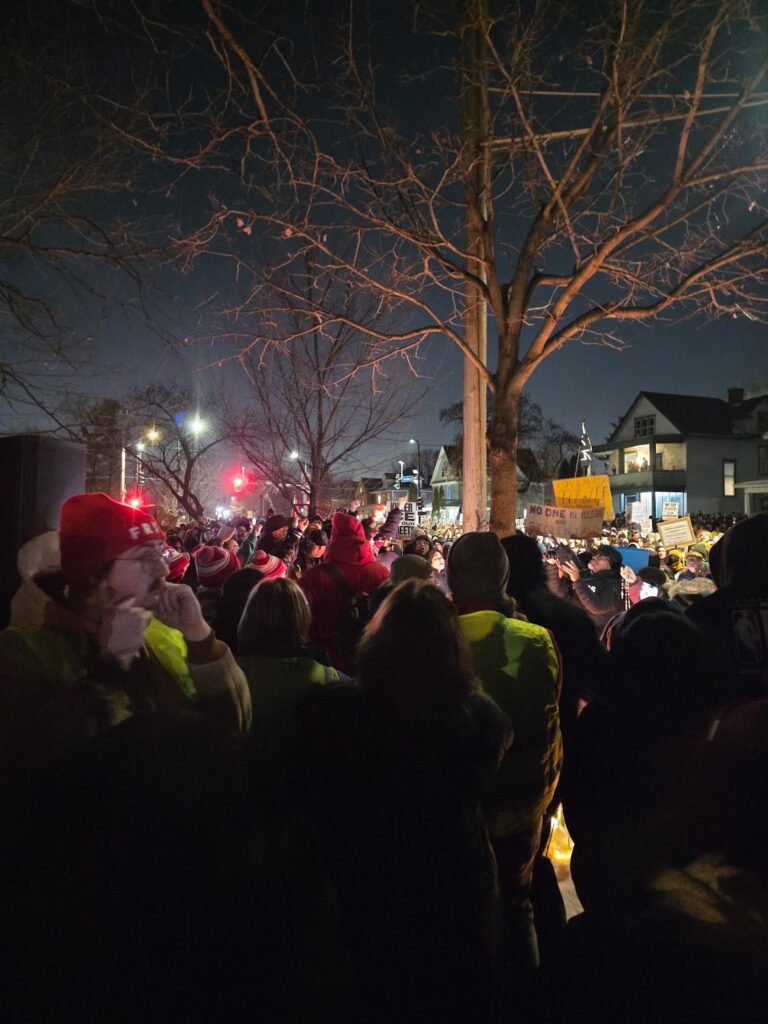
A high school student named Devin offered the kind of words that make you believe a community can survive its wounds. “The tragic end of Renee’s will brought us all here today,” he said. “But it would be more tragic if it was the end of us.”
That is what people were trying to protect tonight. Not just their anger, not just their grief, but their future. Their ability to remain human in a moment designed to harden them.
Four blocks from where George Floyd was killed, the nation and Minnesota are again standing at the edge of a moral choice. We can let fear become routine. We can let power become unrestrained. We can let the word “enforcement” serve as a blanket covering any act, no matter the cost.
Or we can insist, loudly and without apology, that government power must be restrained by truth, by humility and by the dignity of human life.
Walz’s question should not be rhetorical. It should be a standard.
Do you have no decency?