

Close Menu
TheHub.news

    This Day in History: October 3rd

    By TheHub.news Staff

    In Their Hands: Restoring Citizenships and Giving Fair Chances

    By Jeremy Busby

    ICE Is Still Targeting the Haitian Community in Springfield

    By TheHub.news Staff

    Subscribe to Updates

    Get the latest creative news from FooBar about art, design and business.

    X (Twitter) Instagram YouTube
    X (Twitter) Instagram YouTube
    TheHub.news
    Support Our Work
    • Home
    • Our Story
      • News & Views
        • Politics
        • Injustice
        • HBCUs
        • Watch
      • Food
        • Cuisine Noir
        • soulPhoodie
      • Passport Heavy
      • Travel
      • Diaspora
      • This Day
      • Entertainment
      • History
      • Art
      • Music
    • Health
    • Money

      Cashflow Coach: I Planted a Money Tree!

      August 4, 2026

      Breaking Down the 2 Different Types of Income

      July 7, 2026

      Black Americans Are Already Living Through a Recession

      July 6, 2026

      You Must Be an Owner to Win 

      June 23, 2026

      Economic Empowerment Has Always Been a Part of Black History

      February 12, 2026
    • Books
    • Business
    • Sports
      1. First and Pen
      2. View All

      DHS Shamelessly Uses Brian Dawkins Footage Without Permission to Tout Fear

      September 30, 2026

      Carlan Gay Traveled the World to Build a Sports Career Very Few Are Built to Forge

      September 25, 2026

      Texans’ Aziz Al-Shaair Shows How Humanity Can Exist in Sports

      September 22, 2026

      Jalen Brunson Launches Family-run Management Group

      September 18, 2026

      DHS Shamelessly Uses Brian Dawkins Footage Without Permission to Tout Fear

      September 30, 2026

      Carlan Gay Traveled the World to Build a Sports Career Very Few Are Built to Forge

      September 25, 2026

      Texans’ Aziz Al-Shaair Shows How Humanity Can Exist in Sports

      September 22, 2026

      Jalen Brunson Launches Family-run Management Group

      September 18, 2026
    • Tech
    • Podcasts
      1. Karen Hunter is Awesome
      2. Lurie Breaks it Down
      3. Human(ing) Well with Amber Cabral
      4. Financially Speaking
      5. In Class with Carr
      6. View All

      This Day in History: October 3rd

      October 3, 2026

      In Their Hands: Restoring Citizenships and Giving Fair Chances

      October 2, 2026

      ICE Is Still Targeting the Haitian Community in Springfield

      October 2, 2026

      Chicago’s Gary Comer Youth Center Grows Community With Urban Agriculture

      October 2, 2026

      This Day in History: October 3rd

      October 3, 2026

      In Their Hands: Restoring Citizenships and Giving Fair Chances

      October 2, 2026

      ICE Is Still Targeting the Haitian Community in Springfield

      October 2, 2026

      Chicago’s Gary Comer Youth Center Grows Community With Urban Agriculture

      October 2, 2026

      This Day in History: October 3rd

      October 3, 2026

      In Their Hands: Restoring Citizenships and Giving Fair Chances

      October 2, 2026

      ICE Is Still Targeting the Haitian Community in Springfield

      October 2, 2026

      Chicago’s Gary Comer Youth Center Grows Community With Urban Agriculture

      October 2, 2026

      This Day in History: October 3rd

      October 3, 2026

      In Their Hands: Restoring Citizenships and Giving Fair Chances

      October 2, 2026

      ICE Is Still Targeting the Haitian Community in Springfield

      October 2, 2026

      Chicago’s Gary Comer Youth Center Grows Community With Urban Agriculture

      October 2, 2026

      This Day in History: October 3rd

      October 3, 2026

      In Their Hands: Restoring Citizenships and Giving Fair Chances

      October 2, 2026

      ICE Is Still Targeting the Haitian Community in Springfield

      October 2, 2026

      Chicago’s Gary Comer Youth Center Grows Community With Urban Agriculture

      October 2, 2026

      Black Girl Vitamins’ New Podcast Is Creating Space for the Health Conversations Black Women Deserve

      September 30, 2026

      In Class with Carr: “Cross Colors”

      September 29, 2026

      In Class with Carr: Whose Labor? Which Stories?

      September 7, 2026

      In Class with Carr: King Me: Africana Governance and Purpose in a Changing World

      August 31, 2026
    TheHub.news
    Beauty

    Why Everyone Should Care About the History of Our Hair

    By Danielle BennettNovember 4, 20224 Mins Read
    Share Email Copy Link
    Image credit: ShutterStock
    Share
    Facebook Twitter LinkedIn Email Copy Link Threads

    As the owner of a hair salon that caters to Black businesswomen, one of the most fraught decisions my clients face before public appearances, major corporate events, or the first day in a new role, is what to do with their hair. 

    They don’t take these resolutions lightly. And although legislation against hair discrimination continues to gain traction, they are well aware of the nuanced penalties and scrutiny that still exist for “wrong hair choices” in the workplace. 

    Our chats become full-blown deliberations, more complex than the usual prep-at-bedtime rituals or tips on how to preserve their hair while at the gym. For them, choosing hairstyles that look and feel great, but can also fend off dehumanizing remarks from colleagues, remains a weighty task. 

    My clients know their hair gets a lot of attention; it always has and it always will. And while they understand the influence of its natural beauty, they also recognize how others might see it as a constant source of threat, pain and fear.

    The story of our hair starts with a marvelously civilized-turned-savage history.

    In ancient African societies (as far back as the 15th century), Black hair was an important symbol of identity. In the book, Hair Story: Untangling the Roots of Black Hair in America, authors Ayana D. Byrd and Lori L. Tharps explain how it was a strong indicator of tradition and pride. Africans used it to communicate significant attributes about themselves like tribal affiliation, social status, leadership roles and language.  There was never a time when one’s hair was not done. In fact, someone would be considered ill if their hair wasn’t specifically styled.

    However, during the trans-Atlantic slave trade, this rich heritage, along with its proud, visual aspects was erased…and new symbolism was imposed onto Black hair, specifically by white slave owners.

    Upon their capture and prior to boarding slave ships, the heads of enslaved Africans were shaved by slave owners, a deliberate act to strip them of their respectability and place in society. The motivation and intent, to “break their spirits”, in order to control and render them inferior. The egregious, ongoing traumatic act (among many), is what started most of the negative stereotyping about how Black people present their hair…and why the generational damage and pain that encompasses it still exists for many of us today.
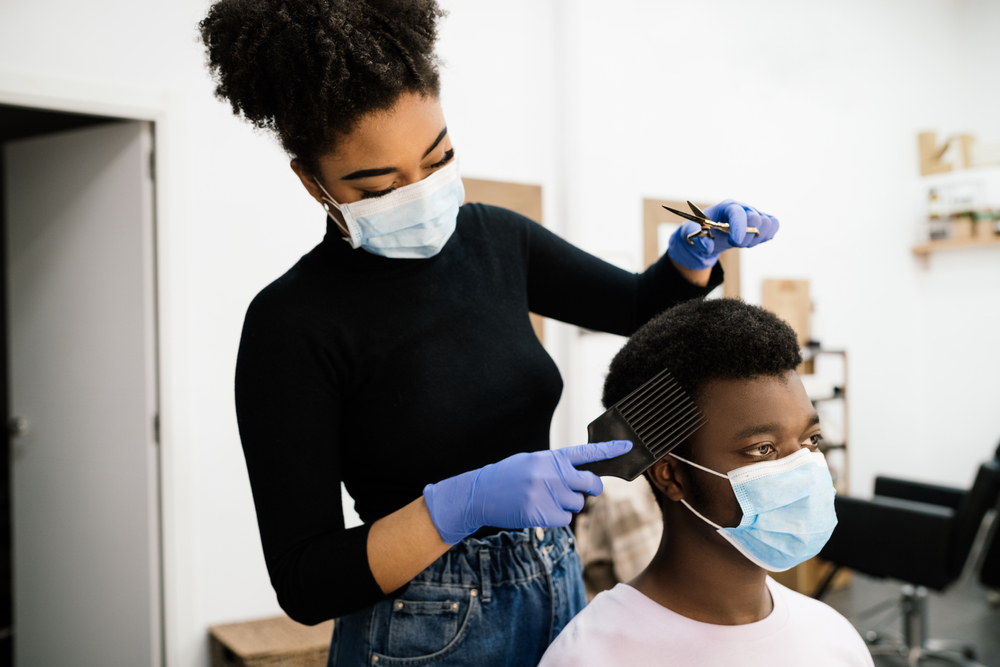
    Image Credit: ShutterStock

    The self-hatred surrounding hair existed in white communities first.

    In The Paper Bag Principle: Of the Myth and the Motion of Colorism (a study written by Audrey Elisa Kerr, a professor of English Literature at Southern Connecticut State University, published by the Journal of American Folklore), during slavery, social and political hierarchies were evident among slave owners. Those with greater wealth sought to purchase slaves with more European-like features and hair because they prioritized white women with fair skin and straight hair over the whites who didn’t possess the same distinctions.  

    This was a defining moment in Black hair history because the perspective was an extension of the colorism and texturism that already existed among whites themselves. 

    Straighter hair textures were an indicator of status among whites long before becoming a mark of prestige in Black communities. And according to a study by the Journal of Social Cognitive and Affective Neuroscience, these narrowly defined standards of beauty and prominence continue in white spaces today.

    Our hair is never “just hair”. 

    Whether it was used as a tool for survival (slaves cornrowed maps of escape routes to freedom into their hair when writing and drawing was risky), empowerment (launching a legacy of Black commerce and economic independence, owing to hair care titans like Annie Turnbo Malone and Madam C.J. Walker), or resistance (worn as a symbol of activism and individualism by way of the Civil Rights and “Black is Beautiful” Movements of the 1960s), Black hair has a prolific and deep history of celebration and freedom.

    At the same time, it is burdened with centuries-old, historically racist injustices; many of which are at the hands of those who didn’t always look like us, but personally suffered from the very prejudices they projected onto us.

    So, when my clients express concern about the prospects of having their hair touched without consent or someone maligning its texture, it underscores the importance of why Black hair is all of society’s lessons to learn—not just ours.

    Thehub.news
    Danielle Bennett
    • Instagram

    Danielle Bennett, a hairstylist of 20 years, is the owner of The Executive Lounge, a hair salon that caters to businesswomen, located in the Chelsea neighborhood of New York City. She specializes in natural hair care, haircuts, color, hair weaving and is certified in non-surgical hair replacement. Danielle partners with her clients to provide customized services, while she pampers them with luxury products and professional, private accommodations. “The Executive Lounge is your home away from home; it is a tranquil, modern sanctuary where you matter. Your time is valued and your opinion counts. Why? Because you deserve it.” - Danielle Bennett

    Related Stories

    George E. Johnson, Pioneering Founder of ‘Afro Sheen,’ Has Written His Memoir at 97

    February 13, 2025

    These Black-founded Brands Disrupted the Last 10 Years of the Beauty Industry

    August 17, 2023

    Experts Explain Why Iron Deficiency Could Be a Main Cause of Hair Loss in African Americans

    May 3, 2023

    P&G Acquires Black-owned Haircare Company, Mielle Organics

    January 12, 2023

    Why Hair Salons Are Still One of the Most Segregated Spaces in America

    December 8, 2022

    Beauty Is Never Skin Deep: Why Texturism Continues to Assign Privilege

    November 17, 2022
    Recent Posts
    • This Day in History: October 3rd
    • In Their Hands: Restoring Citizenships and Giving Fair Chances
    • ICE Is Still Targeting the Haitian Community in Springfield
    • Chicago’s Gary Comer Youth Center Grows Community With Urban Agriculture
    • Did You Know the West African Nation of Guinea Was Declared Independent on This Day?

    This Day in History: October 3rd

    By TheHub.news Staff

    In Their Hands: Restoring Citizenships and Giving Fair Chances

    By Jeremy Busby

    ICE Is Still Targeting the Haitian Community in Springfield

    By TheHub.news Staff

    Chicago’s Gary Comer Youth Center Grows Community With Urban Agriculture

    By Ayara Pommells

    Subscribe to Updates

    A free newsletter delivering stories that matter straight to your inbox.

    About
    About

    TheHub.news is a storytelling and news platform committed to telling our stories through our lens. With facts at the center, we document the lived reality of our experience globally—our progress, our challenges, and our impact—without distortion, dilution, or apology.

    X (Twitter) Instagram YouTube

    This Day in History: October 3rd

    By TheHub.news Staff

    In Their Hands: Restoring Citizenships and Giving Fair Chances

    By Jeremy Busby

    ICE Is Still Targeting the Haitian Community in Springfield

    By TheHub.news Staff

    Chicago’s Gary Comer Youth Center Grows Community With Urban Agriculture

    By Ayara Pommells

    Subscribe to Updates

    A free newsletter delivering stories that matter straight to your inbox.

    © 2026 TheHub.news A 501(c)(3) tax-exempt organization.

    Type above and press Enter to search. Press Esc to cancel.