

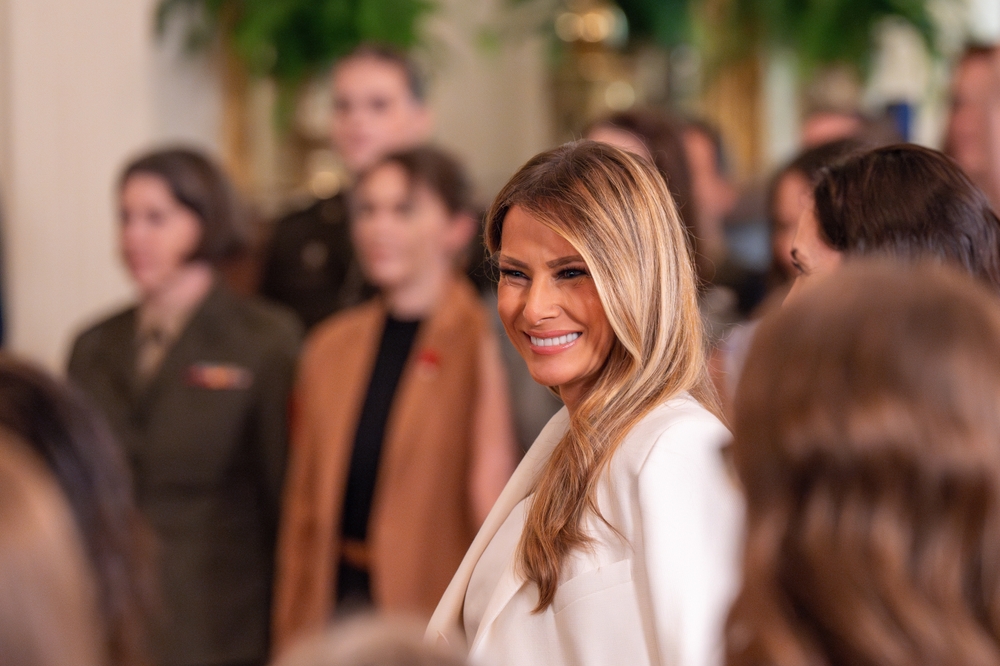
The box office numbers weren’t the most interesting part of that Melania documentary. The audience was. Because audiences don’t just choose stories. They choose reflections.
Long before opening weekend, this documentary had already been engineered to make people feel something, whether that feeling was curiosity, mockery, loyalty, or cultural defiance. The rollout was glossy, expensive as hell, and impossible to ignore.
The trailers leaned hard into her mystique and aesthetic control. The marketing machine treated it less like a documentary and more like an event. Social media did what social media always does when power and spectacle collide. The memes flew immediately. TikTok dragged the trailer. Folks joked that it would be two hours of couture, silence, and controlled blinking. Somebody on my Facebook feed said she’d rather get a pap smear by Edward Scissorhands than go see the film. Critics pre-wrote their skepticism. Industry analysts predicted a modest opening and treated it like a niche political curiosity.
And underneath all of that noise, something more interesting was happening. The jokes, the eye-rolls, snark, and the pre-release predictions created the kind of polarized attention that modern media ecosystems thrive on. People weren’t just deciding whether they wanted to watch the documentary. They were deciding what watching it would mean.
Was it political loyalty? Was it curiosity? Was it hate-watching? Was it cultural signaling? By the time opening weekend arrived, the documentary wasn’t just a film release. It was a cultural inkblot test, and everybody already knew which side they were supposed to see.
And then opening weekend hit.
The documentary pulled in roughly $7 million domestically, which was well above what analysts had predicted for a political documentary that most critics had already written off.
On the right, the reaction was immediate and celebratory. Conservative commentators framed the turnout as proof that “real America” was still paying attention, still showing up, still rejecting what they framed as elite media snobbery. Some right-wing media figures pointed to the strong audience score and treated it like vindication and proof that critics were out of touch, proof that cultural gatekeepers no longer controlled what people valued, proof that audiences were “finally” choosing their own heroes.
You saw the familiar culture-war script unfold in real time: critics hate it, therefore it must be important. Critics mock it, therefore it must be threatening. Critics dismiss it, therefore it must belong to “the people.”
Meanwhile, critics and much of mainstream cultural media did the opposite. Reviews ranged from bored to brutal. Some called it airbrushed. Some called it empty. Some called it expensive propaganda wrapped in soft lighting and designer fabric. The common thread was that it revealed almost nothing new either emotionally, politically, or historically about a woman who has built her entire public brand on revealing almost nothing at all.
And then the audience data started coming in, Y’all.
Once the dust settled, once the memes cooled down, once critics finished dragging the film, the audience numbers told a story that was much harder to laugh off. The turnout wasn’t random and it wasn’t scattered curiosity. It wasn’t a broad cross-section of Americans watching out of vague interest. It was a concentrated turnout: three-quarters white, majority female, and largely over age fifty-five.
And that’s when the headlines started changing tone. Suddenly this wasn’t just a box office story. It became a demographic story. A cultural story. A “what does this mean?” story. Outlet after outlet circled the same observation with slightly different language: older white women showed up, and they showed up strong. In markets like Dallas, Tampa, Orlando, Phoenix, West Palm Beach, and Atlanta. These are places that sit right at the intersection of white suburban wealth, conservative media saturation, and performance-driven femininity culture.
And that’s when the snark got quieter. Because it’s one thing to mock a documentary. It’s another thing to have to explain why a very specific demographic turned out for a very specific story about a very specific woman standing next to a very specific kind of white male power. Once you see that pattern, it stops looking like curiosity and starts looking like recognition.
White women don’t just randomly mobilize culturally at scale without somethin’ deeper pulling on identity, memory, and survival scripts that run older than this documentary, older than this presidency, and older than most of the commentary pretending this was just about aesthetics or culture-war fandom. And this is where a lot of the coverage started to get visibly uncomfortable, because describing who showed up is easy. But explaining why they recognized themselves in what they were watching is much harder.
Most of the stories about the turnout of older white women stayed safely on the surface. They framed these women as fans of elegance, mystique, traditional femininity, or simply loyal members of a political base showing cultural solidarity. Some suggested nostalgia. Some leaned on lifestyle aesthetics. Others reduced it to partisan identity, as if this were just another data point in a never-ending red-versus-blue spreadsheet. The tone ranged from mildly fascinated to lightly mocking to analytically detached, but almost all of it stopped short of asking what emotional or psychological need for so many white women was being met by this particular story at this particular moment.
What they didn’t say is just as revealing.
They didn’t talk about white women’s proximity to power as a survival strategy. They didn’t talk about how often American culture teaches women, especially white women, that stability comes from aligning with power rather than challenging it. They didn’t talk about how generations of women have been socialized to measure safety, status, and even self-worth through their relationship to powerful men, even when those men are volatile, cruel, racist, sexual predators, or otherwise morally compromised. They didn’t talk about the long history of women navigating systems where speaking out carried real material risk. And they definitely didn’t talk about how cultural consumption can function as emotional rehearsal and as a way to process your own life through somebody else’s public narrative.
This is why I love and teach media literacy. Because if you only read coverage at the level of “who showed up,” then you miss the deeper question of “why this story felt familiar.” Media literacy ain’t just about spotting bias or misinformation. It’s also about recognizing when reporting stops at description instead of moving into interpretation. It’s about noticing when cultural phenomena get flattened into demographics instead of examined as reflections of deeper social conditioning, power structures, and identity scripts. It’s about understanding that media doesn’t just tell us what happened, it tells us what a culture is willing, and unwilling, to say about itself.
And sometimes, what a culture refuses to say out loud is the most important part of the story.
So, what were so many white women watching in that documentary?
Strip away the polite media language, the demographic curiosity framing, and the lifestyle explanations about elegance and mystique, and something much more uncomfortable comes into focus. It wasn’t just the glamour and mystique. They weren’t just watching couture and lighting and curated stillness. They were watching a woman who appears to have learned how to remain materially secure and socially protected while standing next to volatile white male power. They were watching a version of survival that looks controlled instead of chaotic, polished instead of desperate, elevated instead of trapped.
But if you go one layer deeper, they were also watching a woman who seemed to answer questions many of them have been taught not to ask out loud. How do you stay safe next to a man whose anger fills a room? How do you maintain status when the person tied to your stability is also capable of cruelty? How do you keep your life intact when the system that protects you is the same cruel system hurting other people? How do you convince yourself that proximity to power is the same thing as having power?
Because for many white women, the documentary was not just about Melania. It was about witnessing a woman who appears to have mastered the art of emotional containment inside male dominance. It was about watching what it looks like to stand next to a man who is feared, hated, or controversial and still move through the world with protection, wealth, and social insulation intact.
And at a moment in American history where many white women are living alongside white men who are angrier, more radicalized, more openly hostile to demographic change, more resentful of women’s autonomy, more vulnerable to extremist pipelines, and more comfortable expressing racist or misogynistic ideas out loud, that image carries enormous psychological weight. Because it raises a quiet, dangerous question: If this is what white male power looks like now, what does survival next to it require?
Some white women were watching for reassurance. Reassurance that you can stand next to cruelty and still be safe. Reassurance that you can stay aligned with power and still be socially rewarded. Reassurance that you can benefit from a system without having to confront everything it does.
Some white were watching for instruction. Maybe not consciously in some cartoony villain way. But in the way people watch other people navigate systems they themselves are trapped inside. How do you keep your marriage intact? How do you keep your social circle intact? How do you keep your financial life intact? How do you keep from becoming collateral damage when the man closest to you is moving through the world fueled by grievance and fear?
And some white women were watching for permission. Permission to believe that survival inside proximity to harmful power is not weakness or complicity, but survival strategy. They wanted permission to believe that staying is intelligence and silence is dignity. And, that stability is worth the moral cost.
That is why this cultural moment matters. Because what people choose to watch is often less about curiosity and more about self-recognition. And at a moment when white male grievance politics is reshaping laws, culture, and everyday life, watching a woman who appears to remain protected inside that power structure can feel less like entertainment and more like preparation.
Because a visible segment of white male political energy is operating like it is running out of time and they’re trying to claw back control of a country that is becoming more diverse, more pluralistic, and less automatically centered on white male dominance. You see it in the MAGA rhetoric about “taking the country back,” in replacement panic, in attacks on reproductive rights, in escalating hostility toward immigrants, queer people, and Black political power. And when power structures move into that kind of defensive escalation, the people tied to them start asking a quieter question: how do you survive the fallout?
That’s where Melania takes on symbolic weight.
Because, intentionally or not, she represents a template for surviving proximity to volatile power. How to stand next to grievance-fueled dominance and remain materially secure, socially insulated, and publicly composed. How to reveal almost nothing. How to let power rage outward while you stay protected by distance, silence, and control.
And at a moment when many white women are watching men in their own lives get pulled deeper into grievance politics, demographic panic, and authoritarian nostalgia, that template becomes legible. Not aspirational but functional. Because the unspoken fear is that if white male power escalates, or destabilizes, what happens to the people tied to it?
That’s why the film turnout data matters. Because sometimes people don’t show up to watch a story. They show up to study what survival might look like if the world they have always known starts cracking underneath them.
History teaches us that empires don’t just teach men how to rule. They teach women how to live beside what ruling requires. And every era teaches its women how to survive the men who rule it, and how to keep loving them long after they reveal their cruelty.
Thanks for reading. If this piece resonated with you, then please consider becoming a paid subscriber. Paid subscriptions help keep my Substack unfiltered and ad free. They also help me raise money for HBCU journalism students who need laptops, DSLR cameras, tripods, mics, lights, software, travel funds for conferences and reporting trips, and food from our pantry. You can also follow me on Facebook!
We appreciate you!