



Close Menu
TheHub.news
    Karen Hunter

    Karen Hunter’s Black History Month Lesson Starts With the Light Switch

    By TheHub.news Staff

    Theaster Gates: Art as Practice, Philosophy and Community Repair

    By Dr. Rev Otis Moss III

    This Day in History: February 15th

    By TheHub.news Staff

    Subscribe to Updates

    Get the latest creative news from FooBar about art, design and business.

    X (Twitter) Instagram YouTube
    X (Twitter) Instagram YouTube
    TheHub.news
    Support Our Work
    • Home
    • Our Story
      • News & Views
        • Politics
        • Injustice
        • HBCUs
        • Watch
      • Food
        • Cuisine Noir
        • soulPhoodie
      • Passport Heavy
      • Travel
      • Diaspora
      • This Day
      • Entertainment
      • History
      • Art
      • Music
    • Health
    • Money
      1. Copper2Cotton
      2. View All

      How to Fight Inflation and Win

      December 9, 2025

      August 2018 Net Worth Update

      December 9, 2025

      Dividend Update: August 2018

      December 9, 2025
      Passive Income

      Be Passive About Your $

      November 17, 2025

      Economic Empowerment Has Always Been a Part of Black History

      February 12, 2026

      How to Fight Inflation and Win

      December 9, 2025

      August 2018 Net Worth Update

      December 9, 2025

      More Blacks Needed On Corporate Boards

      December 9, 2025
    • Books
    • Business
    • Sports
      1. First and Pen
      2. View All

      Bad Bunny Gave Us All a Musical Lesson to Enjoy And Learn From

      February 12, 2026

      Brian Flores Was Right But the Issue Is Not for Black Coaches to Fix

      February 3, 2026

      Fritz Pollard Alliance Issues Statement on ICE in Minnesota

      January 28, 2026

      Where Is the Black Athlete Anger for Lane Kiffin’s “Make Baton Rouge Great” Post?

      January 28, 2026

      Bad Bunny Gave Us All a Musical Lesson to Enjoy And Learn From

      February 12, 2026

      Brian Flores Was Right But the Issue Is Not for Black Coaches to Fix

      February 3, 2026

      Sandra Idehen Named League One Volleyball’s First Commissioner

      February 2, 2026

      To Protect and Serve…I Guess?!?

      January 30, 2026
    • Tech
    • Podcasts
      1. Karen Hunter is Awesome
      2. Lurie Breaks it Down
      3. Human(ing) Well with Amber Cabral
      4. Financially Speaking
      5. In Class with Carr
      6. View All
      Karen Hunter

      Karen Hunter’s Black History Month Lesson Starts With the Light Switch

      February 15, 2026

      Theaster Gates: Art as Practice, Philosophy and Community Repair

      February 15, 2026

      This Day in History: February 15th

      February 15, 2026

      Jackie Ormes: Reframing Black Life in Ink

      February 14, 2026
      Karen Hunter

      Karen Hunter’s Black History Month Lesson Starts With the Light Switch

      February 15, 2026

      Theaster Gates: Art as Practice, Philosophy and Community Repair

      February 15, 2026

      This Day in History: February 15th

      February 15, 2026

      Jackie Ormes: Reframing Black Life in Ink

      February 14, 2026
      Karen Hunter

      Karen Hunter’s Black History Month Lesson Starts With the Light Switch

      February 15, 2026

      Theaster Gates: Art as Practice, Philosophy and Community Repair

      February 15, 2026

      This Day in History: February 15th

      February 15, 2026

      Jackie Ormes: Reframing Black Life in Ink

      February 14, 2026
      Karen Hunter

      Karen Hunter’s Black History Month Lesson Starts With the Light Switch

      February 15, 2026

      Theaster Gates: Art as Practice, Philosophy and Community Repair

      February 15, 2026

      This Day in History: February 15th

      February 15, 2026

      Jackie Ormes: Reframing Black Life in Ink

      February 14, 2026
      Karen Hunter

      Karen Hunter’s Black History Month Lesson Starts With the Light Switch

      February 15, 2026

      Theaster Gates: Art as Practice, Philosophy and Community Repair

      February 15, 2026

      This Day in History: February 15th

      February 15, 2026

      Jackie Ormes: Reframing Black Life in Ink

      February 14, 2026

      In Class with Carr: Black History in Times of Trouble

      February 2, 2026

      The Rise of the “Righteous Whites” and the Collapse of Plausible Deniability

      January 24, 2026

      How Insurers Use Your ZIP Code and Credit Score Against You

      January 21, 2026

      In Class With Carr: New World Order

      January 19, 2026
    TheHub.news
    Health

    The Most Common Skin Disease in Our Community We Don’t Know We Have

    By Danielle BennettSeptember 27, 20237 Mins Read
    Share Email Copy Link
    Image credit: ShutterStock
    Share
    Facebook Twitter LinkedIn Email Copy Link Threads

    With seasonably colder months fast approaching, dealing with dry, itchy skin every now and then is common. But if you are one of the nearly 32 million Americans who have eczema, then you know there is a big difference between an occasional rough skin patch and living with the disease. 

    For many, managing eczema is tricky because the symptoms are sporadic. They range from mildly parched irritation in small, concentrated areas to widespread, unbearably painful inflammation. Flare-ups seem to magically appear overnight but will often take a heck of a lot longer to get under control. 

    And if your skin is melanin-rich, then the disease is even more troublesome for you than for others.  

    First of all, when it comes to dermatological education and research, Black skin is notoriously underrepresented, if not outright excluded. A study published in Social Science & Medicine—a peer-reviewed academic journal covering social science research on health—estimates that less than 5% of medical textbooks illustrate conditions on dark skin. Not only do these biases in literature make diagnosis and treatment difficult for doctors, but they also impose enormous barriers for us to recognize and advocate for skin concerns like eczema on our own.

    Also, despite the fact that eczema is one of the most common skin conditions we face in our community, the lack of awareness, representation and education are oftentimes why we inadvertently suffer for years. Nonetheless, they are also reasons why we at TheHub.news have decided to get the lowdown on the disease so we all understand how eczema shows up on our skin, as well as how it is diagnosed and treated.

    So, please keep reading to discover more about eczema from board-certified dermatologists with real experience in treating skin of color, and learn what you can do if you believe you have it.

    https://www.instagram.com/p/ClcbN7spzJS/?utm_source=ig_web_copy_link&igshid=MzRlODBiNWFlZA==

    What Exactly is Eczema?

    Also known as atopic dermatitis, eczema is a sort of umbrella term that encompasses a series of chronic skin conditions by which an overactive immune system creates a weakened skin barrier that triggers itchy, dry, scaly skin, blisters and skin infections.

    Doctors say the reason why eczema is complicated is because it does not present as the same across the board. In fact, there are several forms of the skin condition that vastly range in appearance and severity. It can appear as early as babyhood, usually showing up on the face, knees and elbow, and then, as we age, spread to varying parts of our bodies.

    View this post on Instagram

    A post shared by Cetaphil US (@cetaphilus)

    Why are Black People More Prone to Eczema? 

    According to dermatologists, more research is necessary to learn why eczema is more likely to affect Black people, but multiple scenarios such as environmental factors and genetic traits, play significant roles for us. “Some people are born with a genetic tendency to develop eczema,” says Caroline Robinson, MD, a Chicago-based, board-certified dermatologist and founder of Tone Dermatology to Women’s Health. “However it is not completely understood why some people develop a more severe form than others or when it develops.” 

    The MD further explains that in addition to strong familial traits, reports have also shown how exposure to certain chemicals, allergens and pollutants—dust and mold, for example—may also increase the likelihood of developing the disease and the risk of its severity because Black skin doesn’t retain as much water as white skin. So, for us, our natural predisposition for dry skin may also serve as a basis for why eczema is so common.

    What Does Eczema Look Like on Black Skin?

    As we Black folk come in a wide range of shades, experts describe how the appearance of eczema will vary based on skin tone. Boston-based dermatologist Dr. Uchenna R. Okereke agrees: “Eczema on Black skin presents itself as ashen gray, purple or violaceous, red-brown or dark brown,” she explains to InStyle. She also adds that while eczema is usually thought to appear as patches of dryness (scaling, crusting, scratches or thickening of the skin), it can also turn up in other forms. “It can appear as little bumps, papules, thickened plaques, lichenoides, or what we call a follicular presentation, and this presentation is more common in persons with darker skin tones.”

    View this post on Instagram

    A post shared by Uchenna R. Okereke, MD, FAAD (@urownskindoc)

    How Can You Treat Eczema in Black Skin?

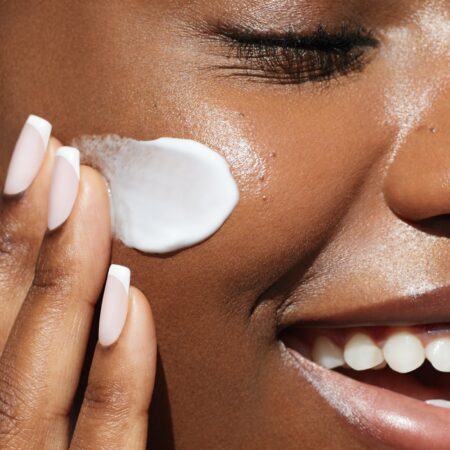
    There are several ways to treat eczema, but clinicians specify how they mostly depend on the severity of the case. At any rate, gentle skin cleansing and the liberal use of moisturizers is the mainstay of treatment. 

    “Moisturizers are one of the most important treatments,” says Laura Scott, MD, board-certified dermatologist and associate director of the Skin of Color division at the University of Miami Miller School of Medicine, per Women’s Health. “We need to restore lost water and seal it in, so thick creams or ointments are the backbone to any eczema treatment, as they can prevent flare ups.” 

    Both doctors warn that when it comes to additives such as fragrance, color and certain ingredients such as retinoids and alpha hydroxy acids, less is definitely more. These components have a tendency to dry out or irritate the skin, which, owing to weakened skin barriers, poses a problem for individuals with eczema. As a result, products like these tend to seep into the skin more easily, robbing the skin of its moisture. Emollient, over-the-counter products like Vanicream Moisturizing Cream or CeraVe Moisturizing Cream are safe, effective over-the-counter options. 

    “I utilize a combination approach in treating eczema which consists of medicated topical emollients, thick moisturizers, free and clear detergents, and gentle cleansers, such as Dove Irritation Care Body Wash,” Dr. Okereke shares. “It’s a fragrance-free body wash that cleanses and nourishes the skin with a thick, extra moisturizing lather that your skin will absolutely love.” 

    For more severe cases, she says a prescribed oral or injectable medication may be needed.

    Can Eczema Cause Additional Injury to the Skin?

    Seeing as Black people are inherently prone to dark spots and scarring, experts also caution against leaving eczema untreated because it can exacerbate post-inflammatory hyperpigmentation. The best way to remedy the issue is to immediately treat the affected area as soon as a flare-up begins so it addresses both problems without stirring up further irritation.

    “Oftentimes, the hyperpigmentation is more psychologically disturbing to the patient than the eczema flare,” explains Dr. Okereke. “It can last several months, even years.”

    However, if you are indeed dealing with both conditions altogether, she recommends over-the-counter products that contain gentle, moisture-rich ingredients such as Vitamin E or seek the assistance of a dermatologist for a more targeted treatment. Dr. Okereke elaborates: “Topicals that we utilize to treat hyperpigmentation such as hydroquinone, can potentially irritate the skin, therefore, a thoughtful plan is required to effectively manage both conditions without precipitating a flare-up.” 

    https://www.instagram.com/p/CmPqnuwy2bn/?utm_source=ig_web_copy_link&igshid=MzRlODBiNWFlZA==

    The Final Takeaway

    Although eczema is one of the most common skin diseases our community faces and navigating its challenges is because of the fact it’s mostly depicted on white skin – a main reason why so many of us don’t realize we are living with it – it is also important to remember that every dry patch that will appear on our skin is not an indicator of the disease. Doctors note that if the patches aren’t itchy, then an eczema diagnosis is unlikely. 

    In many cases, eczema is completely manageable with over-the-counter, mild, hydrating cleansers and moisturizers or by the use of specialized ointments or steroid creams. But it’s best to defer to a dermatologist as soon as you can if experience consistent itching in your dry patches. 

    Doctors also point out that food is rarely a trigger of eczema, but if you suspect your diet could be a contributing factor, then be sure to reach out to an allergist right away.


    Black skin Eczema skin disease skincare Thehub.news
    Danielle Bennett

    Danielle Bennett, a hairstylist of 20 years, is the owner of The Executive Lounge, a hair salon that caters to businesswomen, located in the Chelsea neighborhood of New York City. She specializes in natural hair care, haircuts, color, hair weaving and is certified in non-surgical hair replacement. Danielle partners with her clients to provide customized services, while she pampers them with luxury products and professional, private accommodations. “The Executive Lounge is your home away from home; it is a tranquil, modern sanctuary where you matter. Your time is valued and your opinion counts. Why? Because you deserve it.” - Danielle Bennett

    Related Stories

    Brownkind Founders Dr. Abhijit Desai, Dr. Gauri Desai Launch Beauty Brand for Melanin-rich Skin

    August 7, 2024

    Melanin Matters: The Black Skin Care Myths We Grew Up Believing

    January 10, 2024

    Watch Out for These Skin Complications If You Have Melanin-rich Skin

    November 8, 2023

    Changing the Face of Vitiligo: Why Is There Still So Much Stigma?

    September 6, 2023

    Collagen Is on the Rise

    January 18, 2023

    Ask The Good Doctor

    June 25, 2022
    Recent Posts
    • Karen Hunter’s Black History Month Lesson Starts With the Light Switch
    • Theaster Gates: Art as Practice, Philosophy and Community Repair
    • This Day in History: February 15th
    • Jackie Ormes: Reframing Black Life in Ink
    • The Real Reasons Why So Many White Women Watch That Melania Documentary
    Karen Hunter

    Karen Hunter’s Black History Month Lesson Starts With the Light Switch

    By TheHub.news Staff

    Theaster Gates: Art as Practice, Philosophy and Community Repair

    By Dr. Rev Otis Moss III

    This Day in History: February 15th

    By TheHub.news Staff

    Jackie Ormes: Reframing Black Life in Ink

    By Dr. Rev Otis Moss III

    Subscribe to Updates

    A free newsletter delivering stories that matter straight to your inbox.

    About
    About

    TheHub.news is a storytelling and news platform committed to telling our stories through our lens.With unapologetic facts at the center, we document the lived reality of our experience globally—our progress, our challenges, and our impact—without distortion, dilution, or apology.

    X (Twitter) Instagram YouTube
    Karen Hunter

    Karen Hunter’s Black History Month Lesson Starts With the Light Switch

    By TheHub.news Staff

    Theaster Gates: Art as Practice, Philosophy and Community Repair

    By Dr. Rev Otis Moss III

    This Day in History: February 15th

    By TheHub.news Staff

    Jackie Ormes: Reframing Black Life in Ink

    By Dr. Rev Otis Moss III

    Subscribe to Updates

    A free newsletter delivering stories that matter straight to your inbox.

    © 2026 TheHub.news A 501(c)(3) tax-exempt organization.

    Type above and press Enter to search. Press Esc to cancel.