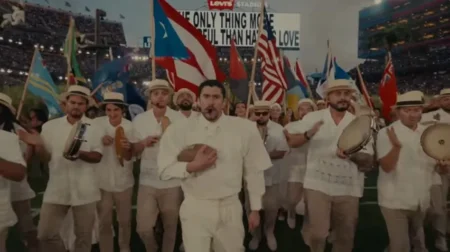
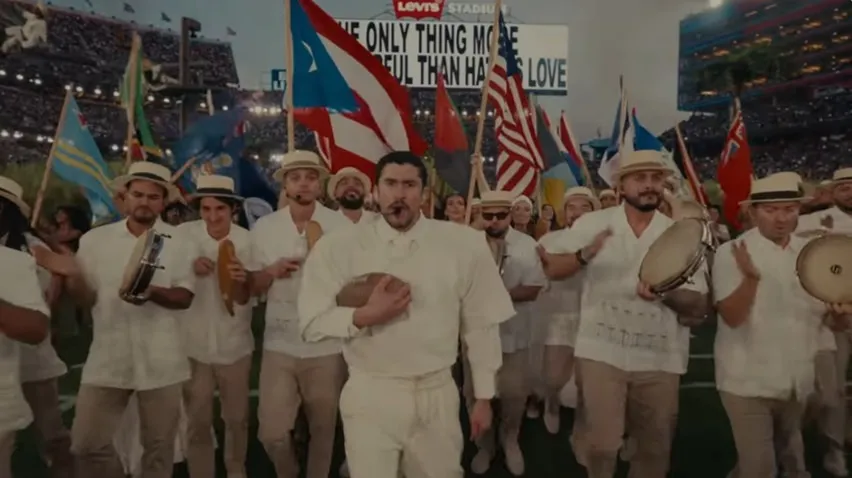
On Sunday night, Bad Bunny reportedly gave over 120 million viewers (and counting) a lesson in culture that all could learn from and ended it with a show of love of unity.
"Together we are America."
— First and Pen (@firstandpen) February 9, 2026
Bad Bunny's football says it all as he blesses all of the Americas and the Caribbean to close out his Super Bowl Halftime Show. pic.twitter.com/UAr9LI8hnP
But racists, as always, chose hate over knowledge and complained voraciously over Bad Bunny’s brilliant and vibrant tribute to Puerto Rico.
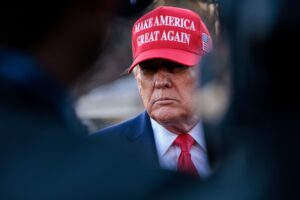
Ever since the global superstar was announced as the Super Bowl LX Halftime Show headliner, racists, led by their king, Tr**p, have been up in arms.
They expressed faux outrage over Bad Bunny’s decision to perform solely in Spanish, and raged over his decision to host a month-long residency in Puerto Rico so his fans could avoid the harassment from ICE taking place across the United States.
Mind you, when Shakira sang in Spanish at the Super Bowl Halftime show in 2020, no one cared.
When some of these same racists were singing their hearts out to Ricky Martin’s “Living La Vida Loca” at weddings held at country clubs, no one cared.
When we were learning Spanish in school, especially at elite private schools, no one cared.
And when a Spanish-speaking man on a scooter navigates through the freezing rain or snow to deliver food, no one cares.
But when politics becomes involved for no other reason than to sow hate, suddenly some people started caring.
Music is a universal language. Regardless of the language it’s sung or written in, the beat and feeling create a unique experience for different people.
That’s what happened on Sunday night in San Francisco, and despite what racists would have you believe, Benito’s decision to perform entirely in Spanish only enhanced his show.
Even if you didn’t understand the lyrics, you understood it was something special, and it definitely was.
It was a lesson that everyone could have learned from.
You could have learned the actors working in the fields that Bad Bunny passed through represented jíbaros who worked in sugarcane fields in Puerto Rico.
You could have learned about the instruments that produced the beautiful sounds everyone danced to like the Panderos, Cuatros, Maracas and Palitos.
You could have appreciated the significance of the Piragua stand, nail salon, domino table and the barber shop that Bad Bunny interacted with.
You could have learned about the rich history of boxing shared between Puerto Rican and Mexican fighters as Benito glided in-between them.
You could have understood why waking up a sleeping child in the middle of the party was so funny.
You could have learned about Villa’s Tacos and the Caribbean Social Club in Brooklyn and its owner, María Antonia “Toñita” Cay.
You could have recognized Bad Bunny was bringing attention to Puerto Rico’s ongoing electrical power crisis when he climbed the power poles.