

Today marks 60 years since activists Bobby Seale and Huey P. Newton founded the Black Panther Party.
Recognized as one of history’s most influential organizations, the Black Panther Party set out to empower Black Americans, challenge politicians and protect communities. The organization became known for providing community “survival programs,” supporting Black Americans, and advocating for community reforms.
To celebrate the party’s 60th anniversary, here are five women who helped define the Black Panther Party.
Ericka Huggins
Ericka Huggins played a pivotal part in the Black Panther Party, helping lead the party for 14 years and holding the longest leadership role amongst women. She began with political activism in 1963 when she attended the March on Washington. By age 18, Huggins led the Los Angeles chapter alongside her husband, John. Upon returning to Connecticut following the assassination of her husband, she founded the New Haven, Connecticut chapter.
That same year, she was arrested alongside Bobby Seale on conspiracy charges, kickstarting a nationwide campaign to free her. While waiting for trial and for the charges to be dropped, Huggins began practicing meditation, incorporating it in her work as a speaker. She also became known for her writing, leading the Black Panther Intercommunal News Service and publishing poetry. Huggins also became the first Black person elected to the Alameda County Board of Education and served as a professor at Laney College and Berkeley City College.
Kathleen Cleaver
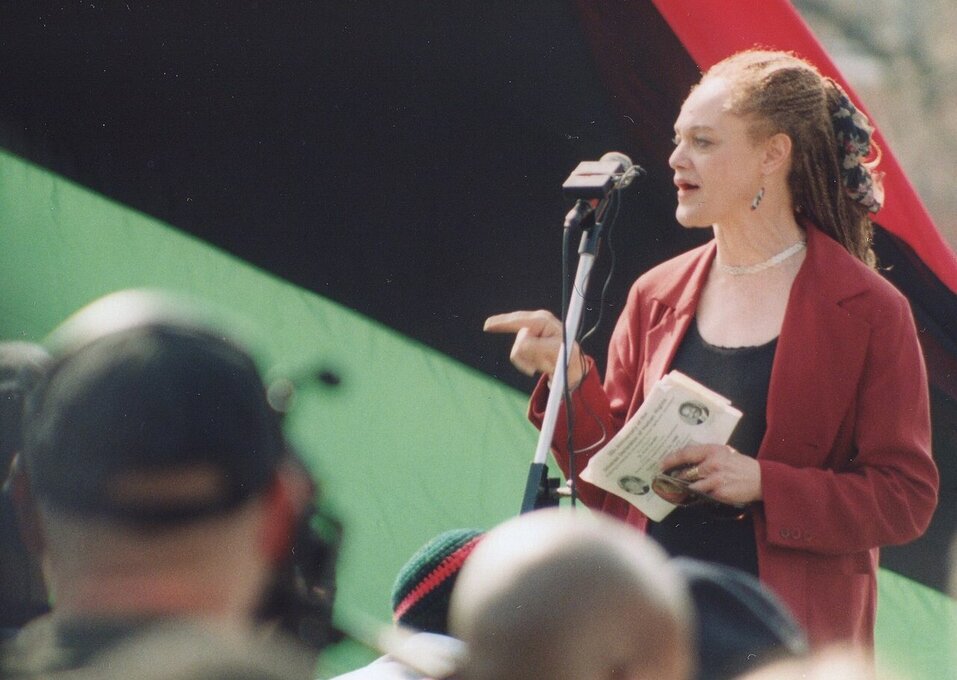
Born in 1945, Kathleen Cleaver became an icon of the Black Power movement. With the Black Panther Party, she became Communications Secretary, serving as the first to assume the position and the first woman to join the Central Committee. Through her position, Cleaver became a mouthpiece for the party, organizing protests, holding press conferences and handing out pamphlets. In 1968, she fled into political exile with her husband, Eldridge Cleaver. By 1983, she had returned to education, graduating with honors from Yale Law School in 1989 before joining a practice. Throughout her legal career, she clerked for Judge A. Leon Higginbotham and served on the Georgia Supreme Court’s Racial and Ethics Bias Commission. Cleaver also began teaching, taking a position in Yale University’s History Department and African American Studies Program while actively pursuing prison reform.
Elaine Brown
Elaine Brown joined the Black Panther Party after moving to Los Angeles in 1965. In 1974, she became the first and only woman to lead the movement after Huey P. Newton fled to Cuba on criminal charges. Brown led the party for three years, from 1974 to 1977. During her leadership, the Black Panther Party expanded community activism, providing free breakfast for children and health clinics for members.
They also began efforts to provide equitable housing. Since leaving the Black Panther Party, Brown has remained devoted to the cause. After briefly running for the Green Party presidential nomination, she now serves as COO of Oakland & the World Enterprises. The non-profit has supported initiatives such as providing economic relief for businesses and formerly incarcerated people as well as helping develop housing complexes for those in need of a home.
Barbara Easley-Cox
Initially a student at San Francisco State University, Barbara Easley-Cox joined the Black Panther Party after meeting Kathleen and Elridge Cleaver. With the Black Panthers, she took part in their Free Breakfast for Children program, Free Clothing Program and other initiatives prioritized by the party. A member from 1970 to 1974, she joined the U.S. offices and the international chapters in Algeria and Germany. After moving to Philadelphia from Germany, she began working with the anti-poverty organization The Advocate Community Development Corporation and eventually chaired the organization by the 90s.
Charlotte Hill O’Neal
Charlotte Hill O’Neal’s activism began at 17 at the Kansas School of Human Dignity, where she began spreading the importance of teaching Black history. By 1969, she joined the Black Panther Party, where she met Pete O’Neal and eventually married him. After her time with the Black Panthers, she and Pete founded the United African Alliance Community Center in 1991. The nonprofit supports people in Tanzania and focuses on empowering youth.