


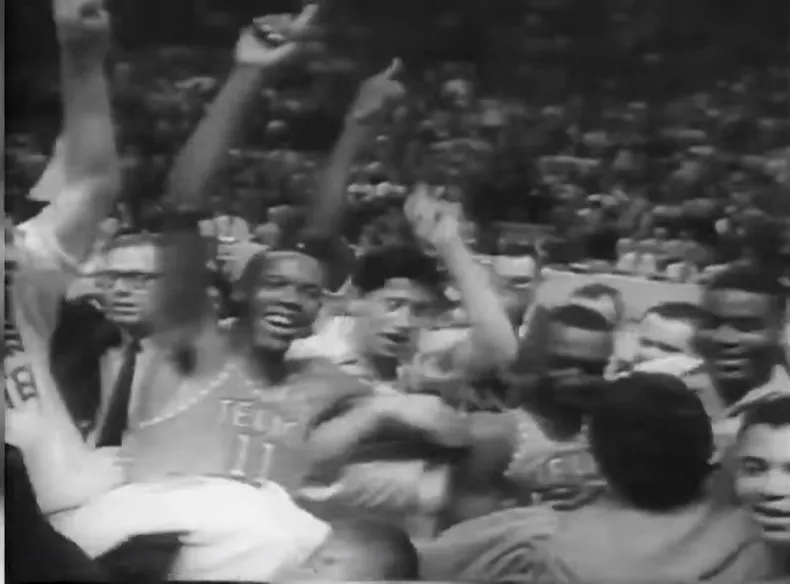
“Five starters, two subs. Forty minutes, seven players. I’m only going to play the Black players in the final game tomorrow. Just you.”
That was the moment when Texas Western head coach Don Haskins, played by Josh Lucas in the movie “Glory Road”, decided to dispel negative stereotypes about Black athletes and make history by starting five Black players in the NCAA title game against Adolph Rupp and the Kentucky Wildcats.
While the two-decades old movie was powerful and remains a must-see sports film, the true story it depicted, which celebrated its 60th anniversary on March 19th, is obviously much more important, particularly in the current time we’re living in.
The NCAA Championship won by the Texas Western miners in 1966 is honored by sports fans, but with Black history (and people) under attack, it’s a moment that seems to feel less relevant in today’s society ruled by ignorance.
Yet it’s a moment whose relevance, and importance, has never been more significant precisely because of what we’re experiencing in America.
In 1966, the Texas Western Miners endured racist attacks and threats to finish with one loss during (Seattle) the regular season. In the movie, the tournament game against Kansas was the featured moment, which they won in 2OT. Yet the round prior the Miners needed overtime as well to beat Cincinnati.
After defeating Kansas, Haskins’ squad beat Utah to reach the Tournament Championship game against Kentucky, a team featuring Hall of Fame coach Pat Riley and zero Black players.
In response to the questions of whether Black players were “smart enough” or simply good enough to win a championship, Haskins started Bobby Joe Hill, David Lattin, Orsten Artis, Willie Worsley and Harry Flournoy, the first all-Black starting lineup in NCAA Championship game history, and brought Nevil Shed and Willie Cager off the bench.
A seven player rotation for a championship winning team that finished the year at 28-1 and was enshrined into the Pro Basketball Hall of Fame in 2007.
The game took place during the Civil Rights era, so this game carried additional meaning off the court as the team was fighting for respect on the court as much as they were fighting for it in the streets.
They faced questions about whether they had the intelligence, not just the athleticism, to win.
“There was a certain style of play whites expected from blacks,” said Perry Wallace, who became the first Black basketball player in the SEC when he played for Vanderbilt in 1967. “`Ni**er ball’ they used to call it. Whites then thought that if you put five blacks on the court at the same time, they would somehow revert to their native impulses.”
“Rod Hundley, the former West Virginia and Lakers star, had the funny quote of the tournament when he was talking about Texas Western,” wrote the Baltimore Sun’s John W. Stewart the weekend of the game. “`They can do everything with the basketball but sign it.’”
In the streets, those vile thoughts were sometimes complemented with greater physicality than they experienced under the boards.
This experience is what today’s athletes don’t know about thanks to the political white-washing of Black history, the elimination of Black history courses, the restriction of Black books and the big money of college sports that blind far too many Black athletes from learning about the past.
By not learning about the past, these athletes are purposely denied the recognition, understanding and motivation to fight back against a system that has hampered them in so many ways.