

Lissen . . .
There’s a particular kind of silence that settles over a spectacle before the laughter begins. It’s the hush of secondhand embarrassment that comes from watching two aging white dudes who still believe they are symbols of masculinity and good health accidentally become metaphors.
Come look at this nonsense with me because I refuse to carry it alone. Bring yo’ snacks and ya’ low expectations.
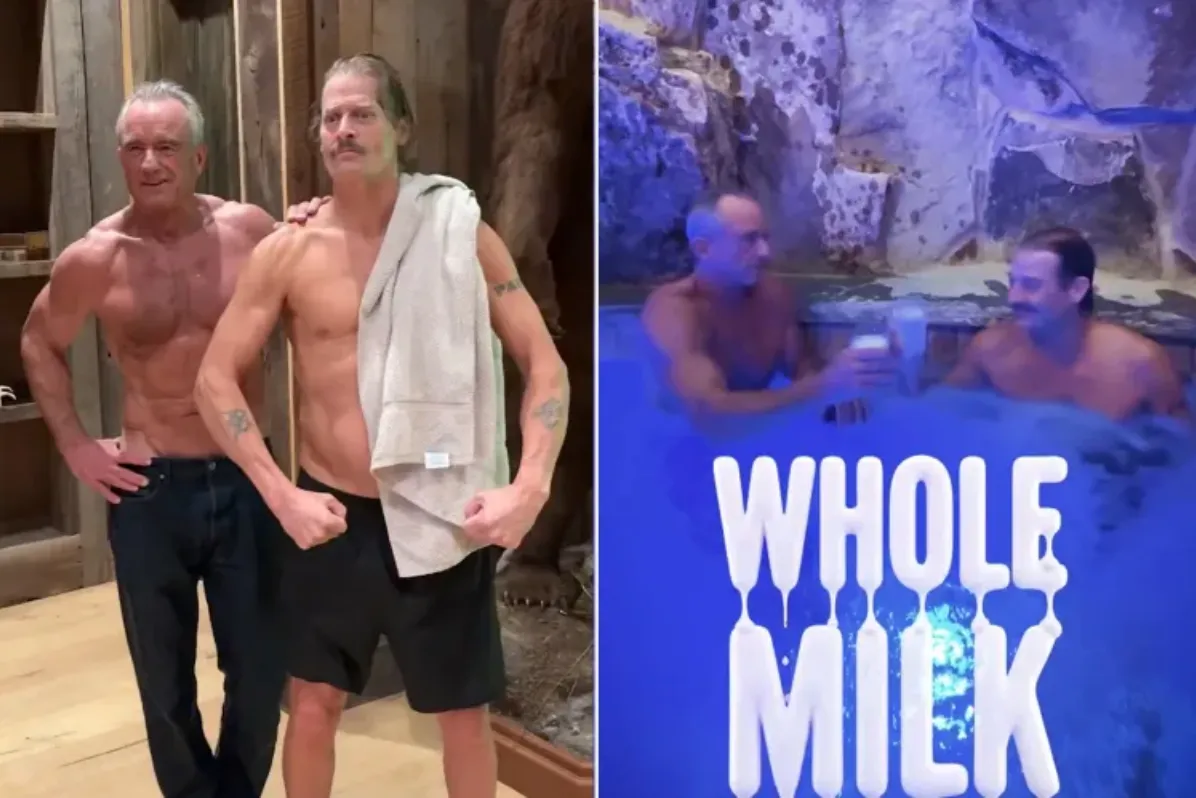
In a roughly 90-second clip, U.S. Secretary of Health and Human Services Robert F. Kennedy Jr. teams up with musician Kid Rock to promote his “Make America Healthy Again” campaign with the simple tagline: “GET ACTIVE + EAT REAL FOOD.”
The video starts with the two of them posing shirtless. There’s a quick montage of sit-ups, push-ups, and stationary biking. A sauna scene. Kennedy doing a cold plunge … in jeans, Y’all. And it ends with them toasting whole milk in a hot tub. Neither man breaks a sweat. Not a bead. Not a glisten. Not even that polite upper-lip dampness you get from walking briskly to the mailbox. And that, in itself, is the thesis.
So essentially, America’s modern public health strategy is two shirtless men marinating in chlorinated water and clinking glasses of saturated fat.
Let’s begin with the visuals, shall we?
RFK Jr.’s chest has the wiry tautness of a man who wants to prove something. The tendons show. The skin is tight in that way older men’s skin gets when they lift just enough to stay lean but not enough to build mass. Kid Rock’s torso, meanwhile, looks like a relic from a canceled tour. It’s a broad but softened layer of time and indulgence. They are not frail men. They are not obese. But they are also not the gladiators this aesthetic is trying to conjure up for the people.
They pose!
They flex!
They grimace!
They sit in steam like Roman senators discussing Empire. LOL. But their bodies never move with urgency. There is no strain in the neck. No reddening of the face. No gasping breath. No damp sheen of effort. It is all masculinity as performance, not exertion.
And of course the whole thing is scored to Kid Rock’s “Bawitdaba,” which isn’t really a song. It’s mostly rhythmic nonsense syllables, a growl stretched over a beat, and a testosterone tantrum disguised as music. It’s not meant to mean anything other than “I am loud, therefore I am.” It’s very late-90s energy, part hip-hop mimicry, part heavy-metal machismo, and part frat-basement rebellion. So pairing it with a “Make America Healthy Again” campaign is almost poetic in its irony. Which makes it a perfect aesthetic choice for men who are performing vitality rather than actually demonstrating it.
And that’s what makes it so perfect. Because this video isn’t really about health. It’s about whiteness in its aging mirror.
Consider the casting.
RFK recently admitted to snorting cocaine off toilet seats. This confession was delivered with the breezy entitlement of a man who knows he will never be permanently marked by his transgressions. And Kid Rock’s public persona has long leaned into Confederate nostalgia, beer-soaked nationalism, and the aesthetic of permanent adolescence.
And these are supposed to be messengers of American health?
This is the irony we’ve got to dissect a bit deeper. American whiteness has always framed itself as the standard of discipline, strength, restraint, rationality, and bodily control. From eugenics to diet culture to the Protestant work ethic, white masculinity has sold itself as the moral spine of the nation. Fit. Clean. Sober. Upright.
Yet the political movement most obsessed with “strength” keeps producing men who look like nostalgia in meat suits. The slogan says “Make America Healthy Again.” But the visual says: We are trying to resurrect a body that peaked decades ago.
MAGA masculinity is obsessed with the image of vitality while resisting the structural conditions that produce actual health. It rails against seed oils but defunds public health. It shouts about testosterone while gutting labor protections. It fetishizes “real food” but shrugs at food apartheid systems. It glorifies self-reliance while refusing to address the healthcare system’s collapse.
It romanticizes the “strong American worker” while opposing unions that secure safe workplaces and healthcare benefits. It lectures about discipline while slashing school lunch programs and child nutrition funding. It warns about pharmaceutical conspiracies while dismantling regulatory oversight that protects consumers. It preaches bodily purity while ignoring the environmental toxins saturating poor and rural communities. And it performs rugged individualism while depending on a crumbling medical infrastructure, it has no real plan to repair.
So instead, we get a 72-year-old Cabinet official and a 55-year-old nostalgia act in a sauna pretending that flexing counts as public policy. The whole damn thing feels like Empire cosplay and a desperate attempt to project virility at a moment when the demographic, cultural, and political dominance of whiteness is visibly fracturing. The panic isn’t subtle anymore.
Notice what else is happening here, Y’all. The cold plunge in jeans. The milk toast in a hot tub. The soundtrack from a bygone bro era. These are all signals. They’re not random. The denim says rugged. The whole milk says anti-elite purity politics. The song says I was cool once and I’m still mad about it. This is coded nostalgia aimed at a base that longs for a time when white male rebellion was marketed as authenticity
Kid Rock has always sold a fantasy of rugged American masculinity. RFK Jr. is now trying to graft public health onto that fantasy. But health, real health, requires humility, expertise, community infrastructure, and boring, sustained investment. This video is none of those things. It’s vibes doing a lot of heavy lifting for a movement that keeps insisting it is the last bastion of strength.
The reactions online have ranged from confusion to mockery. Late-night hosts have had a field day. Commentators have labeled it “weird and creepy.” But beneath the jokes is a growing recognition that the aesthetic of power no longer matches the reality. Neither of these men look like the future. They look like a rerun.
There’s a deeper historical irony here, too.
Whiteness has long constructed itself through control of the body and by determining who is disciplined, who is deviant, who is pure, who is corrupt. Black and brown and queer bodies have been pathologized and medicalized. Women’s bodies have been regulated. Meanwhile, white male excess, their drugging, violence and sexual deviance is often reframed as “boys being boys.”
Now, as chronic illness rises, life expectancy dips, addiction ravages communities, and the healthcare system buckles, the same demographic that once dictated bodily norms is scrambling to rebrand itself as the face of clean living.
And the best they could come up with is this bromance video? Two sixty-something men flexing in steam with their skin dry as parchment.
There’s something almost tender about it tho’. The way they pose. The way they trrryyy to summon intensity. It feels less like a declaration of strength and more like a plea: Please still see us as powerful. But power that has to be posed is already slippin’.
So lemme be clear about why this matters . . .
Most coverage will treat that video as goofy, cringe, meme-worthy. What need to be media literate and ask a harder question: what does it mean that this is the aesthetic language of American public health right now? Because what we’re watching is the visual language of power trying to reassure itself.
Most people will laugh at the jeans in the cold plunge. They’ll joke about the milk. They’ll mock the soundtrack. But the deeper story is about symbolism. About who gets to stand at the center of “health,” “strength,” and “America.” About how whiteness has historically defined itself through discipline, bodily control, purity, and dominance, and what it looks like when that mythology starts to wobble.
Every prop in that video is doing rhetorical work. The sauna. The denim. The whole milk. The 1998 testosterone anthem. The dry flexing. None of it is random. It’s all branding and propaganda. It’s identity construction and nostalgia performing as governance.
And that’s the lesson, Y’all.
Politics today is increasingly aesthetic. It puts vibes before policy and optics before infrastructure. If you don’t know how to read symbols, then you’ll mistake performance for leadership every single time. And you’ll see flexing and think strength. You’ll hear volume and think authority.
But real health doesn’t live in a hot tub. Real strength doesn’t need a soundtrack. Real governance doesn’t rely on abs and lighting and sauna haze.
What we’re witnessing isn’t strength and vitality. It’s anxiety dressed up as dominance. It’s a movement trying to resurrect an image of itself that feels safer than the present. And when power starts flexing this hard, it’s not because it’s strong. It’s because it knows the mirror is no longer lying for it.
Thanks for reading. If this piece resonated with you, then please consider becoming a paid subscriber. Paid subscriptions help keep my Substack unfiltered and ad free. They also help me raise money for HBCU journalism students who need laptops, DSLR cameras, tripods, mics, lights, software, travel funds for conferences and reporting trips, and food from our pantry. You can also follow me on Facebook!
We appreciate you!