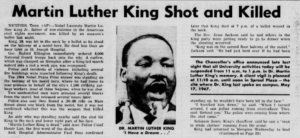

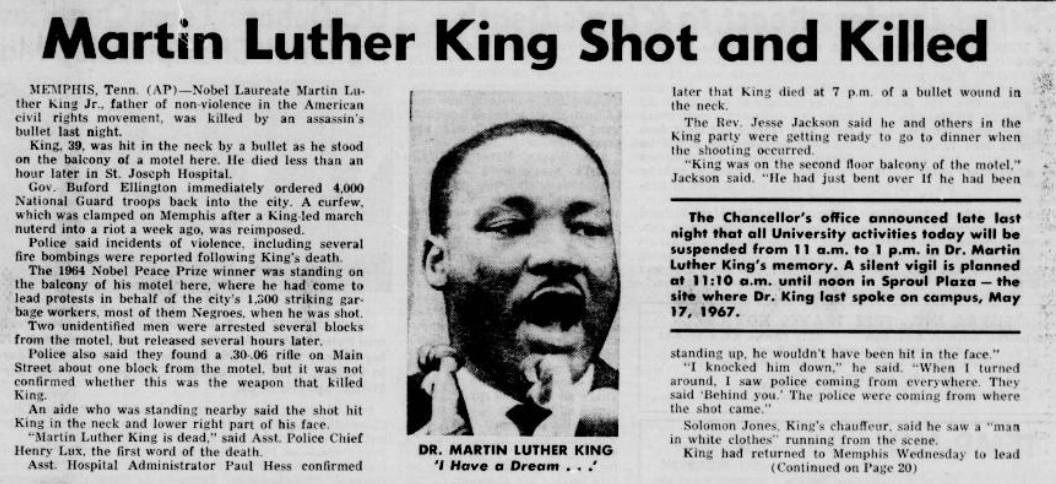
On April 4, 1968, the civil rights movement lost its most recognizable leader when Martin Luther King Jr. was assassinated in Memphis, Tennessee. Just after 6 p.m., King was standing on the balcony outside his room at the Lorraine Motel when a rifle shot struck him in the jaw and severed his spinal cord. He had come to Memphis to support striking sanitation workers and was preparing to leave for dinner when he was shot. King was taken to St. Joseph’s Hospital, where he was pronounced dead.
He was 39.
King had arrived in Memphis amid a growing effort to expand his work beyond civil rights and into the fight against poverty and economic inequality. In the final months of his life, he had organized the Poor People’s Campaign, which called for jobs, better wages and economic opportunity for poor Americans. In Memphis, he joined Black sanitation workers who were protesting dangerous conditions and unequal treatment.
The night before his death, King delivered what would become his final speech. Speaking at Mason Temple, he told supporters that “we’ve got some difficult days ahead,” but said he had “been to the mountaintop” and had seen the future of the movement. Less than 24 hours later, he was dead.
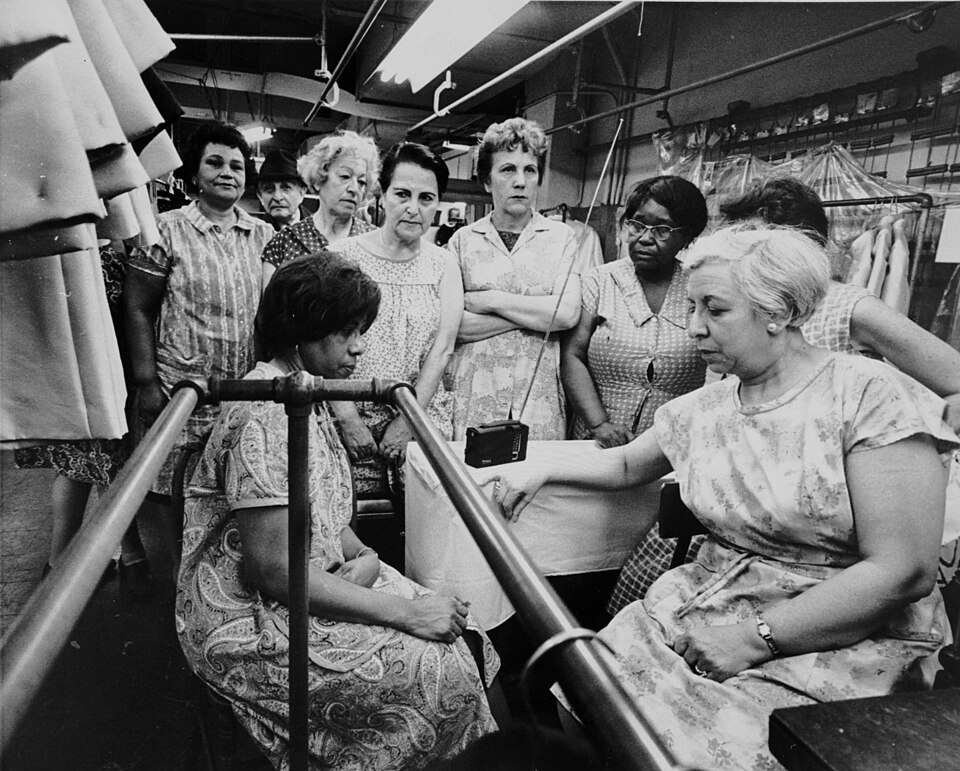
News of the assassination spread rapidly across the United States. Riots erupted in more than 100 cities, including Washington, Chicago and Baltimore. National Guard troops were deployed in several cities as officials struggled to restore order. President Lyndon B. Johnson declared April 7 a national day of mourning.
King’s funeral was held on April 9 in Atlanta, where tens of thousands of mourners lined the streets. His casket was carried through the city on a simple wooden farm wagon pulled by two mules, a symbol of the poverty and inequality he had spent his life fighting.
Investigators soon focused on James Earl Ray, an escaped convict whose fingerprints were found on the rifle recovered near the motel. Ray fled the country but was arrested two months later at an airport in London. He pleaded guilty in 1969 and was sentenced to 99 years in prison, though he later claimed he had been part of a larger conspiracy.