



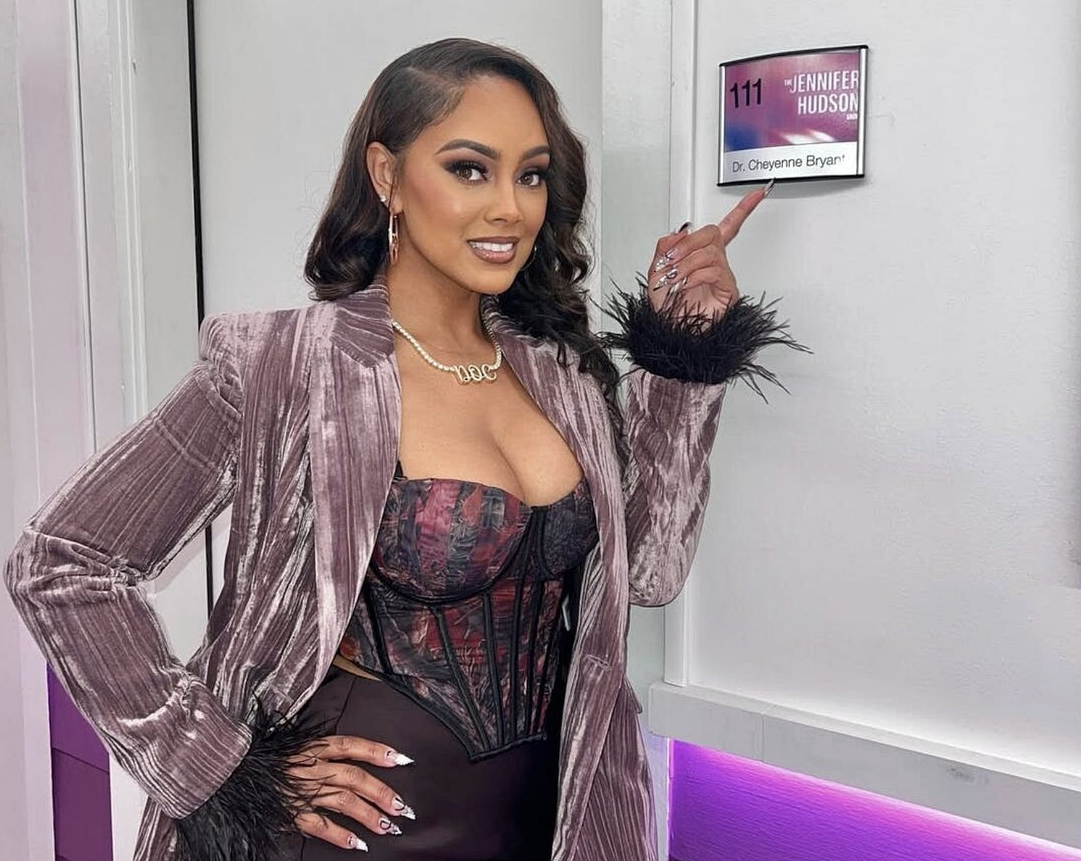
The ongoing dragging of media personality and self-proclaimed “psychology expert” Cheyenne Bryant has been loud and messy as hell.
For weeks now, folks have been dissecting her credentials. They’ve questioned whether she earned the doctorate she claims. Folk have wondered why her dissertation and records are hard to locate and have scrutinized her explanation that the closing of Argosy University made documentation difficult. The controversy escalated as Bryant has publicly claimed to be “Dr.” but also admitted she is not a licensed therapist, inviting a lot more debate about titles, credentials, expertise, public trust, and what people are allowed to sell under the language of healing.
And yes, the questions being raised are absolutely legit. Because if somebody builds a whole public brand around expertise, especially in the mental health and wellness space, folks have every right to ask where that expertise came from, what the credential actually means, and whether the public is being misled. “Dr.” is not just a flex or a cute prefix you throw in front of your name because it looks good on a flyer. It signals authority, training, and a level of vetting that ordinary people often do not know how to verify.
But the more important conversation is not simply about this one Black woman getting dragged online. I think the more important issue we need to be talking about is about the shady ecosystem that made this kind of credential confusion possible in the first place. We gotta have an honest conversation about institutions like Argosy University, the University of Phoenix, DeVry, Walden, Capella, Strayer, Ashford, the Art Institutes, ITT Tech, Corinthian Colleges, Grand Canyon University, and the whole for-profit and for-profit-adjacent higher education machine that sold credentials to people, especially Black women, who were hungry for mobility, legitimacy, protection, and a way into rooms that had been historically closed to them.
Some of these schools collapsed. Some were sued. Some settled deceptive advertising claims. Some became the subject of borrower-defense findings. Some were accused of misleading students about costs, job placement, program length, or career outcomes. A 2024 class-action lawsuit alleged that Walden targeted Black and female students and misrepresented the cost and credit requirements of its DBA program. The case resulted in a $28.5 million settlement. And yet the larger machine kept doing what predatory systems do best, which is turning aspiration into debt.
These schools didn’t just “expand access” to non-traditional students. Many of them built their business models around aspiration. Around working adults, first-generation students, people shut out of elite universities, and people who had been told that education was the only way to survive capitalism with your dignity intact.
And yes, they preyed on Black people. They preyed especially hard on Black women, because Black women have been told over and over again that if we just get one more degree, one more credential, one more certification, one more set of letters behind our names, then maybe this country will finally stop treating us like we are underqualified for the lives we already earned.
But let me tell y’all somethin’. I have a whole Ph.D. from one of the top ten doctoral history programs in the country, and folks still resent Black women like me with the same old venom they aimed at the so-called welfare queen. The credential does not save you. The letters behind your name do not protect you from a culture committed to seeing Black women as fraudulent, uppity, undeserving, loud, angry, lucky, dangerous, or out of place.
They will still put air quotes around “Dr.” They will still call you bitches, c*nts, n*ggers, grifters, diversity hires, race hustlers, and everything else their little anti-Black imaginations can cough up. They will still move the goalpost after you cross the finish line. They will still ask who let you in the room. They will still demand proof, then resent the proof, then pretend the proof ain’t good enough.
People don’t want to believe us anyway. They don’t believe us when we are poor. They don’t believe us when we are credentialed. So long ago, I said “fuck it.” If this country is determined to misread, underestimate, resent, and call us wrong before we even open our mouths, then we might as well take advantage of being wrong. We might as well stop auditioning for the approval of people who were never going to see Black women as credible unless we are some damn useful mammies, silent, broken, or dead.
But I digress.
This conversation isn’t just about one woman’s degree. We need to talk about how Black women became some of the most educated and most indebted people in America at the same damn time. These institutions used their glossy ads, flexible schedules, online convenience, the doctoral titles, the “you can do it too” empowerment language, and the FAFSA pipeline sitting there like an open vein.
Now, I am not trying to say that every person who attended one of these schools is unqualified. I am not saying people did not work hard. Many did. Some worked harder than students at traditional universities because they were juggling jobs, children, aging parents, bills, grief, exhaustion, and the particular American cruelty of trying to better yourself while being charged luxury prices for survival. But we need to stop confusing individual effort with institutional quality.
Because where are the outcomes? Where is the evidence that these programs consistently delivered strong job placement, strong earnings, serious academic training, respected credentials, and debt loads that made sense? Too often, the numbers tell a much uglier story: low graduation rates, high debt, weak repayment outcomes, aggressive recruitment, and disproportionate harm to Black students.
A Brookings report found that for-profit colleges enrolled only about 10 percent of students but accounted for roughly half of student-loan defaults, while New York Fed researchers found that students who attended for-profit institutions took on more debt and were more likely to default than comparable students elsewhere. And the federal borrower-defense record is even more damning: officials said 90 percent of Ashford students never graduated, and the Department of Education found that the Art Institutes left borrowers with high debt and without the promised earning capacity or employment necessary to repay it.
So, this was not just a few students making “bad choices.” It was a whole marketplace built around promises of mobility, job placement, flexible access, career transformation, and respectable credentials. But again and again, federal agencies found schools exaggerating or misrepresenting employment outcomes, salary prospects, employer relationships, program costs, and career services. DeVry ended up settling FTC claims that it misled students about jobs and earnings. University of Phoenix settled FTC claims that it falsely suggested relationships with major employers.
When I was a reporter for The Chronicle of Higher Education, I remember looking into doctoral programs at some of these institutions and asking some very basic questions: Who is teaching these PhD and doctoral-level courses? How many are full-time faculty? How many are adjuncts? How many actually hold doctorates themselves? Because if you are charging people doctoral-program money, then the people teaching them should not be academically undercredentialed, underpaid, disposable laborers patched together to keep the machine running.
And this is why I flinch every time people run to social media yelling with memes like, “BLACK WOMEN ARE THE MOST EDUCATED GROUP IN AMERICA.” First of all, that claim is often misstated. Black women are highly educated, and Black women earn a large share of degrees among Black students. But that is not the same thing as saying Black women are more educated than every other racial and gender group in the country.
Second, even when we celebrate Black women’s educational ambition, we almost never ask some important follow-up questions. Educated where? At what cost? With what support? Under what conditions? And with what return?
Because a degree is not just a symbol. A degree is also a debt instrument. And Black women are carrying a crushing share of that burden. Undergraduate debt. Graduate debt. Parent PLUS debt. Professional school debt. Multiple degrees. Multiple promissory notes. Multiple attempts to buy our way into a labor market that still underpays us, questions us, and demands that we overperform just to be considered competent.
So yeah, at the end of the day I understand why people are dragging Bryant over her Ph.D. I understand the questions about institutional legitimacy, accreditation, prestige, rigor, and whether certain degrees are being inflated into credentials they are not. But if we are going to have that conversation, then let’s not stop at one woman on the internet. Let’s talk about the entire predatory higher-ed marketplace that made these credentials desirable, available, expensive, and unevenly respected in the first place.
Let’s talk about how Black women were told to get more education, to “go as high as you can go,” and then punished with more debt. Let’s talk about how universities discovered that Black aspiration could be monetized and then turn us into modern-day sharecroppers. Let’s talk about how the language of “access” became a cover story for extraction.
And let’s definitely talk about what happens next, because the coming federal student-loan changes are about to shake this whole damn system, Y’all. And for the life of me, I don’t know why there’s such silence around this issue, and why students are not in the streets making noise. Folks can spend weeks screaming about one woman’s dissertation, but somehow the restructuring of graduate borrowing barely breaks through.
What I am watching now is how the upcoming federal student-loan changes will disrupt this entire marketplace. Beginning July 1, new graduate borrowers will no longer have access to Grad PLUS loans, the federal program that allowed many students to borrow up to the full cost of attendance. New caps will limit most graduate borrowers to $20,500 per year and $100,000 total, while professional students will be capped at $50,000 per year and $200,000 total.
The stated argument from the Education Department is that these limits will curb overborrowing and pressure institutions to control costs. But the real question is who will get squeezed first: the schools that built bloated graduate programs around easy federal loan money, or the students who were using that money as their only bridge into advanced credentials. And this is where the conversation about Black women, credentialing, and predatory higher education becomes urgent.
If unlimited graduate borrowing helped fuel a marketplace where expensive master’s, doctoral, and professional programs could flourish without proving strong outcomes, then loan caps may finally force a reckoning. Programs that depend on students borrowing tens or hundreds of thousands of dollars for degrees with weak labor-market returns may have to justify their existence.
But there is also a danger here: Black women and other first-generation, working-class, and adult students may be pushed toward private loans with fewer protections, worse repayment options, and no access to federal forgiveness programs. So the coming question is not simply whether these loan changes will reduce debt. The question is whether they will expose the degree machine, or simply make the most vulnerable students pay for its collapse.
Which brings me back to Bryant.
She is not the whole scandal. She is a symptom of a larger credential economy that has been feeding on insecurity, exclusion, aspiration, and debt for decades. A market that told Black women to keep climbing, keep borrowing, keep proving, keep credentialing, keep adding letters, keep paying tuition, and keep becoming undeniable, only to turn around and mock the very degrees it sold them.
So drag the résumé if you must. Ask for the dissertation. Ask for the transcript. Ask for the accreditation. Ask what “Dr.” is doing on the flyer. But listen, after y’all finish dragging one Black woman, save some of that smoke for the institutions that built an empire out of selling legitimacy to people this country never intended to respect in the first damn place.
Because that is the real con.
Thanks for reading. If this piece resonated with you, then please consider becoming a paid subscriber. Paid subscriptions help keep my Substack unfiltered and ad free. They also help me raise money for HBCU journalism students who need laptops, DSLR cameras, tripods, mics, lights, software, travel funds for conferences and reporting trips, and food from our pantry. You can also follow me on Facebook!
We appreciate you!