


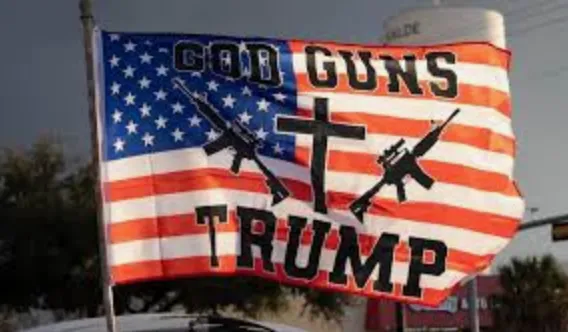
In America, even the gun lobby has to pretend it’s shocked when the state does exactly what it’s always armed itself to do . . . which is decide who gets to live armed, and who gets to die for it.
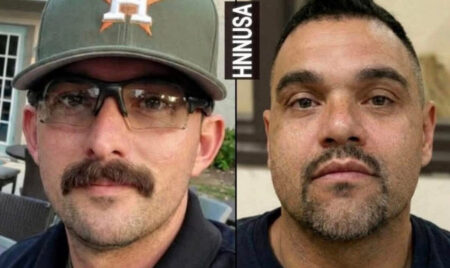
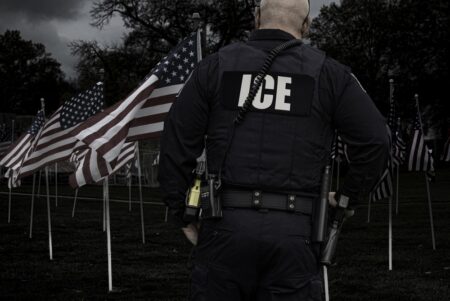
Ever since the ICE shooting of Alex Pretti last month in Minnesota, and the Trump administration’s clumsy, panicked messaging afterward, we’ve been watching a hot mess of a political theater unfold.
Gun-rights organizations are publicly pushing back. Libertarians are writing essays about how the Second Amendment is inherently anti-authoritarian. Conservative influencers have suddenly discovered the language of state overreach. MAGA figures keep arguing with prosecutors. Prosecutors are beefing with gun activists. And folks are acting like they just stumbled onto some brand-new constitutional crisis.
Most of the coverage right now is stuck in the wrong frame. Libertarians are arguing about whether Trump is too authoritarian to be truly pro-gun. Conservatives are obsessing over whether the administration is sending mixed messages. Mainstream outlets are treating this like a Republican family feud that could impact the midterm elections.
But that all misses the entire point. The real issue isn’t whether Trump is betraying the Second Amendment. The real issue is who that amendment has actually protected in real life, and who has been told they had gun rights on paper while being denied them in practice.
These conversations are dancing around the truth folks don’t want to name. So let’s put race, power, and history back into the frame because this ain’t about the gun rights crowd suddenly showing good faith.
What we are watching is not some moral awakening. It is panic from people who just realized the machinery they defend can turn around and recognize them, too! They recognize that the line between protected and expendable might not be as permanent as they were promised.
Because for the first time in a long time, the machinery of state violence brushed up against white folks who fit the cultural template of who guns are supposed to belong to. And that, not the Constitution, is what triggered the alarm.
Listen Y’all, I am not about to argue over whether the Second Amendment is being applied correctly. I want folks to know that Americans have been lying to themselves about how it has actually been applied for centuries. And I want you to ask yourself this question: Why in the hell has it taken this long for people to notice that constitutional rights in America have never been enforced equally in the first place?
For decades, American gun culture has operated on a quiet but rigid hierarchy. Armed white citizens have been framed as protectors, patriots, and embodiments of liberty. Armed Black folks have been framed as threats, risks, or problems to be neutralized. The Second Amendment has never functioned purely as a neutral legal right. It has functioned as a social permission structure. By social permission structure, I mean who society expects to have guns, who society trusts with guns, and who society assumes is dangerous the moment a gun is in their hand. This is a permission structure backed by race and history.
From slave patrols to Black Codes to modern policing, guns in white hands have been associated with order. Guns in Black hands have been associated with danger. Which is why the sudden rhetorical explosion after Pretti’s death rings so hollow. Because we have seen this movie before.
For example, Philando Castile was legally carrying. So were countless other Black gun owners shot during traffic stops, in their homes, or in public encounters where compliance didn’t save them.
Soooo, where was this constitutional panic then? Where were the emergency press conferences about the fragility of the Second Amendment? Where were the breathless essays about authoritarian drift? Where were the warnings that prosecutors were redefining possession as threat?
They were mostly silent.
Because when Black gun owners are killed, it doesn’t challenge the story America tells itself about guns and freedom. It protects that story and sends the same message it has always sent: the right to be armed exists but the right to survive while armed depends on who you are. The Pretti shooting disrupted that psychological contract because it suggested, even briefly, that being the “right kind” of gun owner might not guarantee protection from the state.
But even this “conflict” is being misread. Because the real fight is not between the gun lobby and state power. The real fight is about who authoritarian power is allowed to touch. The gun lobby is not rebelling against state violence as a concept. It is rebelling against the idea that state violence might become unpredictable for their people. And that is a very different thing.
Their entire brand is built on selling the lie that guns make you free. That guns make keep you safe from state power. That armed citizenship makes the government think twice. But this country has always been willing to shoot armed citizens. It just prefers to choose which ones.
The government has never feared an armed public in the abstract. It has feared armed populations that it does not control. And it has tolerated, and often encouraged, armed populations that reinforce existing hierarchies. Think slave patrols. Think lynch mobs.
That’s why militias can show up heavily armed at state capitols and be framed as activists. That’s why open-carry demonstrations can be treated as political expression.
And that’s why Black armed self-defense has historically been met with surveillance, repression, and deadly force.
The Pretti moment has indeed created a crack in the illusion because it suggested something dangerous to the gun lobby’s brand: that guns do not automatically make you sovereign. They make you visible to state power, and depending on who you are, that visibility can make you a target and disposable.
This is the reality Black Americans have lived with for generations. So when gun-rights organizations suddenly adopt the language of civil liberties, forgive us if we don’t join the applause.
Because if this were truly about principle, the movement would have confronted racial disparities in gun enforcement long ago. If it were about constitutional universality, every police shooting of a legally armed Black person would have been treated as a Second Amendment crisis. If it were about resisting authoritarianism, the movement would have long interrogated how state power selectively criminalizes armed citizenship.
If this were truly about resisting authoritarianism, the movement would have spent years interrogating the ways state power has selectively criminalized armed citizenship.
The American state has always treated rights as conditional. The gun lobby has always treated that conditionality as acceptable as long as it tracked racial and cultural boundaries. What makes this moment feel like a crisis to them is not that the system is breaking. It’s that, briefly, the system stopped behaving predictably. And when predictability disappears, privilege suddenly feels like vulnerability.
That’s what this is, Y’all. It’s not a Second Amendment awakening. It ain’t some libertarian revolution. And it’s not a moral reckoning about state violence. It’s just an uncomfortable and politically inconvenient reminder that rights in America have always been strongest for those who least needed to test them.
Now that the boundary lines feel less fixed, the people who have always lived safely inside them are calling it a constitutional emergency. But for many of us, this has never been a revelation, only the conditions we have always been expected to survive. And systems like this do not change simply because new people finally learn to see them.
Thanks for reading. If this piece resonated with you, then please consider becoming a paid subscriber. Paid subscriptions help keep my Substack unfiltered and ad free. They also help me raise money for HBCU journalism students who need laptops, DSLR cameras, tripods, mics, lights, software, travel funds for conferences and reporting trips, and food from our pantry. You can also follow me on Facebook!
We appreciate you!