



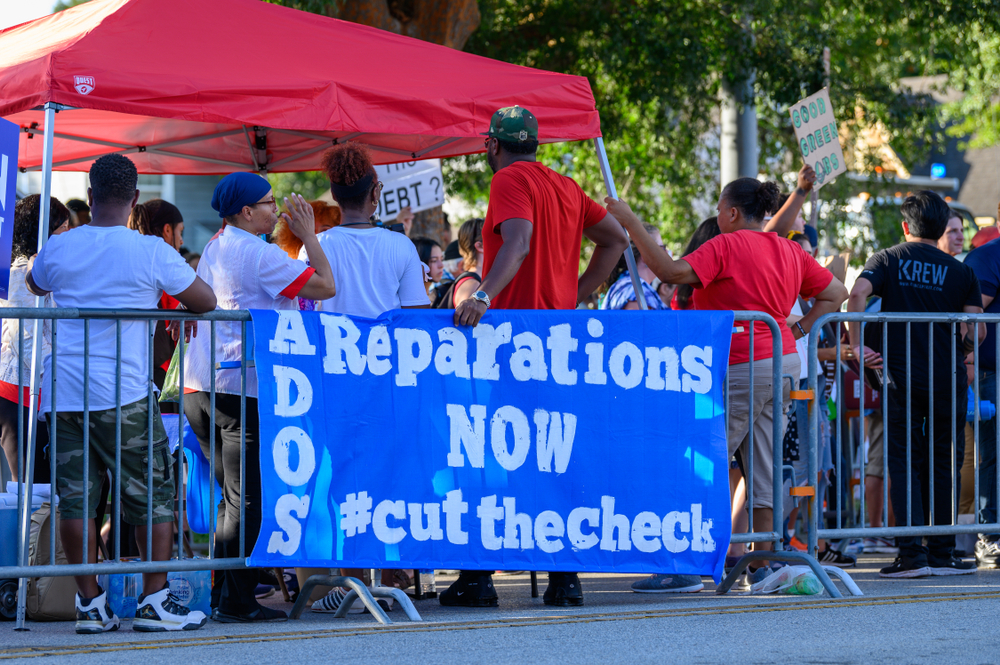
A federal judge ruled earlier this week to let a lawsuit filed against the Evanston, Illinois, reparations program proceed.
Announced first by Legal Newsline on Tuesday, U.S. District Judge John F. Kness denied a motion filed by the city of Evanston to dismiss the lawsuit. Filed in 2024 by the conservative legal group Judicial Watch, the case features five plaintiffs who are arguing that the program violates the Constitution’s Equal Protection Clause. They argue that by using race as a requirement, they are not applying the law fairly and are violating the first section of the Fourteenth Amendment.
In their motion, the city argued that the plaintiffs never applied for the program and the application window had long since closed in 2021, the lawsuit should not move forward. With the recent ruling, the judge has not yet decided on the program’s legality.
Established in 2021, the Evanston reparations program provides Black residents and descendants with $25,000 in payment to make up for the city’s history of housing discrimination. In the 1940s, Black residents of Evanston were forced to live in a small area known as the 5th Ward. Homes outside of the 5th Ward were essentially demolished, forcing more Black residents inside the triangular area. The reparations program specifically focuses on housing discrimination from 1919 to 1969.
Through the funds, the city is attempting to address the ongoing impact of their previous legislation. With the launch of the program, Evanston became the first city to create a reparations program of this kind.
“We have a large and unfortunate gap in wealth, opportunity, education, even life expectancy,” said architect of the program, Robin Rue Simmons, in 2019, per NPR. “The fact that we have a $46,000 gap between census tract 8092, which is the historically red-line neighborhood that I live in and was born in, and the average white household led me to pursue a very radical solution to a problem that we have not been able to solve: reparations.”
The latest announcement on the ruling comes almost two months after the Evanston Reparations Committee announced a new round of plans to issue reparations. On February 5th, they announced that another 44 residents- participants 127 to 171- will be allotted $25,000 payments to cover housing costs.
The expansion of the reparations program comes amidst an increase in reparations proposals amongst a number of states.
In Nov. 2025, the Detroit task force submitted recommendations on a reparations program that would address unjust city policies. Created throughout the span of two years, the recommendations report recommended that $40,000 in downpayment assistance and $30,000 in home repairs should be given to Black Detroit residents. The task force also suggested the creation of 1,000 new housing units that would be affordable for anyone who makes an income of $35,350. Further housing suggestions included implementing rent control policies, creating shelters for unhoused residents and refunding citizens who lost their homes due to tax foreclosure.
“We have been guided as a Task Force by our understanding that the wealth and imperialist power of the United States may be attributed directly to profits generated by the enslavement of our ancestors – through the slave trade, chattel slavery, peonage, and prison labor,” said the task force in the report. “In colonial America and the United States, extraction of Black labor and the violence with which this extraction was conducted ensured the accumulation of wealth by whites, so that their heirs today continue to enjoy economic security and prosperity.”
Meanwhile, in San Francisco, during late December, the Board of Supervisors also voted to revive a committee’s 2023 reparations draft, giving final approval to create a fund to address discriminatory city policies.
The report suggested one-time payments of $5 million, a guaranteed annual income of $97,000, down-payment funds, tax and debt relief as well as affordable housing solutions.