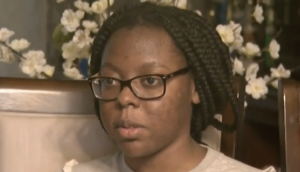

“Sometimes I wish instead of always thinking about other kids, you would have thought about me.” — Najya Hannah-Jones
Listen Y’all, that is the single most heartbreaking, devastating, and important sentence in that entire New York Times Magazine essay that so many people are grappling with right now.
As an historian whose work centers Black childhood in the story of American race, I know that this single line is an ancient prayer. You can hear it in the archives. GENERATIONS of Black children have whispered some version of this plea to their parents and other kin, their churches, schools, movement leaders, and to America itself.
Would somebody just please think about and see ME?
Not what I represent. Not what can be proven or disproven through me. Not what my suffering teaches us about racism. Not what my life can accomplish for the race. Not what sacrificing ME might accomplish for some larger principle.
JUST. ME.
I am always asking Y’all to CENTER THE CHILD in all things. So can we do that for a minute? Can we?
I wanna take a few moments to silence all the adults arguing right now over a mother’s parenting, her motives, and her private relationship with her daughter because at the end of the day none of us were there. I want to decenter Y’all. Just shhhhhhhh and let us focus on the words that were published and attributed to child who is becoming. Let’s just take a minute to strip away all the adult arguments about integration and segregation, public schools and private schools, neighborhoods, about class and aspirations, about identity, personal trauma, racial solidarity and individual responsibility. Put down the sociology, all the politics, and ideology. Center the child and listen to the child’s voice.
I want us to seriously listen to what is this godling is trying to tell us because her powerful words are a doorway into a much larger meditation that implicates every Black adult who professes to love Black children. That includes me, a woman who does not have her own children but teaches other people’s children.
She is telling us something terribly complicated about Black love. Black people LOVE our children. Lord knows we do. We love them deliriously, extravagantly, irrationally. We kiss them fat cheeks. We pray over them even when some of us no longer believe in a god. We photograph their days like we are documenting miracles. Because we are. Our children are the corrective genius to all that this American hellscape has tried to destroy for generations.
We have the unmitigated gall to keep answering W.E.B. Du Bois’s terrible old ethical question: “Ought children be born to us? Have we any right to make human souls face what we must face?”
We keep giving our ancestors an audacious, defiant, unflinching yes. Yes, even here in America. DuBois called America for Black children “a sneering, cruel world.” Yes, keep giving birth to Black children in a country that we know hates them. Yes, this country despises Black children. The message is everywhere. Every which way. This country sees our children as worthless, up for abuse, disposable, and killable. They just told Nolan Wells’ parents and everybody else to go home because ain’t nothin’ here to see.
This country has never had enough dead Black children. And it never will. Black parents know the risks, and yet we dream futures for our godlings. Black parents make all kinds of obscene calculations. And yet we keep sending our children toward the sun.
Do I send them to this school or that school? Do we live in this neighborhood or the other one across town? Is it time to give them “the talk?” Are they too young to learn that a police officer might profile them, beat them, or shoot them? Should I let my son wear that hoodie outside this house. When do I tell my boy it is dangerous for him to run in public?
Do I let my daughter walk home alone? Is this teacher doing something racist toward my child? Do I teach my child to fight back to protect their body? Should I tell them to just stay quiet, walk away, raise their voice, call me, record it, survive it, just come back home to us? How much do I tell them about America’s racism and how much innocence can I preserve for just a l’il while longer?
Do I take that job or promotion that cuts into my time at home with them? Do I yank my child out of yet another school so we can move across the country for a better opportunity? I desperately want to give them what I didn’t have, but will I end up giving them less of myself in the process?
Young Najya wants us to chew on a much harder question: It is possible for us to love Black children profoundly and still fail the Black child standing directly in front of us. Love just ME, mama. ME, daddy. ME auntie, uncle, grandmama and n’em. ME.
Some of Y’all might tell me that I should just be quiet because I don’t have any children of my own. What do I know about being a parent? I am humble enough to acknowledge that I have zero personal experience, and I don’t live with the terrible daily agony of having my heart on edge every time my child leaves my home.
But as a child advocate whose journalistic and scholarly work obsesses over Black children, I do know that love in the aggregate is an easier thing and that “Black children,” like “Black people,” are so easily treated as abstractions. Every day this country turns our children into abstractions every which way. Y’all know the vocabulary they use to call our children some version of the n-word. They code it in terms like achievement gap, juvenile, at risk, urban youth, thug, statistic, cause, hashtag, and an unarmed body that cause its own death.
“Sometimes I wish instead of always thinking about other kids, you would have thought about me.”
When you really hear the unbearable specificity of this girl child’s sentence it makes your heart beat fast. It’s a desperate plea. ME, Mama, daddy, auntie, uncle, grandmama and n’em. ME and not the movement, system, institution, respectability politics, or anything else.
JUST. ME.
Our children have had to ask us that question for more than 500 years in this country. How much longer do they have to keep asking that same question? How many times?
I am adamant that loving our children in this dying American empire is gonna require something offensively particular. I need Y’all to think about what DuBois did in September 1906 when a white mob terrorized Atlanta. This is was a father who had spent his entire career thinking about millions of Black children, obsessively so.
But that night he was forced into a moment when his love for his daughter became an unreasonable, inconvenient, uncooperative, terrible promise to America. All that intellectual abstraction went out the window that night. He wasn’t sitting there on his front porch contemplating the “Talented Tenth,” or ideology, sociology, journalism, infographics, data, grand theories.
That was 120 years ago this month! That night he answered his own aching question: “Ought children be born to us?” Y’all, he answered it with a double-barreled Winchester shotgun and buckshots. He put his own body between the mob and his child and he promised, if you come for mine, I will “spray your guts across the grass.”
Now, DuBois was not a perfect father. He did some questionable shit that harmed his daughter in her later years. That’s another worthwhile conversation for a different day. But on that September night, he was thinking only about the child tucked away safely behind him in South Hall.
What we saw was a Black father who was constantly thinking about the color line, education, Black leadership and liberation, the future generations yet to be born, prioritize HIS child over his own ideology and reputation, respectability politics and class aspirations, the movement, or other people’s comfort. I tell you that old story because 120 years later, another Black godling is giving us the other half of that lesson if we’ll just stop, center her, and listen to her voice.
“Sometimes I wish instead of always thinking about other kids, you would have thought about me.”
ME.
Yolande and young Najya’ experiences are not equivalent but these two Black daughters’ stories ask us to reverse the direction of our gaze. Don’t look over your child’s shoulders toward the beautiful world you hope to build in this corrupt, racist, soulless, dying Empire. Look directly into your godling’s face and see the future right here.
Look at ME.
Look at your beautiful, irksome, complicated, unfinished Black child in the sacred, messy act of becoming, and love me inconveniently, irrationality, and in ways that fuck up everybody else’s evil plans. Love ME so ferociously. Love me like a m’fkin REVOLT when America comes hunting for another sacrifice! And then I want racist America to find you standing in the doorway giving it a terrible promise with your long, stiff middle finger.
I want you to tell them: “You cannot have this one! MY baby girl, my baby boy ain’t available for ANY kind of sacrifice. Not even for my own beautiful ideas about what Black liberation is supposed to look like.
And one day when I look back on my childhood, I won’t even have to fix my lips to ask, “Did you think about me?” Because I will remember that you were standing in the doorway with your Black body between the mob and me.
Amen.
Thanks for reading. If this piece resonated with you, then please consider becoming a paid subscriber. Paid subscriptions help keep my Substack unfiltered and ad free. They also help me raise money for HBCU journalism students who need laptops, DSLR cameras, tripods, mics, lights, software, travel funds for conferences and reporting trips, and food from our pantry. You can also follow me on Facebook!
We appreciate you!