





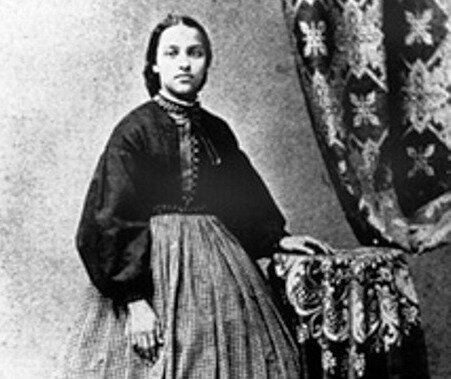
On this day in 1862, educator Mary Jane Patterson became the first Black American woman to receive a bachelor’s degree.
Born in Raleigh, North Carolina, in 1840, Patterson was the eldest child of a freeborn father and a formerly enslaved mother. Although there are conflicting sources, it is believed she was the oldest of seven or ten children.
At the age of 12, the Patterson family moved from Raleigh, North Carolina to Oberlin, Ohio. Five years later, at the age of 17, she began taking preparatory courses at Oberlin College, a previously predominantly white college that eventually became one that admitted men and women of all races. In 1835, Oberlin admitted the first Black American student and became coed two years later.
After completing her preparatory courses, Patterson opted to take another route rather than the usual two-year courses created for women scholars and took the “gentlemen’s” course. Through the “gentelemen’s course,” men were offered a wider range of subjects, including Greek, Latin and mathematics.
Upon completing the course, Patterson became the first Black woman to earn a BA in U.S. history.
With her degree, she continued to pave the way through teaching. After positions at a Norfolk, Virginia school and at what is now known as Cheyney University of Pennsylvania, Patterson traveled to Washington, D.C. to teach at what is currently known as Dunbar High School. The school was the first official public high school for Black Americans in U.S. history.
While at Dunbar High School, Patterson once again broke ground by becoming the first Black principal in the school’s history. From 1871 to 1872, she held the position until she was briefly demoted to assistant principal and replaced by a man. A year later, Patterson regained that position and retained it until 1884.
Under her tenure, the school flourished, expanding from 50 students to 172 students. By 1884, however, the school once again decided that the institution should be led by a male principal, forcing Patterson to step down again for the same reason. She remained at the school as a teacher until she passed away in 1884.
Throughout her career, Patterson also participated actively in advocating for women’s rights. Alongside other figures like Mary Church Terrell, Josephine Beall Bruce, Anna Julia Cooper and Charlotte Forten Grimke, she helped found the “Colored Woman’s League of Washington D.C.”
The coalition was born out of the desire to create a club that addressed ways to improve the lives of Black women, children, and lower-income people. Eventually, CWL grew to include 113 organizations.
Although it would only last for four years in this form, throughout its lifetime, the coalition recorded a variety of achievements, including providing public lectures for girls at Howard University and high schools, raising nearly $2,000 for a building for the league as well as establishing a school for sewing. The coalition also offered classes for German, English and Literature.
By 1896, the CWL merged with the National Federation of Afro-American Women to create the NACW. The organization is still around today and is dedicated to protecting Black women’s rights.
Through her work as a teacher and advocate for women’s rights, Patterson’s legacy includes paving the way for other Black women in education and women’s rights, including Terrell and Fanny Jackson Coppin.
Her work and achievements are honored through the Mary Jane Patterson Scholarship, an award established in 2019 as part of the Teachers for Urban Schools Project. She is also honored in Washington, D.C. as part of the capital’s walking tour. Her home is one of the highlighted historic sites.
“Miss Patterson was held in high esteem by a large circle of friends and educators, and none will miss her more than the large number who have been aided by her in their struggle for advanced education,” said the Evening Star upon Patterson’s death on September, 25, 1894. “Miss Patterson not only interested herself in matters pertaining to the education of her race, but was foremost in all things tending to elevate them.”