





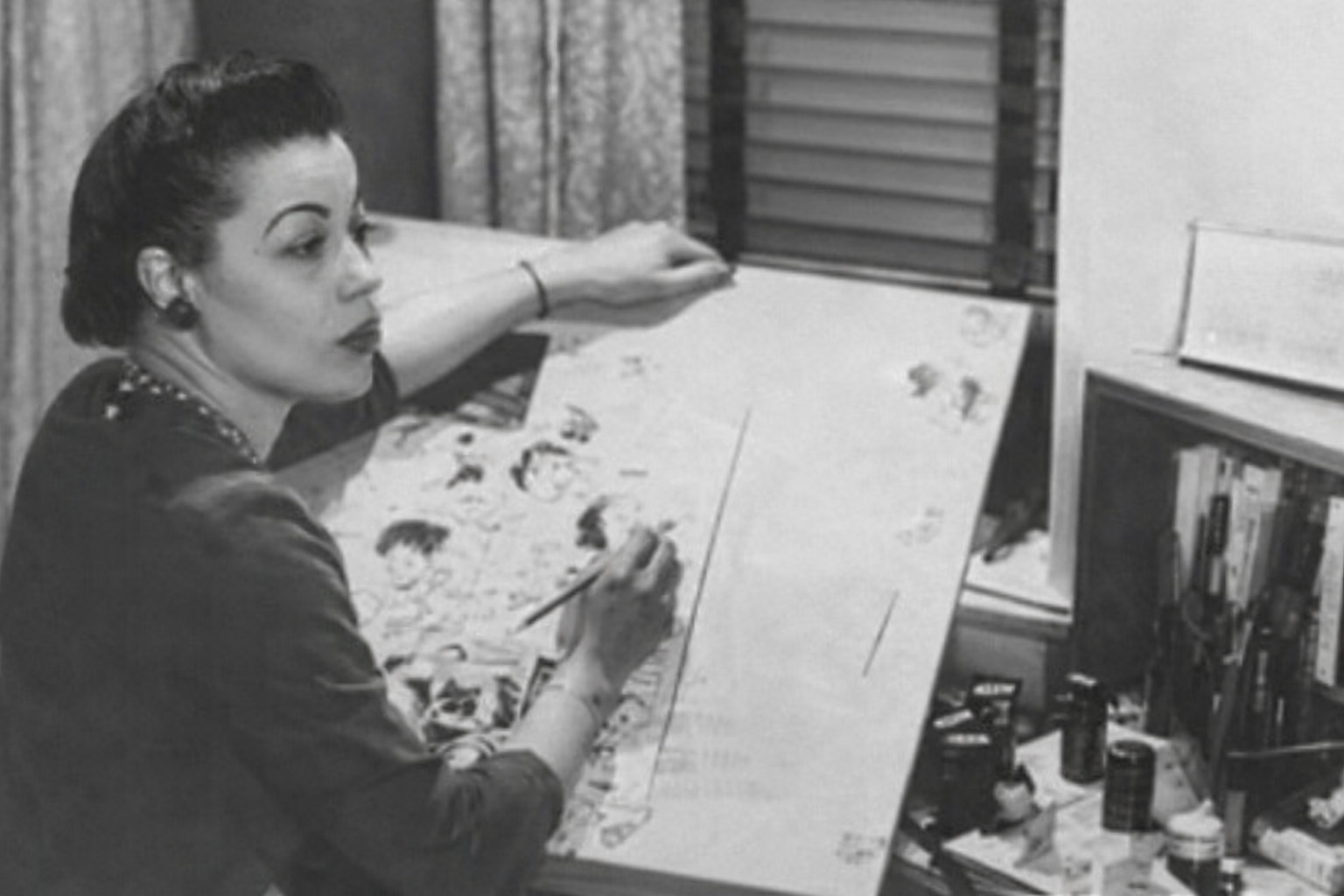
The Genius of Black People
Created by Rev. Dr. Otis Moss III, TheHub.news presents its Black History Month series celebrating the genius of Black people—stories of courage, faith and creativity forged in struggle. Inspired by ancestors like Walter Francis White, this series honors sacred memory and lifts up the divine brilliance shaping justice and resilience today.
Jackie Ormes (1911–1985) is widely recognized as the first Black woman to become a professional cartoonist in the United States. Self-taught, her work fundamentally reshaped how Black people, especially Black women, were depicted in popular media. Working primarily from the 1930s through the 1950s, she used the comic page to challenge racist caricatures, celebrate Black style and intellect and insert sharp political commentary into everyday Black life.
Ormes began her career as a proofreader for the Pittsburgh Courier, one of the leading Black newspapers of the era. In 1937, she debuted “Torchy Brown in Dixie to Harlem,” a comic strip following a young, ambitious Black woman who leaves the South to pursue a singing career in New York. At a time when mainstream comics and newspapers relied heavily on demeaning, minstrel-based images of Black people, Torchy was glamorous, independent and adventurous. She had agency, ambition, and desire, a direct rebuttal to the stereotypes that dominated white-owned media.
In the mid-1940s, Ormes created “Patty-Jo ’n’ Ginger,” a single-panel cartoon that ran in the Courier for years. The strip featured Ginger, a fashionable older sister, and Patty Jo, a politically aware little girl whose sharp commentary skewered segregation, housing discrimination, the Cold War, McCarthyism and more. Through Patty Jo’s wisecracks, Ormes brought sophisticated political critique into the realm of domestic humor, making it accessible to readers who rarely saw their concerns acknowledged in print. She also collaborated on a Patty-Jo doll, one of the first mass-produced Black dolls that looked like a real child instead of a caricature, another quiet but powerful intervention in representation.

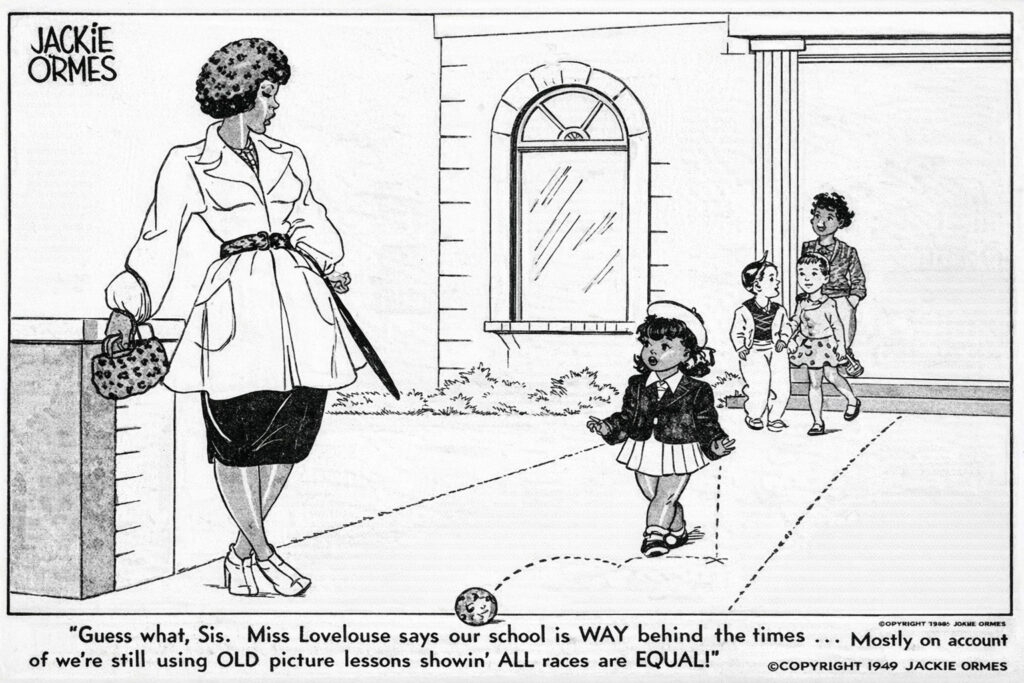
Ormes’s work was more than entertainment; it was visual counter-narrative. Her characters were stylish, modern and deeply human. They moved through middle-class Black worlds filled with art, fashion, romance and conversation, images that contradicted the narrow roles assigned to Black characters elsewhere. By drawing Black women as complex, intelligent and beautiful, Ormes opened cultural space for later generations of Black artists and storytellers.
Today, Jackie Ormes is celebrated not only as a pioneer in comics but as an early architect of positive Black representation. She understood that images shape imagination and that how Black people are drawn on the page influences how they are seen in the world. Through ink and wit, she insisted on dignity, nuance and joy.