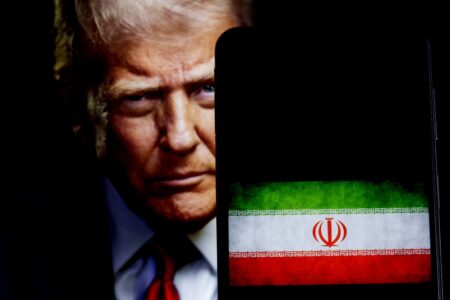




The only way systems of large-scale violence survive public scrutiny is by teaching people to see them in fragments.
War happens over there. Policy happens in conference rooms. Reconstruction happens after the crisis. Technology is neutral. Policing is domestic. Race is social. Authoritarianism is something that happens in other countries. But power has never respected those boundaries. Power moves through destruction, administration, investment, and enforcement as part of the same continuum. And once you see that pattern clearly, it becomes very difficult to pretend that any of these stories are separate from each other.
A few weeks ago, political leaders, billionaires, and policy architects stood under the sterile lights of a global economic conference in Davos and talked about Gaza like it was a fixer-upper.
Not a graveyard.
Not a mass trauma site.
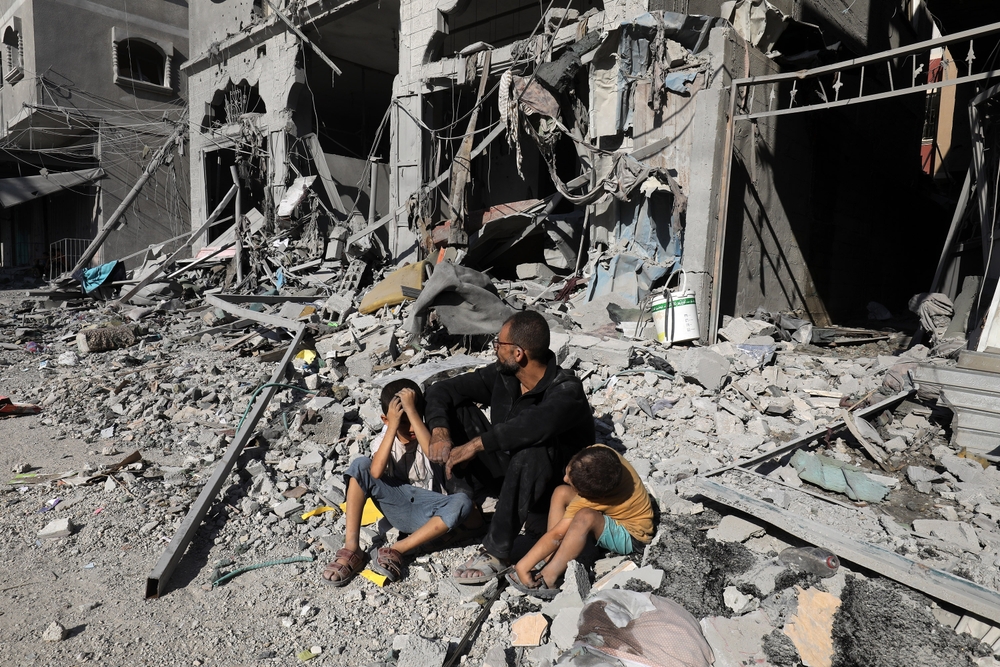
Not a place where thousands of human beings are starving and families are still digging through concrete dust with their bare hands looking for bone fragments.
A fixer-upper.
They spoke about master plans, infrastructure corridors, coastal tourism, industrial zones, and the promise of a fully rebuilt territory rising from devastation into something modern, profitable, and strategically valuable.
The imagery accompanying those discussions was clean, polished, and eerily serene. Glass towers stretched along the Mediterranean coastline. New housing complexes, industrial districts and technology hubs stood where flattened neighborhoods once held families, shops, mosques, schools, and ordinary daily life. The message was unmistakable: destruction was being reframed as opportunity, and the future was being marketed before the present catastrophe had even ended.
At the center of it all was the language that always appears when power is preparing to do something monstrous and call it progress. The conversation was not about mourning or accountability. It was about location, potential, reconstruction timelines, investment, and profit.
Gaza was described as strategically positioned coastal property, as if geography could be separated from the people who lived and died on that land. The scale of destruction was reduced to engineering metrics: millions of tonnes of rubble, demolition logistics, and construction capacity. Entire communities became technical obstacles to be cleared. Entire generations of life were translated into debris removal projections. The emotional and human reality of that destruction was almost entirely absent from the forward-facing narrative of redevelopment and investment.
At the time, many people were disturbed by the tone of those conversations. There was something grotesque about watching glossy architectural fantasies being unveiled while humanitarian catastrophe remained ongoing. But what is becoming clearer now, weeks later, is that the moral horror of that moment was even deeper than many people initially understood. Because while those redevelopment visions were being unveiled to the world, another reality was unfolding on the ground; one that is now being described in reports, investigations, and survivor testimony in ways that should permanently change how we understand what has happened in Gaza and the scale of human cruelty required to sustain it.
Those investigative reports describe the use of chemicals and munitions and explosive force capable of generating extreme heat and pressure environments that do more than kill. They destroy the physical evidence of human existence.
Families have described situations in which multiple people were present in enclosed spaces during strikes, yet fewer bodies were recovered than the number of people known to have been there. Civil defense teams have described being forced to document absence rather than remains. The language emerging from these accounts is horrifying in its simplicity. People are not only dying. In some cases, they are being reduced to biological traces, fragments, or nothing that can be physically identified as a body.
And you have to ask: what kind of mind studies the human body closely enough to understand how to make it disappear? What kind of system rewards the engineers, scientists, and policymakers who dedicate their careers to methodically design weapons and perfecting the mechanics weapons whose purpose is not just to end life, but to erase the physical fact that a human being was ever there?
The psychological and cultural violence of that reality is profound. Human societies are built around the ability to bury, mourn, and physically acknowledge the dead. Burial rituals exist across cultures because they are essential to how humans process grief, maintain memory, and mark historical truth. When bodies cannot be recovered, grief becomes suspended in a state of permanent uncertainty.
Families are denied closure. Communities are denied the ability to fully document their losses. Entire lives risk being reduced to statistical estimates rather than being recorded as individual human stories. When death becomes so physically destructive that it erases the physical evidence of a person’s existence, the violence extends far beyond the moment of killing. It becomes a form of historical erasure.
Now, when you place these two realities next to each other, the rapid unveiling of futuristic redevelopment plans and the simultaneous emergence of reports describing catastrophic bodily destruction, the moral contradiction becomes impossible to ignore. The same territory being marketed as a future tourism and technology hub is also is also a landscape where people are being killed in ways that can leave little physical trace behind. The same coastline being discussed as prime development opportunity is still the site of ongoing civilian death, mass displacement, and unresolved humanitarian collapse.
This sequence follows a pattern that is deeply familiar in the history of empire and colonial expansion.
Large-scale violence is followed by administrative restructuring. Administrative restructuring is followed by economic rebranding. Once the destruction becomes normalized or distant enough from global attention, redevelopment is presented not as replacement, but as “progress.” The original population becomes a historical preface to a new economic narrative. The violence that created the conditions for redevelopment becomes reframed as unfortunate but necessary, and eventually, it disappears from the primary story entirely.
When you look at this historical pattern honestly, you begin to see how different supremacist projects often move in parallel. You begin to see how racial domination systems, whether built through colonial expansion, apartheid logics, or ethno-nationalist state violence, rely on the same sequence: dehumanize, destroy, reorganize, and then rename the result as civilization, security, or progress.
Different histories. Different religious contexts. Different political vocabularies. But a disturbingly similar belief that some populations are expendable if their removal clears the path for the future someone else wants to build.
The reports describing extreme weapons intensify this pattern because they raise urgent questions about evidence, documentation, and memory. When people die in ways that leave identifiable remains, there is at least a physical record of their existence. When people die in ways that leave little trace, the burden of historical proof shifts almost entirely onto testimony and incomplete records. That shift matters enormously because physical evidence often determines whether atrocities are recognized, investigated, or denied. When violence becomes powerful enough to erase physical evidence, it also becomes easier to erase historical accountability.
What makes this moment uniquely disturbing is the speed of the narrative transition. Once redevelopment narratives fully take hold, it becomes much harder to reinsert the memory of violence into public consciousness. The earlier someone documents the transition from destruction to development language, the harder it is for history to be rewritten cleanly.
Right now, the world is being asked to move from humanitarian catastrophe to redevelopment vision while the catastrophe is still unfolding. The deeper question is not whether Gaza will eventually need rebuilding. War zones do require reconstruction. The question is who controls the narrative of that reconstruction and whose lives are centered in that story.
Who decides when a place transitions from site of mass mourning to site of economic opportunity? Who defines what “new” means when the previous version of that place was destroyed through large-scale violence? Whose deaths are treated as central to the historical story, and whose deaths become background conditions for future development? And so we have to write against future amnesia
This is not simply a geopolitical conflict. It is a struggle over historical memory. It is a struggle over whether mass destruction will be remembered as tragedy requiring accountability or reframed as transformation requiring investment. History shows that redevelopment often arrives hand in hand with historical amnesia. But amnesia is never complete. The physical structures of the future are always built on top of the moral record of the past.
What makes this moment even more terrifying is not just what these weapons appear to do to the human body. It is the fact that they exist at all, that they are being deployed with Western supply chains, and that their development reflects a broader global trend toward increasingly total forms of state violence.
Weapons are never created in a moral vacuum. They are created because someone anticipates a future in which that level of destructive force will be considered useful or necessary.
History offers an uncomfortable pattern. Military technologies normalized in foreign conflict zones often migrate into domestic security doctrine. Surveillance systems, counterinsurgency tactics, and militarized policing frameworks have repeatedly followed this path. What begins as war fighting abroad often becomes public safety at home.
This is why marginalized communities in the United States need to pay attention to how state violence is normalized abroad. Law enforcement exchange and training programs between U.S. police departments and Israeli security forces have been publicly documented for years. These programs are framed as counterterrorism cooperation. But they also represent deeper ideological exchanges about how states identify and manage populations they perceive as threats.
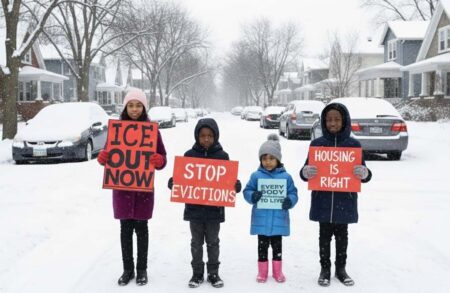
We are already living in a moment where immigration enforcement is described by many communities as traumatic and terrorizing. When enforcement is paired with militarized language, militarized equipment, and militarized tactical frameworks, it shifts the relationship between communities and the state from governance to occupation.
The existence of extreme weapons technologies forces a larger moral question: why does any society believe it needs weapons capable of producing that level of total bodily destruction? None of this means battlefield weapons will be deployed wholesale inside American cities. But it does mean that societies that normalize extreme state violence abroad often normalize increasingly aggressive forms of state control at home.
The most dangerous shift is not technological, but psychological. It is the moment when societies begin to believe that extreme violence is sometimes necessary for stability. Once that belief becomes normalized, the question is no longer whether extreme force will be used again.
The question becomes who will be reclassified as a legitimate target next.
Thanks for reading. If this piece resonated with you, then please consider becoming a paid subscriber. Paid subscriptions help keep my Substack unfiltered and ad free. They also help me raise money for HBCU journalism students who need laptops, DSLR cameras, tripods, mics, lights, software, travel funds for conferences and reporting trips, and food from our pantry. You can also follow me on Facebook!
We appreciate you!