


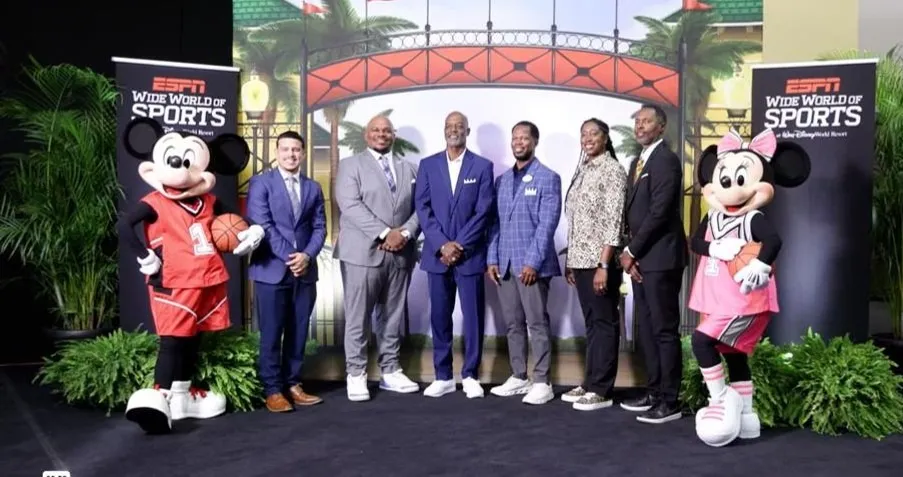
This weekend, the HBCU Hoops Invitational takes over the Walt Disney World Resort to bring together men’s and women’s basketball teams from across the HBCU landscape.
But the tournament, run by HBCU Hoops Global, Inc., is about much more than basketball.
“The HBCU Hoops Invitational is far more than a basketball tournament—it’s a powerful celebration of heritage, excellence and the limitless future of HBCU athletics,’’ said HBCU Hoops Global vice president Haywoode Workman, who is a former NBA player, NBA referee and HBCU athlete. “We are building a legacy that extends well beyond the court to open doors to academic achievement, career readiness and financial opportunity for our scholar-athletes.”
I spoke with Workman about the tournament and its importance both on and off the court.
“It all began as a 19-year-old kid playing in the CIAA in the conference championship in football….and I was the starting point guard,” said Workman.
It was his experience as a two-sport athlete at Winston-Salem State University where he first honed his experience and love for HBCUs, and as time passed and he played in the NBA and then refereed in the league, he began to realize that HBCUs were overlooked by college basketball tournament organizers.
“Hold up. There’s never been an HBCU at the Maui Invitational?” he questioned many, many years ago.
That realization shifted his focus back to college basketball and HBCUs specifically, and became the first step in creating and launching the HBCU Hoops Invitational.
“Around 2015, 2016, I decided that after I finish reffing, this is what I was going to retire to do- the HBCU Hoops Invitational.”
So almost a decade later, that vision has finally come to reality in Florida.
Taking to the court are Florida A&M University, Tuskegee University, Florida Memorial University and Barber-Scotia College on the men’s side, and Bethune-Cookman University, Hampton University, Edward Waters University and Cheyney University on the women’s side.
For Haywoode, this is a dream come true, but it’s not something completely new to him for not only did he have decades of experience in the sport, but he also ran his own Pro-Am, so he learned how to organize and structure tournaments and how to bring people together.