




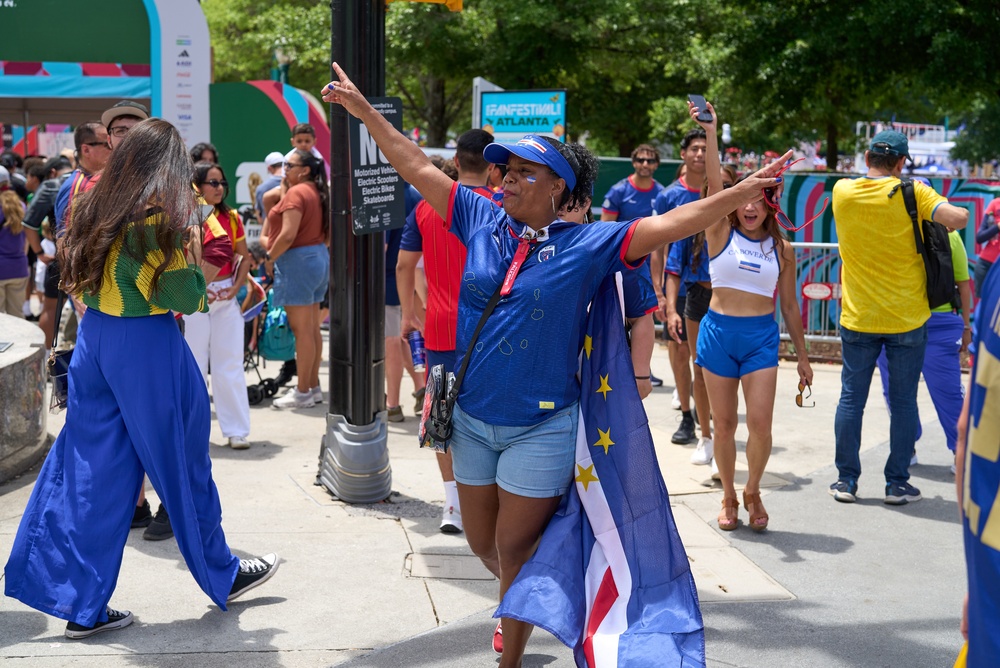
David didn’t topple Goliath this time, but Cape Verde’s World Cup dream ended in a masterclass of pure determination.
Going toe-to-toe with the soccer superpower Argentina in extra time in one of the greatest World Cup upsets in recent memory, after having navigated a tough group stage unbeaten—securing draws against Spain, Uruguay and Saudi Arabia—and making their first-ever appearance in the tournament’s knockout rounds, this small but mighty team didn’t just play “fútbol”.
They wrote their own legendary underdog story!
Known as the Blue Sharks, they kicked off their World Cup debut on June 15 with a string of mind-blowing performances. In their first match, they faced off against Spain, the reigning European champions, and stunned them—and left them goalless—with a surprising 0-0 draw. With an impressive roster featuring standout players like Pedri, Lamine Yamal and Rodri, Spain was widely considered a favorite to go far in the tournament, but they couldn’t find a way to breach Cape Verde’s defense, leaving many spectators scratching their heads and questioning if the result was just a lucky fluke.
Well, it wasn’t luck. And Cape Verde wasn’t done yet.
On June 21, their next game against Uruguay, ranked 19th in the world, the Sharks continued to defy expectations. They fought hard to secure a 2-2 draw, marking a monumental moment as they scored their first-ever goals in World Cup history.
With many skeptics in their rearview, the momentum was palpable as they headed into their final Group H match against Saudi Arabia on June 26. They faced yet another challenge, but they held their ground, concluding the match in another 0-0 draw. This result not only solidified their reputation as a team to be reckoned with but also allowed them to make history again by advancing to the knockout stage, an achievement that will surely be celebrated for years to come.
Still, their story didn’t end there.
Defying Uruguay was one thing. But pushing Argentina to the very edge of humiliation on Friday night in Miami was an absolute clinic in fearlessness. Proving their previous victories were no stroke of luck, the Sharks stepped onto the pitch against the world’s best with a terrifying swagger, a small island country with a population of just over 500,000 against a soccer-obsessed nation with over 46 million people. One country making its World Cup debut as a No. 67-ranked team in FIFA, going head-to-head with the defending world champions, who are not only the reigning title holders and heavyweights but also boast the best player in the sport.
Cape Verde, however, wasn’t intimidated by legacy, stars or pressure. Instead, they pushed the reigning champions into extra time and into a thrilling spectacle of mental toughness, tactical brilliance and pure, unfiltered willpower.
For 120 heart-pounding minutes, Argentina would fight Cape Verde like hell to clench the lead with goals of 1-0, 2-1 and finally 3-2, but the Sharks never backed down despite the odds. Although they ultimately couldn’t pull off the upset—Argentina advanced to the round of 16—they really didn’t need to conquer the reigning champions to leave a lasting impact on soccer enthusiasts and the world at large.
Players like Vozinha (the team’s star goalkeeper), who delivered stunning performances in goal, has cemented his place in the annals of Cape Verdean soccer and the history of the World Cup. Sidny Lopes Cabral’s incredible equalizer in extra time not only demonstrated his skill but also created a moment that fans will recall alongside the most memorable goals ever scored in the tournament.
Cape Verde (officially known as Cabo Verde), an enchanting archipelago of ten islands situated about 600 kilometers off the coast of West Africa, possesses a rich history and dynamic culture. Discovered in the mid-1400s by explorers from Genoa and Portugal, these islands remained uninhabited until the Portuguese established a settlement in Cidade Velha in 1464, which eventually became the first capital.
Initially used as a shipping hub and a center for the trade of enslaved people, Cape Verde underwent significant transformations over the centuries, ultimately achieving independence from Portugal in 1975. Today, the islands are home to a population of 530,000, making it one of the smallest countries to qualify for the World Cup, alongside Curaçao.
Cape Verde’s capital city, Praia, houses around 180,000 residents, while São Vicente contributes another 88,000 to the mix. Praised for its political stability, the country stands out as one of the most reliable democracies in Africa, with a thriving economy primarily driven by services like tourism and foreign investment. A sizable community of Cape Verdeans, estimated at 500,000, resides in the United States, where they passionately cheered for their national team during the World Cup.
According to The Guardian, Cape Verde earned a spot in the tournament by competing in the African qualifiers. Their journey began poorly with a 0-0 tie against Angola, followed by a tough 4-1 loss to Cameroon. Despite this rough start, they managed to win seven out of their next eight matches, finishing first in their group and pushing the favored Cameroon to second place.
“Independence Day and 13 January 1991—when the first multiparty elections were held—are the two symbolic dates that have united our people,” José Maria Silva, the national director of state protocol, told the British publication after the team qualified. “This World Cup qualification can already be considered the third defining moment of our nation.”
The 26-player roster consists of many players with dual nationalities, brought together by coach Pedro Leitão Brito, also known as Bubista. It includes members from 25 clubs across 14 countries. Interestingly, there are more players born in the Netherlands (six) than in Praia (four); and a total of 11 players hail from Cape Verde.
The standout player is their captain, Ryan Mendes, who has played for Lille in France and Nottingham Forest in England before moving to the UAE and Turkey.
Cape Verde was placed on a list by the U.S. government that requires citizens to pay a returnable bond of $15,000, along with a visa fee, in order to travel to the states. This high cost stopped Vozinha’s mother, Ana Candida Evora, from attending the tournament, until House Democratic leader Hakeem Jeffries, the only member of Congress with Cape Verdean heritage, stepped in to help.
Jeffries contacted Secretary of State Marco Rubio and urged the State Department to use all available resources to assist the family. He worked alongside FIFA and the Cape Verdean government to get the necessary entry requirements cleared, including waiving the U.S. visa bond fees that citizens of Cape Verde typically face. These combined efforts allowed Vozinha’s mother to obtain her visa in time to attend his match against Uruguay in Miami.
“Cape Verdeans in America and throughout the diaspora have been celebrating the underdog grit and resilience of the Blue Sharks, joined by soccer fans from nations throughout the globe,” Jeffries said before the match against Uruguay.
He continued. “It is a privilege to announce that Vozinha’s mom will be able to secure a visa in time to attend their game this Sunday against Uruguay.”
When the final whistle blew, the world didn’t see a defeated team in Cape Verde. They saw legends. And the country didn’t just participate in this World Cup; they shattered the glass ceiling of what a tiny nation of people can achieve.
So, to every dreamer, every underdog and every person told their goals are ‘out of reach,’ let the Blue Sharks be your ultimate proof: never let the size of the giant dictate your faith.
Because sometimes, you don’t always need to lift a trophy to change the world – you just need to “write your story”…and the world will watch you rise, too.