


Norman C. Francis, civil rights champion, recipient of the Presidential Medal of Freedom and the first Black president of Xavier University of Louisiana, passed away last Wednesday, February 18th, in Jefferson, La.
His death, in a hospital, was announced by his family.
Mr. Francis was 94.
Community members, activists and leaders throughout Louisiana are uniting to celebrate his life and the impact he made. He was an extraordinary person whose commitment to service played a vital role in creating a brighter future for Louisiana.
“The nation is better and richer for his having lived among us,” expressed Reynold Verret, the president of Xavier University in a statement.
A pivotal figure in the aftermath of Hurricane Katrina, Mr. Francis stepped up to lead the Louisiana Recovery Authority, which was responsible for overseeing the massive, multi-billion-dollar rebuilding effort that followed the devastating storm. His leadership not only guided the upturn but also inspired countless individuals to participate in rebuilding their communities, too.
Former New Orleans Mayor Mitch Landrieu recently took to social media to pay tribute. Reflecting on their relationship, Landrieu, who was serving as lieutenant governor when Hurricane Katrina destroyed 80% of the city in 2005, noted how he often turned to Francis for advice during his most challenging moments.
“Francis stood in the breach,” Landrieu said, calling attention to the guidance Mr. Francis provided when the community needed it most. He underscored that what truly sets Mr. Francis apart is his profound respect for every individual, treating them with dignity no matter the circumstances.
Mr. Francis was also a transformative figure in American education, particularly for his long-standing presidency at Xavier University in New Orleans, the only predominantly Black Catholic university in the nation. Taking the helm in 1968, he broke a 40-year tradition of leadership by white nuns, marking a major shift in the university’s history.
His journey began even earlier in 1952 when he became the first Black student to integrate the law school at Loyola University, a move he described as something that “had to be done.” In an interview with Xavier in 2019, he contemplates his activism, pointing out that the goal was to “shake up things” and advocate for serious progress in civil rights. Over his remarkable 47-year tenure at Xavier, which concluded in 2015, he not only shaped the institution but also became one of the longest-serving college presidents in American history.
Norman Christopher Francis, born on March 20, 1931, in Lafayette, Louisiana, was the fourth of five children in a family that faced significant financial hardships. His father, Joseph Abel Francis, worked various jobs as a barber, bellhop and railroad worker, while his mother, Mabel (Coco) Francis, nurtured their Catholic household, which held education in high regard.
Growing up in the shadows of the Jim Crow South, Mr. Francis’s childhood was marked by both challenges and a deeply cultural environment. He fondly remembered the shared French language that bridged some divides between Black and white communities in Lafayette, but the legacy of his father’s mixed-race heritage added complexity to his identity, as he recalled his father’s painful background stemming from a time when societal norms often led to injustice.
Despite these obstacles, Mr. Francis excelled academically, earning the title of valedictorian at St. Paul Catholic School in 1948. His academic achievements earned him a scholarship to Xavier University, where he balanced his studies with a work-study position in the library. His leadership qualities shone through as he served as class president each year, culminating in his graduation in 1952 with a bachelor’s degree in mathematics.
During a 2013 interview with The New York Times, Mr. Francis recounted a decisive experience from his first day at Loyola’s law school that year, when three white students, including Mr. Landrieu, approached him with an unexpected gesture of camaraderie.
“Those three guys walked up to me and said, ‘We want you to know that if you ever need a friend, we’re going to be your friend,’” he recalled, an act that resonated deeply with him as he navigated a predominantly white environment. The moment of kindness and support became a cornerstone of his law school experience, which he described as transformative. It helped dispel any lingering doubts he may have had about his own capabilities, allowing him to recognize that he could indeed compete with those who were perceived to be part of a “superior” race.
Mr. Francis’s journey is a wonderful testament to toughness and guidance shaped by vital moments in American history. After earning his law degree in 1955, he joined the U.S. Army and served in Germany’s Third Armored Division, marking the beginning of a life dedicated to service and advocacy. He quickly transitioned into an outstanding role at Collins, Douglas and Elie, a groundbreaking Black law firm in New Orleans, which represented the Congress of Racial Equality and other civil rights clients. By 1957, he became the dean of men at Xavier University. In a poignant twist of fate, he accepted the presidency of Xavier on the very day that Rev. Dr. Martin Luther King Jr. was assassinated in 1968, a moment that surely weighed heavily on his shoulders. His friendship with Moon Landrieu, who was later sworn in as mayor in 1970, revealed a deeper connection to the city’s civil rights journey; Mr. Francis had the honor of introducing Landrieu at the inaugural ceremony, a powerful gesture of unity in an era of consequential change.
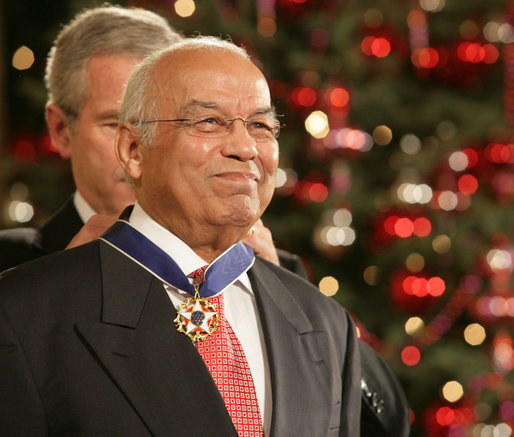
Following the devastation of Hurricane Katrina in 2005, when Xavier was submerged under six feet of water, Mr. Francis acted swiftly to restore the university, ensuring that classes resumed in less than six months. His direction extended beyond the campus when Governor Kathleen Blanco appointed him chairman of the Louisiana Recovery Authority, coordinating the recovery efforts. In recognition of his exceptional contributions, he was awarded the Presidential Medal of Freedom by President George W. Bush in 2006, solidifying his legacy as a champion for both education and civil rights, a life story that not only reflects his personal achievements but also encapsulates the broader struggle for equality, diversity and social justice within the New Orleans community and beyond.
Mr. Francis was married to his wife, Blanche, from 1955 until her passing in 2015. He is survived by his four sons: Michael, Tim, David and Patrick; his two daughters, Kathleen and Christina; his sister, Mabel Bailey; and 11 grandchildren.