




Every season has its ritual scold.
In the summer it’s, “When I was a kid we cut grass for a couple dollars.” In the fall it’s, “We raked leaves and made pocket change.” In the winter it’s, “We shoveled snow. I don’t see no kids out here anymore.”
And then comes the childism and tired-ass sermons about moral decay. The slow head shake. The disappointed uncle voice. The “these kids today…” followed by a whole pile of child-hating. These kids today are lazy, soft, entitled, screen-rotted. Don’t know real work. Don’t know struggle. Don’t know discipline.
It’s grown people looking at a nine or 12-year-old and going, Why aren’t you reenacting my 1983 trauma so I can feel like it built character instead of calluses and anxiety? It’s adults mad that children are not auditioning for their nostalgia porn. Mad that childhood is no longer available as proof-of-suffering exhibits.
And online posts are always paired with the same visual: a grown man planted wide in the frame, chest out, shoulders squared, gripping a tool like a prop from a masculinity audition. The rake, the mower, the shovel becomes a scepter. Look at me, it says. Look at how manhood used to be forged. Look at how soft everybody else has become.
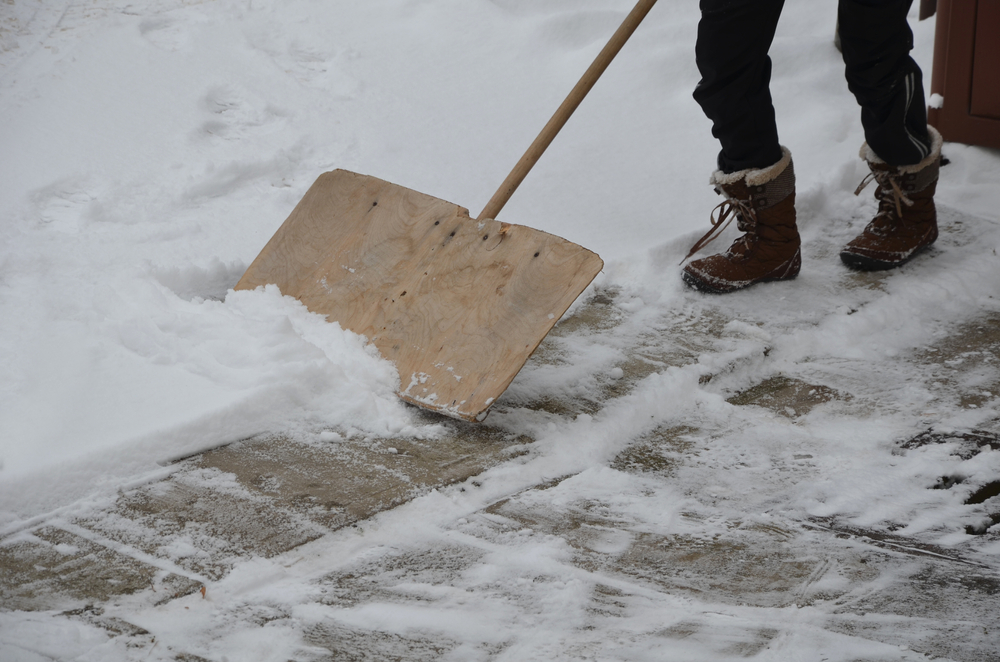
This particular one shows a dude standing in fresh snow, shovel in hand, posed like a catalog model for rugged virtue. He ain’t shoveling. He’s performing shoveling. The stance is deliberate. The camera angle is deliberate.
And somehow, before your eyes even climb back up to his face, they get dragged straight to the aggressively centered bulge, like the composition itself is whispering, no, no, start here. Sir is standing there so desperate to broadcast “manhood” to the entire neighborhood that even the fabric has grown indiscreet.
And then comes the quiet accusation: Where are the kids? Where is the proof that suffering still builds character? Where is the evidence that the next generation is being hardened the way I was hardened? Where is the ritual that reassures me my pain meant something?
Because this ain’t really about snow. Or grass. Or leaves. It’s about a moral nostalgia that needs children to reenact struggle in order for adult hardship to feel meaningful. It’s about a worldview that confuses endurance with virtue and deprivation with discipline. It’s about adults looking at the past and wanting it sanctified, not examined.
What they’re really saying is: My hardship needs witnesses. My past needs validation. My masculinity needs a comparison target that can’t talk back. What they’re really saying is not kids have changed. It’s the world changed, and I don’t know how to make sense of myself inside of it anymore. So they reach for the easiest target to punch down on: children. And suddenly a snow shovel becomes a moral measuring stick, and childhood becomes a character flaw.
The critique masquerades as concern for work ethic, but what it’s really doing is policing worth. It is saying: we suffered, therefore you must suffer. We labored young, therefore you must labor young. We were cold, tired, unsupervised, and expendable, therefore that is the proper shaping of a human being. And if you are not being shaped that way, then something must be wrong with you.
What it exposes is not laziness in children. It exposes unresolved grief in adults. Grief over an economy that no longer guarantees dignity. Grief over masculinity that no longer automatically confers authority. Grief over a world that no longer tells a clean story about effort leading to security. So the longing gets displaced onto children’s bodies. If the kids are struggling, then maybe the struggle still makes sense.
But a kid not shoveling your driveway is not a civilizational collapse, for Christ’s sake. It ain’t the fall of Rome. And it ain’t proof of decay. It is just the world no longer requiring children to perform unpaid or barely paid, uninsured, cold-numbed labor so grown men can feel validated in their struggle.
This is a whole ideology that treats children as failed adults instead of people living inside a different economy, a different legal system, a different risk environment, a different surveillance regime. There are very real, very logical reasons you don’t see packs of kids knocking on doors with shovels anymore, and none of them have anything to do with character.
Let’s start with the fact that the law says children are not supposed to be casual labor pools anymore. Liability is real now. Insurance is real. A homeowner who lets a twelve-year-old clear their driveway and that child slips, hits their head, injures their spine, loses fingers to frostbite, can be sued into oblivion. Entire industries exist now to absorb that risk. Professional snow removal, landscaping services, gig-economy labor, all of it has replaced informal child work because adults are not willing to hold the legal responsibility they once shrugged off.
Adults changed childhood itself. Kids are not roaming neighborhoods the way they once did. Their time is scheduled, monitored, and enclosed. There’s after-school programs, sports, tutoring, therapy, childcare logistics for dual-income households. Free-range wandering has been replaced with GPS-tracked movement. A child knocking on doors today does not read as “enterprising” to many adults. It reads as “Where are your parents?” It reads as “Is this safe?” It reads as “Should I be concerned?”
Adults changed the economy. A “couple dollars” once bought real things. It had weight. Today it’s symbolic at best. No parent is sending their child out into freezing weather for wages that wouldn’t buy a snack. The labor-to-reward ratio is absurd. Adults know this, even when they pretend not to.
And adults changed the threat landscape. In a world of constant surveillance, racial profiling, armed neighbors, police encounters, and viral fear, a child moving independently through adult spaces carries a danger that did not carry the same social meaning decades ago. A white boy with a rake might still be read as wholesome. A Black boy with a shovel might be read as a problem. A Brown kid knocking on doors might be read as suspicious. The nostalgia never accounts for that. It universalizes an experience that was never universal.
We don’t have to imagine it because we’ve seen it.
Because we all watched a Black teenager get hunted and killed for the crime of walking home with Skittles and iced tea. Trayvon Martin wasn’t hustling for pocket change. He wasn’t trespassing. He wasn’t threatening anyone. He was existing while Black, and that was enough to get him stalked and shot. Childhood did not protect him. Innocence did not protect him. “Mind your business and go home” did not protect him.
And just a couple of years ago, a Black boy rang the wrong doorbell in Kansas City and got shot in the head by a white man who decided a child’s mistake was a capital offense. Luckily, he survived. And not long ago, an 11-year-old boy in Houston was killed after a neighbor opened fire when he knocked on the door during an innocent prank.
A child.
Knocking.
On a door.
And for brown and immigrant children, the danger isn’t just gunfire. In Minneapolis this month, Immigration and Customs Enforcement agents detained a five-year-old boy alongside his father as they returned from preschool. This is a moment that has rattled entire communities and underscored how federal enforcement now reaches into everyday life in ways most adults in the nostalgia crowd have never contemplated. This is what ‘Where are the kids?’ sounds like in 2026: a five-year-old getting cuffed on his way home from preschool.
The same thing these nostalgia posts are fantasizing about, kids going door to door, offering help, moving freely through neighborhoods. That fantasy ends the second the kid isn’t white. The myth of the independent kid workforce erases that reality, and in doing so, turns nostalgia into blind spot and sentiment into erasure.
So when people say, “Why don’t kids shovel snow anymore?” what they’re really refusing to say is, the world is armed, paranoid, racialized, and primed to see certain children as threats instead of neighbors demonstrating rugged work ethic. They’re refusing to say that for some kids, moving through adult space now comes with the risk of being followed, confronted, arrested, or shot dead. They’re refusing to say that what once looked like wholesome hustle can now look like a 911 call.
The nostalgia pretends that all children once had equal safety to roam, to knock, to wander, to work. But they didn’t. They never did. And they still don’t.
So when adults ask, “Where are the kids?” what they are really asking is, “Why doesn’t the world look the way it did when my suffering could be romanticized? Why can’t we still believe that hardship is automatically redemptive? Why can’t we still tell ourselves that being made small, cold, tired, and useful was a kind of blessing?”
The posture in these photos tell the story. I carried more. I froze more. I worked earlier. I needed less. And therefore I am more.
But children are not supposed to be props in adult identity repair. They are not supposed to be evidence that pain builds virtue. They are not supposed to be reenacting economic precarity so grown men can feel validated about their pasts.
The real question is not why kids aren’t shoveling snow. The real question is why do so many adults need them to.
If we keep it all the way real, we can admit that this is what capitalism does. It trains people to romanticize their own exploitation, to call it grit, to call it discipline, to call it manhood, and then to demand that the next generation prove its value by suffering too.
Because if the kids don’t have to be exploited and hardened now, then a lot of grown folks have to finally sit with the possibility that they suffered for nothing. And some of them would rather bully a generation of children than grieve that truth.
Thanks for reading. If this piece resonated with you, then please consider becoming a paid subscriber. Paid subscriptions help keep my Substack unfiltered and ad free. They also help me raise money for HBCU journalism students who need laptops, DSLR cameras, tripods, mics, lights, software, travel funds for conferences and reporting trips, and food from our pantry. You can also follow me on Facebook!
We appreciate you!