


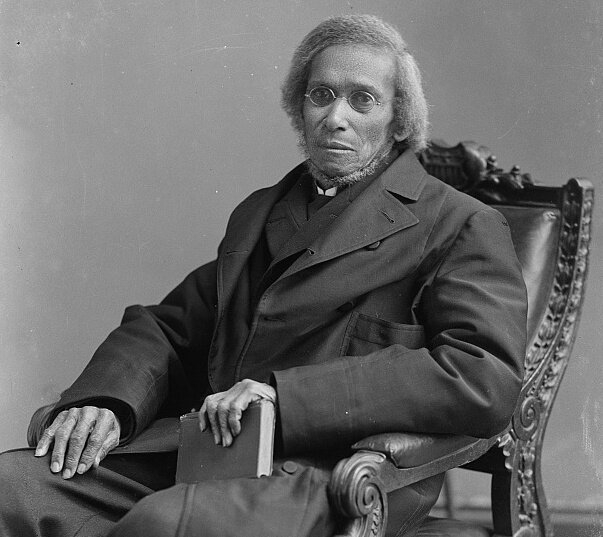
This day in history marks the birth of Daniel Alexander Payne, a towering figure in American religious and educational history who was born on February 24, 1811, in Charleston, South Carolina.
Payne was born free into a prominent free Black family and raised in the Methodist tradition. Orphaned at a young age, he relied on relatives and local mutual aid societies for support and education. Largely self-taught, Payne studied mathematics, science, and classical languages and opened his first school in Charleston at just 18 years old. His early commitment to education was interrupted in 1835, when South Carolina outlawed the teaching of literacy to enslaved people and free people of color in the aftermath of Nat Turner’s rebellion. Forced to close his school, Payne left the South in search of opportunity.
He traveled north to Pennsylvania and enrolled at the Lutheran Theological Seminary in Gettysburg, becoming the first African American educated and ordained by an American Lutheran church body. Although he never served as a Lutheran minister, the experience shaped his lifelong belief that disciplined education was essential to strong religious leadership.
By the early 1840s, Payne joined the African Methodist Episcopal Church, which he viewed as both a spiritual institution and a vehicle for racial justice. He quickly emerged as a reformer, pressing for higher educational standards for ministers and greater organizational structure within the denomination.
“The first duty is to improve the ministry; the second is to improve the people,” he argued repeatedly, often drawing resistance from those who favored emotional worship over formal training.
In 1852, Payne was elected the sixth bishop of the AME Church, a role he would hold for more than 40 years. His influence expanded dramatically after the Civil War. Returning to the South for the first time in three decades, Payne organized missionary efforts aimed at newly freed Black Americans. From Charleston, he helped establish congregations across the South, from Florida to Texas. By the end of Reconstruction, the AME Church had gained more than 250,000 new members under his leadership.

Payne also made history in higher education. He was a founder of Wilberforce University in Ohio in 1856, and in 1863, after the AME Church purchased the struggling institution, he became its president. His appointment made him the first African American to serve as president of a college in the United States. He led Wilberforce through financial hardship, rebuilding after an arson fire and securing support from private donors and Congress. He served as president until 1877.
An accomplished author, Payne published his memoir, “Recollections of Seventy Years”, in 1888 and followed it with The History of the A.M.E. Church in 1891, the first formal history of the denomination.
Daniel Alexander Payne died on November 2, 1893, in Baltimore. His legacy endures through institutions that bear his name, including Payne Theological Seminary, Daniel Payne College, and schools and streets across the country. Historians credit him as one of the most influential figures in shaping African Methodism, second only to the church’s founder, Richard Allen.