





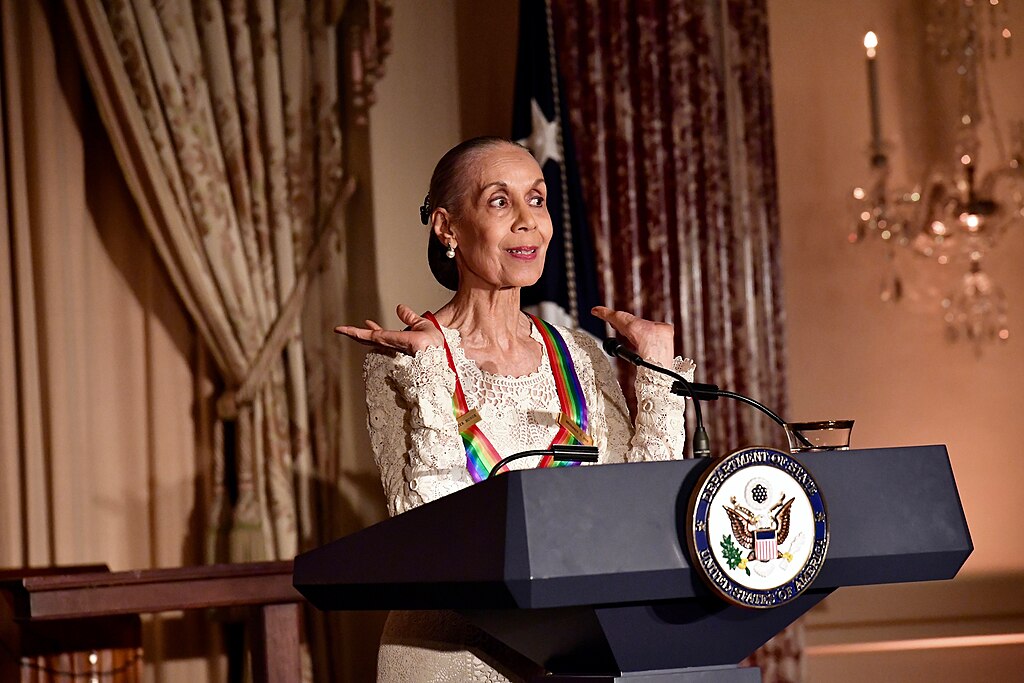
The arts community has lost a consummate icon with the passing of legendary dancer and choreographer Carmen de Lavallade, a remarkable figure whose influence spanned over six decades across theater, opera, film and television.
Renowned for her groundbreaking collaborations with 20th-century giants such as Alvin Ailey, Lena Horne, Agnes de Mille, Harry Belafonte, Josephine Baker and her husband of 59 years, the artist, dancer and actor Geoffrey Holder, Ms. de Lavallade was a trailblazer who enriched the cultural milieu in deeply soul-stirring ways.
As reported by The New York Times, her death, which occurred in a hospital on Monday following a short illness, was confirmed by her son, Léo Holder, and has left a palpable void in the hearts of many who admired her talent and spirit.
Ms. de Lavallade was 94.
She danced well into her 80s, often donning exquisitely flowing tops and skirts and her signature slicked-back hair. Duke Ellington once referred to her as “one of the most ravishing women in the world.” But her legacy is not merely in her breathtaking appearance and performances – it was in her unwavering commitment to breaking barriers and inspiring countless artists who came after her.

Ms. de Lavallade began her illustrious career in Los Angeles, where she honed her craft under the guidance of influential figures like Carmelita Maracci and Lester Horton. Her association with Horton was particularly noteworthy because she not only received valuable training but also performed with his company, which was trailblazing for its time as one of the first racially diverse dance groups in the United States. This experience not only shaped her artistic identity but also placed her at the forefront of a movement that sought to confront racism and prejudice in the performing arts. Despite the inherent challenges of being a Black artist during that era, Ms. de Lavallade’s talent and determination shone through, and allowed her to carve out a space for herself in a predominantly white industry.
Still, the path was far from easy. In an era when racial segregation was rampant, Ms. de Lavallade faced many hostile obstacles, including being restricted from performing alongside white partners on major platforms like The Ed Sullivan Show. However, such limitations only fueled her drive to succeed and make a mark in the dance world; and over the years, she became a major player in various prestigious companies, including the American Ballet Theater, while also choreographing for celebrated ensembles like the Alvin Ailey American Dance Theater and the Dance Theater of Harlem. Her influence also extended beyond her performances, where she inspired renowned choreographers such as Mr. Ailey himself, Ms. de Mille, John Butler and Glen Tetley.
“I never planned, doors opened,” she said during an interview with The Boston Globe in 2014. “Most people in my career stay with one company, but I never did that. I met extraordinary people that gave me something to look forward to. I, unbeknownst to myself, became fearless about going into territory I knew nothing about.”
She also acted in movies and spent 10 years at the Yale School of Drama and the Yale Repertory Theater. There, she worked as a performer, choreographer and movement instructor, training many actors, including a young Meryl Streep. She and Streep even co-starred in a 1975 Yale production of A Midsummer Night’s Dream, with de Lavallade playing Titania and Streep as Helena.
Carmen Paula de Lavallade was born on March 6, 1931, in Los Angeles. Her family had moved to California from New Orleans in the 1920s. Her father, Leo, worked as a bricklayer and postal worker. Her mother, Grace Grenot de Lavallade, passed away when Carmen was a teenager.
According to The Times, Ms. de Lavallade later mentioned that she felt comforted by the diversity in Los Angeles. She said in an interview with the Kennedy Center, “You became involved with all kinds of people. It was wonderful, East L.A., at that time.”
Her first introduction to dance came from her cousin, Janet Collins, who was the first Black ballerina at the Metropolitan Opera and became her mentor. Collins faced relentless racism too, as she had to train separately from white dancers. When she auditioned for Léonide Massine’s Ballet Russe de Monte Carlo, she was told to lighten her skin with powder to perform, but she refused and eventually joined the Met.
“I remember as a child, I just imagined myself dancing like Janet,” Ms. de Lavallade once shared with The Times. “She became my idol.”
Even though she watched her cousin face many difficulties, Ms. de Lavallade chose to follow her passion for dance anyway. She would ride three buses just to attend her first dance classes in Hollywood, and when she was 16, she earned a scholarship to study with Mr. Horton, who ran a school and theater on Melrose Avenue.
“He was a real master,” she said. “He gave you courage.”
Ms. de Lavallade continued: “In Los Angeles during the conservative McCarthy period, we were artists of all races dancing together.”
She also brought a young friend named Alvin Ailey from Thomas Jefferson High School to dance class, and their friendship and teamwork would be enduring. From the moment they met, it was clear that something special was brewing between them, both in camaraderie and artistic collaboration.
“We were dynamite together,” she said.
The larger dance community would take notice of Ms. de Lavallade when she performed in Horton’s ballet Salome in 1950, stepping in for Bella Lewitzky. Lena Horne helped her get into Hollywood, and she acted in several films, including Carmen Jones in 1954. The choreographer of that movie, Herbert Ross, invited her to dance in the Broadway show House of Flowers, which he choreographed and opened that same year. It was also where she met Mr. Holder, another actor in the show.

They were married in 1955. And in subsequent years, they became deeply involved in the civil rights movement.
“It was in our work that we stood up for what we thought,” she shared in an interview with Yale Alumni Magazine. “We did our revolution with our work.”
Alongside her husband, Ms. de Lavallade broadened her array of dance styles, and together, they crafted a piece that would become one of her hallmark performances, Come Sunday, accompanied by Black spirituals performed by Odetta.
Mr. Holder passed away in 2014.
In 1957, Ms. de Lavallade graced the screen in the television adaptation of Duke Ellington’s A Drum Is a Woman, and she also took part in Off Broadway productions. In 1970, she enrolled in Yale’s drama school, where she directed musicals, plays, and operas, but it is her dancing that left a lasting impression on many of her peers and students.
“That body is so amazing, it can do anything,” remarked Judith Jamison, a mentor and the former artistic director of the Ailey company, in a 2017 interview with The Washington Post, prior to the Kennedy Center Honors, where Ms. de Lavallade was celebrated. (She chose not to participate in a related reception at the White House due to her disapproval of the Trump administration.)
Ms. Jamison added, “It’s not about technical prowess. She takes your breath away by achieving it so easily. Her hand moving onstage is enough to take your breath away, just a flick of the wrist, or moving it slowly.”
Ms. de Lavallade graced the stage well beyond the typical retirement age for dancers, astonishingly performing until she was 88 years old. In her memoir, As I Remember It, she pondered the impact of aging on a dancer’s physique.
“You lose something and you gain something,” she said. “You learn that the body is changing and you have to accept, ‘OK, I’m 83.’ I think, how far can I go?”
In addition to their son, Ms. de Lavallade is survived by her older sister, Yvonne de Lavallade Davis.