



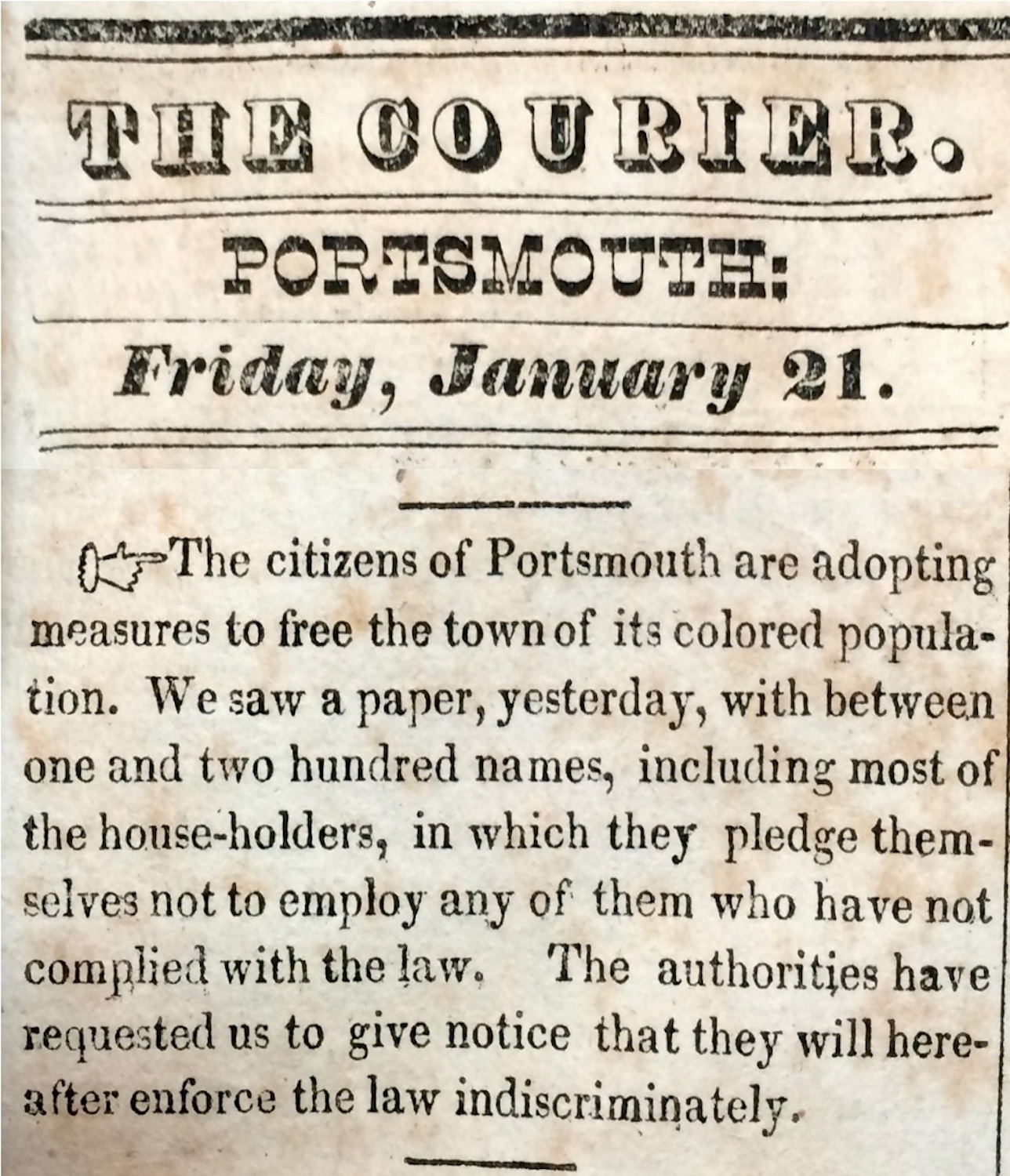
On Jan. 21, 1831, Portsmouth officials publicly announced their intention to apply Ohio law to the city’s African American residents by publishing a notice in a local newspaper. The statement reported that a large number of residents had agreed to withhold employment from Black workers who failed to meet state legal requirements and that local authorities would begin enforcing those requirements without exception.
The notice stated that between 100 and 200 residents, including many householders, had pledged not to hire Black residents lacking required legal documentation and that authorities would enforce the law “indiscriminately.”
The notice was printed by Elijah Glover, editor of the Portsmouth Courier, at the request of city officials. According to later historical accounts, the announcement led to the expulsion of about 80 African American residents under threat of enforcement of the Black Laws.
Ohio’s Black Laws required African Americans to register with county clerks to prove their free status and, under later statutes, to post bonds guaranteeing good behavior and financial self-sufficiency. In Portsmouth, registration was handled at the Scioto County courthouse on Market Street. Many Black residents, including formerly enslaved people and free people without proper papers, did not register and instead lived and worked on the margins of the local economy.
The event later became known as “Black Friday,” a term popularized by Nelson Evans in his 1902 book A History of Scioto County, Ohio. Evans described the forcible removal of Black residents and criticized local leaders for enforcing what he called “savage and brutal” laws. Although Evans incorrectly dated the event to 1830, later research confirms the notice appeared in 1831.
The incident was later cited by historian Carter G. Woodson in several works on African American history, helping to bring national attention to the episode. Records also show Portsmouth experienced an earlier expulsion in 1818, when township officials paid a constable to “warn out” Black residents.
While Portsmouth was not unique in enforcing the Black Laws, the 1831 expulsion stands as a documented example of how those laws were used to intimidate and displace African American communities in Ohio during the early 19th century.