

The news of Rev. Jesse Jackson’s death arrived like the quiet closing of a door that had been open my entire life.
For many Americans, he will be remembered as a civil rights leader, a presidential candidate, and a man who stood in the long shadow of Dr. Martin Luther King Jr. But for me, and for many Black children who came of age in the hard, complicated America of the 1980s and 1990s, he was something more intimate than history. He was proof of possibility before we had the language to name it.
Before I understood political parties or how racism and power actually move in this country, I understood presence. I understood voice. I understood what it meant to see a Black man stand in spaces never built for us and speak as if he had always belonged there. Years later, when I met him as a college student trying to survive inside a hostile white institution, he gave me a piece of survival wisdom that would follow me for the rest of my life. It was a lesson about how to move through America without letting it swallow you whole.
Before I tell Y’all about that lesson, lemme go back a few decades …
I grew up in an America that tried to teach Black children to expect less from life and more from suffering. The 1980s and 1990s were loud with coded language and quiet violence. Crack babies. Welfare queens. Super predators. The country was obsessed with pathologizing us. Every headline felt like it was asking whether we were worth saving.
There was Operation MOVE in Philadelphia, where the city literally bombed a Black neighborhood and called it law enforcement. The Central Park jogger case, where Black teenagers were turned into monsters for a crime they didn’t commit. The Willie Horton ads taught America that Black male criminality was a political strategy.
There was the beating of Rodney King broadcast into living rooms. The Los Angeles uprising that followed was framed as Black chaos instead of accumulated brutality and racial stress. The murder of Yusuf Hawkins in Bensonhurst reminded us that simply existing in the wrong white neighborhood could be a death sentence. There was the Howard Beach killing of Michael Griffith who was chased onto a highway by white men.
Crown Heights was flattened into “urban disorder” after a Hasidic motorcade vehicle struck and killed 7-year-old Gavin Cato, and many Black residents watched in horror as a private ambulance reportedly prioritized treating the driver over the dying child. I remember watching multiple days of uprising fueled by decades of unequal protection, segregated resources, and a community that felt its children’s lives were treated as disposable.
Then came the police killing of Amadou Diallo at the end of the decade, forty-one bullets fired into a Black man reaching for his wallet, and the country still debating whether fear was a valid excuse for execution.
All of it taught us, long before we could vote, drive, or understand what a jury was, that in America your innocence was something other people debated. Your humanity was something other people measured. Your childhood was something other people could revoke. And your story, your beautiful, complicated, ordinary, sacred story, could be snatched out of your hands and rewritten by people who had already decided you were either a problem to solve, a threat to neutralize, or a statistic waiting to happen.
We learned early that you could be twelve and still be described like a predator. Fourteen and treated like a suspect. Sixteen and already framed like a cautionary tale. Your life could be reduced to a headline before you even had time to live it. Your body could become evidence before it was ever allowed to simply just be a body.
Underneath all of it was the quiet terror that you could do everything right. You could speak right, dress right, study right, pray right, comply right, and still be one misunderstanding, one accusation, one wrong place away from becoming the next national lesson in Black disposability.
That was the emotional climate we were raised in. Not just racism as policy, but racism as atmosphere, as weather, and as the pressure you felt in your chest even on days when the sun was out. The national conversation spoke about Black communities like we were never children sitting cross-legged on living room floors trying to understand who we were supposed to become.
And moving through our television screens, through church pulpits, through the cultural bloodstream of Black America, was Jesse Jackson.
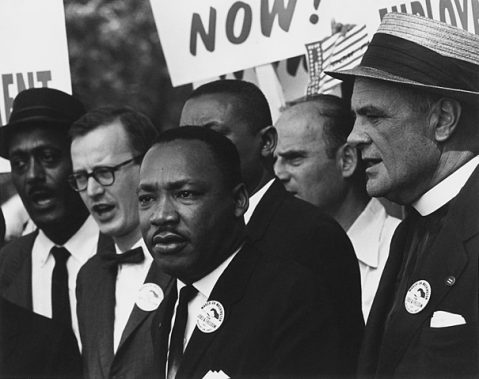
I knew him first as a man who stood next to history. Next to King. Next to movement. Next to grief and defiance and resurrection. As a Black girl still learning Black history in fragments like church sermons and Sunday school, Black History Month posters, watching Alex Haley’s Roots on TV, and the occasional teacher who cared enough to tell the truth, he was proof that the struggle did not end in black-and-white photos. He was living color. He was cadence. He was the sound of a Black man refusing to shrink himself to make white America comfortable.
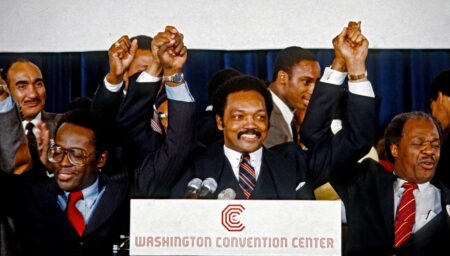
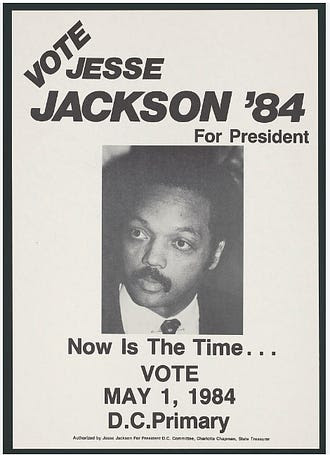
I watched Rev. Jackson run for president before I understood what the presidency really was. What I understood was this Black man could walk onto stages designed for white men and speak like he belonged there. Not like he was asking permission. Not like he was apologizing. He spoke like the microphone had been waiting for him.
And for a Black girl growing up in an era when the dominant narrative said Black children were broken before we even had a chance to become anything, that mattered. That mattered more than policy positions and party affiliation. Because dignity is political, whether you know the word for it or not. I did not know then that what he was offering was narrative oxygen. I only knew that when he spoke, I sat up straighter.
Years later, I met him.
It way my freshman year at Johns Hopkins University. It was a campus that felt like it had been built with architectural hostility toward Black students. Not just physically, but culturally. It was the kind of place where you could feel your difference before anyone said a word. And it was the kind of place where you learned quickly that excellence alone would not protect you from being treated like you were an accident or an imposter.
He came for a Black History Month event. The auditorium was packed and electric. I can’t remember exactly what he spoke about that evening, but all the Black students were all leaning toward him, trying to absorb something we didn’t yet have language for.
And every time a white student stepped to the mic during the Q&A with some cocky, conservative, devil’s-advocate question dressed up as intellectual curiosity, you could feel a ripple of collective eye-rolling move through the Black section of that auditorium like muscle memory. He handled them with that signature mix of preacher’s cadence and surgical precision. He never got rattled, just calmly dismantled their premises until their questions collapsed under their own weight. He made it look effortless, like he had spent a lifetime learning how to turn hostility into a teaching moment without ever surrendering authority.
During the Q&A, I stood up and asked something sharp. Incendiary. The kind of question that comes from being young, smart, angry, and not yet trained in the art of strategic fire. I don’t even remember the exact wording, but it was some shit that made him wince at me and the Black students chuckled. I just remember the feeling of heat in my chest when I said whatever it was that I said.
Afterward, he pointed one big finger like he was jabbing me from the stage and motioned for me to follow him.
I remember walking quietly down that hallway behind this giant feeling like I had been summoned by history itself. Security guards. Movement. The hum of people parting to let him pass. And then the elevator.
The elevator doors closed.
SMACK!
Right across my forehead. Not hard. Not violent. But suddenly enough that the world blinked out for half a second. His hand was so big it swallowed my field of vision. It was warm, solid, heavy in a way that felt more like gravity than force. Everything went dark for a split second, like somebody flipped the lights off inside my brain and then right back on.
I could hear the echo of it. It was a soft, hollow thwap bouncing off the metal elevator walls, followed by the low, barely contained chuckle of his security detail, like they’d seen this exact moment play out a hundred times before.
And I just stood there, stunned and silent, scalp still tingling, realizing I had just been corrected by living history, not with cruelty, not with anger, but with the kind of intimate, unspoken authority Black elders use when they see you standing at the edge of your own potential and refuse to let you waste it.
It didn’t hurt. Not even close. But it stunned me. My body went still. Mouth open. No words. No comeback. Just shock humming through my scalp and down my spine. And in that frozen second, all I could think was: The man who stood next to Martin Luther King Jr. just smacked me on my forehead.
“What are you doing asking questions like this?” he said.
He wasn’t being dismissive or condescending. But corrective.
He told me I had an incredible opportunity being there. That I needed to learn how to navigate spaces like this strategically. And then he gave me the metaphor that would follow me for the rest of my life.
“You ever use a spaghetti strainer?” I hadn’t, but I knew what it was. “Sometimes, you gotta be like a spaghetti strainer. You gotta take what works for you and throw the rest out. That’s what you gotta do at these white schools. Take what works. Throw the rest out.”
At the time, I think I nodded like I fully understood. But I didn’t. Not yet.
But the image lodged itself into my brain. Because what he was really telling me was that you don’t have to internalize every piece of hostility you encounter. You do not have to swallow every narrative handed to you. You can extract knowledge without absorbing the poison.
That lesson saved me in white academic spaces. It saved me in white newsrooms. It saved me in rooms where people assumed my presence was temporary, conditional, or accidental.
Be the strainer, Stacey.
Keep the tools. Keep the knowledge. Keep the access. Let the racism, the gaslighting, the diminishment drain away.
That is survival strategy, Y’all. And that is intellectual and spiritual self-defense. That is emotional triage in a country built on extracting labor from Black brilliance while denying Black humanity.
And the older I got, the more I realized how generous that moment was. Because he didn’t just correct me. He equipped me. That’s what elders in movement do when they are operating at their highest level. They don’t just inspire you. They prepare you.
For Black children growing up in the shadow of Reaganomics, mass incarceration, the war on drugs, and media narratives that framed us as societal threats, Jesse Jackson was a counter-narrative made flesh. He was a reminder that Blackness and intellect and moral authority and national visibility could occupy the same body.
He made it harder for the country to pretend we were invisible. He made it harder for Black folks to pretend we were powerless.
And now, sitting with the reality of his death, I keep coming back to that elevator. That small, human, unscripted moment. Not the speeches. Not the campaigns. The correction. The metaphor. The passing down of survival knowledge in a closed metal box between floors.
Because that is how legacy actually moves. Not just through history books. Through moments. Through sentences. Through metaphors that lodge themselves into young Black brains and quietly shape how we move through hostile worlds.
Rev. Jackson, you were a bridge between eras. Between King’s generation and ours. Between protest and policy. Between survival and aspiration. You gave language to dignity at a time when America was invested in stripping it from us.
And to that Black girl sitting on a living room floor in the 1980s, trying to understand who she was allowed to become, you were proof that the ceiling was not as low as they said it was.
Rest in power. Rest in history. Rest knowing that somewhere, right now, another Black child is watching footage of you speaking and sitting up a little straighter without fully understanding why.
And somewhere, another Black student is walking into a hostile institution carrying a quiet piece of your wisdom in their pocket, whispering to themselves: Take what works. Let the rest drain away. Be the strainer.
Thank you for the dignity. Thank you for the correction. Thank you for the metaphor that became armor.
Good night, Sir.
Thanks for reading. If this piece resonated with you, then please consider becoming a paid subscriber. Paid subscriptions help keep my Substack unfiltered and ad free. They also help me raise money for HBCU journalism students who need laptops, DSLR cameras, tripods, mics, lights, software, travel funds for conferences and reporting trips, and food from our pantry. You can also follow me on Facebook!
We appreciate you!