

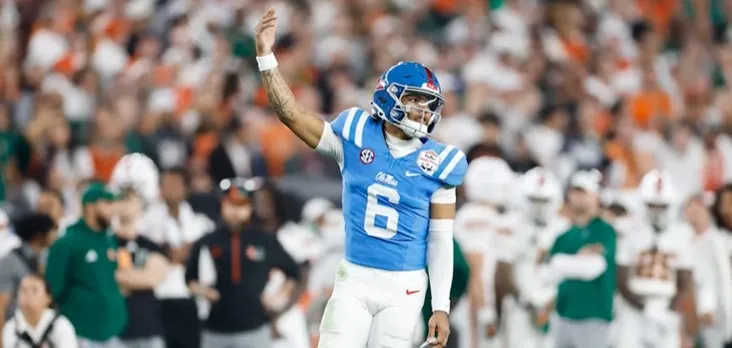
After weeks of frustration, Ole Miss star QB Trinidad Chambliss was finally granted another year of eligibility and will return to the Rebels in 2026.
According to ESPN, state court Judge Robert Whitwell ruled that Chambliss was eligible for a medical redshirt for this season, his sixth, as he met the required criteria.
In his ruling, Whitwell said the NCAA ignored medical evidence when denying Chambliss the waiver. He also noted that Chambliss had submitted enough medical proof to receive a waiver but that the NCAA didn’t act in good faith in its denial.
This caps off a tense period that began on January 9th when the NCAA first denied Chambliss’ waiver request. It continued on February 5th when it denied the QB’s appeal. Then this past Monday, Ole Miss said it had new evidence that supported its QB’s request and asked for reconsideration, but that was ultimately denied by the NCAA as well.
That’s when his team pushed the case to state court.
While a sixth season might seem too long to some, Chambliss’ situation is very unique.
He began his career as a redshirt player at Ferris State in 2021. In 2022, he was unable to play due to respiratory issues stemming from complications from tonsillitis and chronic fatigue. That year he didn’t dress for any games or play a single snap for the team as he battled an ailment that, according to his mother’s testimony, reduced him to a meager 176 pounds.
After healing, he played for Ferris in 2023 and 2024, winning a DII championship in the latter before transferring to Ole Miss for the 2025 season, where he became a star after starting QB Austin Simmons was injured and led the Rebels to the program’s first-ever College Football Playoff appearance, advancing two rounds before losing to eventual CFP runner-up, Miami.
In his fight against the NCAA, Chambliss testified that Ferris State coach Tony Annese told him he would receive a medical redshirt before the start of the 2022 season and that he informed his doctor about how sick he was.
But despite the evidence, the NCAA decided to play hardball, a position that continues to haunt the organization and make it one of the most hated in sports.
Instead of making an exception due to a serious medical condition, the NCAA went low, arguing that Chambliss opted to treat his condition with medication instead of having surgery in 2022 so “he could participate in the football season.”
Not that he skipped treatment and tried to play or that he didn’t try and treat the condition. No, they tried to claim that if he had surgery, he could have played.
But they didn’t stop there.
The NCAA also tried to show that if he made his case for an extra year while at DII Ferris State, he would have been able to enroll in school as a part-time student in order to play his sixth year as DII schools work on a 10-semester calendar, so part-time enrollment would have paused his eligibility.
A last-ditch effort of a drowning group.