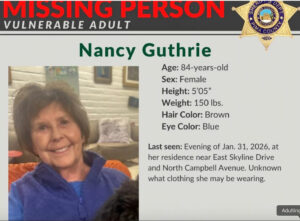


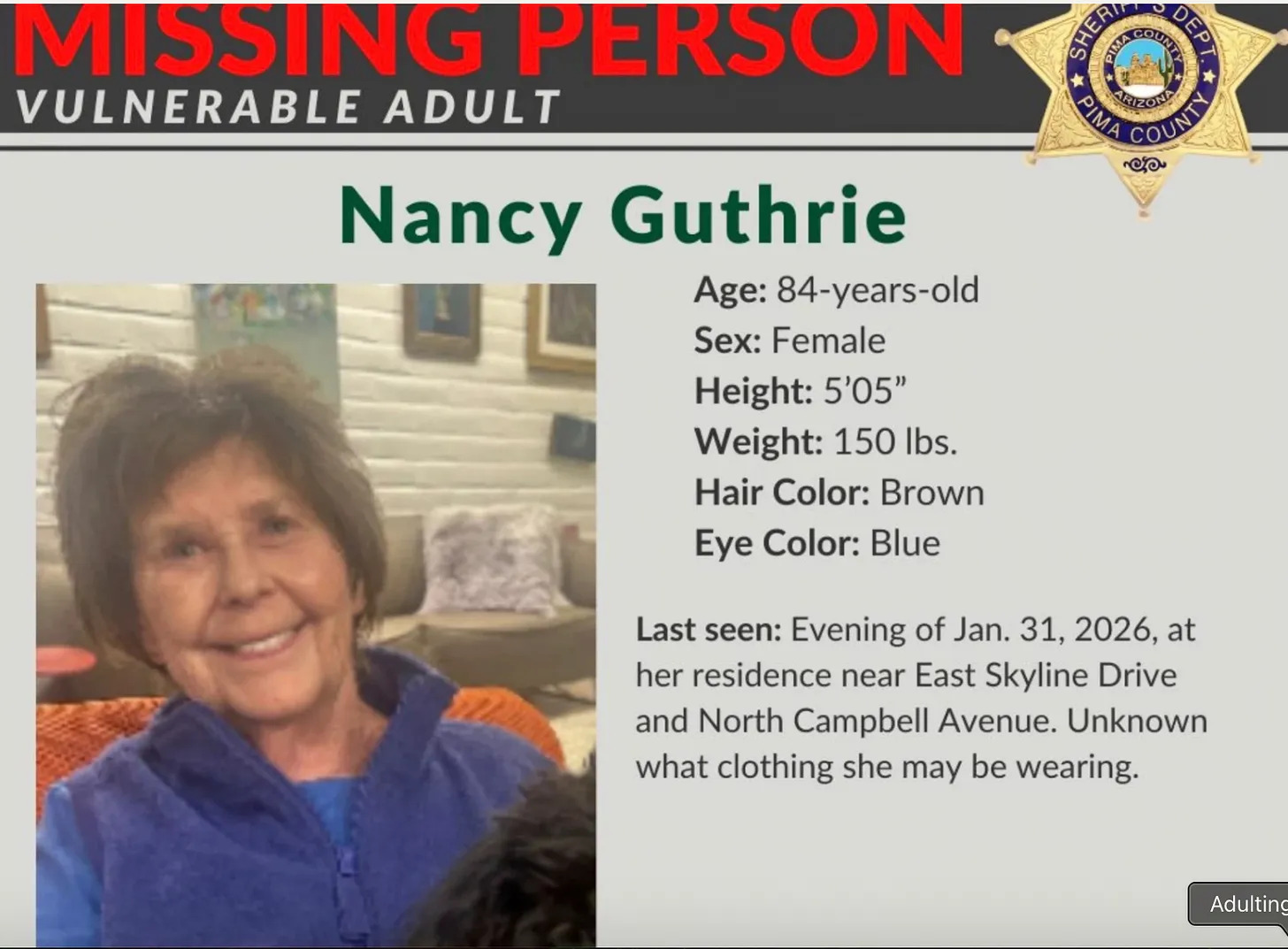
I’m gonna be honest with Y’all and say something that might make people uncomfortable. We’ve spent two months immersed in the disappearance of Nancy Guthrie. The real story isn’t just that she’s missing. It’s why this case won’t leave the national stage when so many others never get there.
And before anybody rushes in to call me a mean, cold-hearted asshole, let me be clear: I want her found. I want every missing person found. That’s not the issue. The issue is how long the media has stayed locked onto this story, as if it’s the only disappearance that matters.
We’ve seen wall-to-wall updates. Speculation. Recycled timelines. Emotional interviews. Endless attention. Meanwhile, thousands of other people, many of them elderly, many of them Black and Brown, have vanished into silence. Folks might not say it out loud, but I know I’m not the only one noticing.
So the question isn’t just why are we still talking about Nancy Guthrie? The real question is: what makes her disappearance so narratively irresistible, and why do so many others barely register at all?
Every year in the United States, roughly 600,000 people are reported missing. That number alone should stop us cold. Six hundred thousand. But the way corporate media operates, you would never know it. Because only a tiny fraction of those cases ever become national stories, and an even smaller fraction receive sustained attention.
Nancy Guthrie’s case didn’t just break through. It stayed. It’s still here. Over the past week alone, we’ve seen a steady drip of updates designed to keep the story alive: emotional coverage of her daughter, Savannah Guthrie, returning to the Today show after weeks away. We’ve seen extended interviews about grief, guilt, and faith. Also, timelines revisiting the night Nancy disappeared. Renewed focus on surveillance footage of a masked intruder. Speculation about investigative missteps, and repeated reminders of the $1 million reward for information.
The story has been repackaged from every possible angle, from the personal and procedural to the spiritual, to ensure it never fully leaves the news cycle. The latest twist just out today is that a new ransom note was sent to media outlets. An anonymous sender is claiming to know who took her and where she is, or even where her body might be buried, while demanding cryptocurrency in exchange for the information. Law enforcement has reportedly treated these messages with skepticism, suspecting they may be part of an ongoing scam rather than credible leads.
Two months later, we are still being asked to care, to watch, to speculate, and to remain emotionally invested. That kind of endurance is not accidental. It is constructed.
So, let’s talk about missing elderly people for a minute, because this is where the conversation gets even more revealing.
Older adults go missing all the time. Not typically through abduction, but through something far more common and far less sensational: cognitive decline as a result of dementia, Alzheimer’s, or disorientation. Studies show that about 60% of people with dementia will wander at least once. Many never make it back on their own. In fact, research suggests that in cases involving missing older adults, nearly 80% involve some form of dementia or cognitive impairment.
This is not a rare thing. It’s a public health reality. And the timeline is brutal. If a missing elderly person is found within 24 hours, their chances of survival are high. But after just a few days, those odds drop sharply. Things like exposure, dehydration, injury and time become the enemy. Which means attention, urgency, and visibility matters.
So here’s the uncomfortable truth: the same media ecosystem that can sustain attention on one missing woman for months routinely fails to mobilize that urgency for thousands of others who need it just as much.
Now let’s factor in race. Because this is where the silence gets even louder. There is no robust national dataset that cleanly breaks down missing elderly people by race. I looked for the numbers. They ain’t there so let that sink in.
We can track kidnapping statistics down to decimal points. We can analyze crime trends with precision. But let’s ask a simple question: how many elderly people of color go missing in this country? Well, the answer is incomplete. And that absence of data tells us something about what, and who, we have decided is worth studying in the first place.
What we do know is that across all missing persons cases, Black and Brown people are disproportionately underrepresented in media coverage. Their disappearances are less likely to become national stories, less likely to generate sustained attention, and less likely to be treated as urgent public crises. This is often framed as “missing white woman syndrome,” but that phrase doesn’t go far enough. Because what we’re really talking about is a hierarchy of visibility.
And at the top of that hierarchy sits a very specific kind of subject: white, often female, often perceived as relatable, often connected directly or indirectly to networks of influence that can amplify their story.
Nancy Guthrie fits that mold. Not just racially, but structurally. Her daughter, Savannah Guthrie, is a co-anchor of NBC’s Today show, one of the most powerful platforms in morning television. That proximity matters because it means access and visibility. It means a built-in pipeline between private grief and public narrative. Her case is legible to the media. It fits the narrative template and activates the machinery. And once that machinery starts, it feeds on itself.
But what about the elderly Black woman with early-stage dementia who wanders out of her home in a neighborhood that doesn’t have the same media reach? What about the Latino grandfather who disappears after a routine walk, in a community where language barriers already limit visibility? What about the older Black man whose cognitive decline was never formally diagnosed because he didn’t have access to consistent healthcare?
Do their disappearances deserve two months of coverage? Do they get national attention? Do they get search parties mobilized with the same urgency?
Or do they simply . . . fade?
There is another layer here that we don’t talk about enough, which is poverty and isolation. Older adults of color are significantly more likely to live in poverty and more likely to live alone. They are more likely to lack consistent caregiving support and more likely to have undiagnosed or untreated cognitive conditions. All of these factors increase the likelihood of going missing, and decrease the likelihood of being found quickly.
So when we talk about who gets attention, we are also talking about who has the infrastructure around them to generate attention. Because media coverage doesn’t just appear out of thin air. It is often driven by families with resources and media literacy, communities with social capital, and networks that can push a story into public consciousness. If those things aren’t in place, a disappearance can remain local, or worse, invisible.
And this is where my frustration comes in. Not because Nancy Guthrie is missing. But because her story is being treated as exceptional, when in reality, it is the system’s response to her that is exceptional. We are watching a full-scale demonstration of what it looks like when a disappearance is deemed worthy of sustained national attention.
Now, some of Y’all might argue: What if her case really is different? What if she was kidnapped? What if she was murdered? What if the harm came from someone close to her? Those are all real possibilities. And if any of them are true, they are horrific.
But none of those scenarios are rare.
People are abducted. People are killed. People are harmed by intimate partners and family members every single day in this country. Black women. Brown women. Elderly people. Poor people. People with no media connections and no national platform to carry their names. Their cases can be just as violent. Just as complex. Just as deserving of urgency. And yet, they do not receive two months of sustained national attention.
So the question is not whether Nancy Guthrie’s case could be exceptional in its details. The question is why exceptional attention is so selectively applied and why some tragedies are treated as national emergencies, while others are absorbed into the background noise of everyday loss. And once you see that, you can’t ignore the contrast.
You can’t ignore the thousands of other families who are begging for even a fraction of that visibility. You can’t ignore the elderly people, especially Black and Brown elderly people, whose disappearances are met with silence, or at best, a brief mention before the news cycle moves on.
This is not about taking anything away from Nancy Guthrie. It’s about asking why the baseline is so unequal. Why does one case get two months of attention, while others don’t get two minutes? Why do we have detailed narratives for some missing people, their photos, interviews, and timelines, while others are reduced to a name on a flyer, if that? Why is urgency so selectively applied?
Because in America, visibility is a form of value, and value is not distributed equally. You don’t just have to go missing to be overlooked. You can be overlooked long before you ever disappear.
So yes, I am tired of hearing about Nancy Guthrie. Not because she doesn’t matter. But because the system has made it painfully clear that so many others don’t. And until we start interrogating that honestly, deeply, and without defensiveness, we will keep having the same conversation. Just with different names and the same silence.
Thanks for reading. If this piece resonated with you, then please consider becoming a paid subscriber. Paid subscriptions help keep my Substack unfiltered and ad free. They also help me raise money for HBCU journalism students who need laptops, DSLR cameras, tripods, mics, lights, software, travel funds for conferences and reporting trips, and food from our pantry. You can also follow me on Facebook!
We appreciate you!