


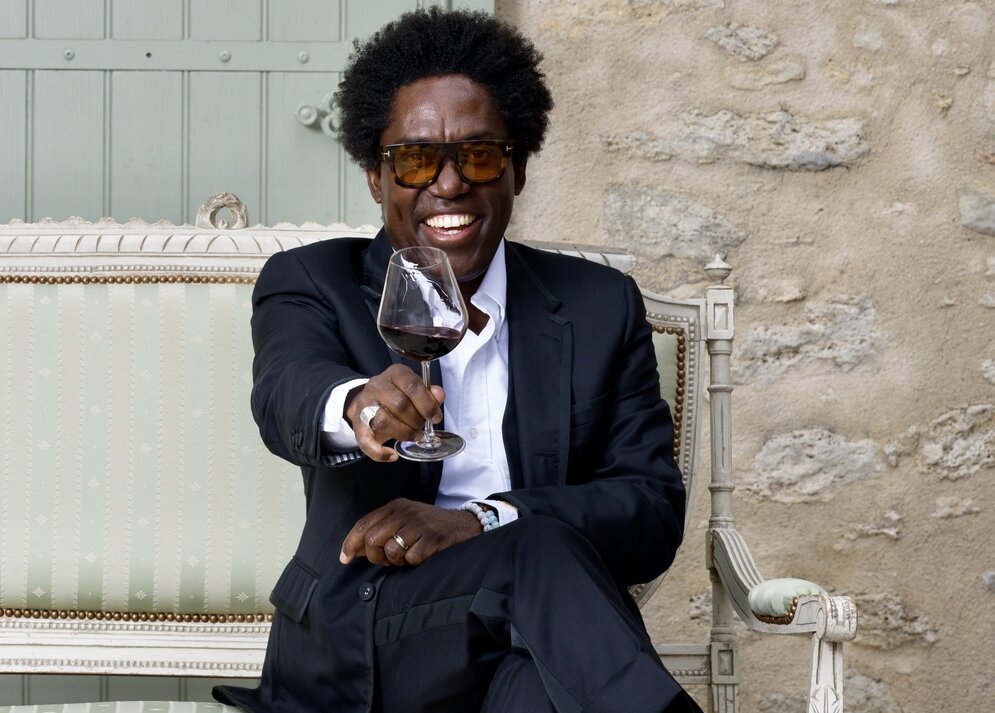
I caught Karlex Antoine on the phone as he prepared to head into an important meeting with an architect he has been collaborating with for months. “We’re going to be building a new cellar,” he says with steady confidence.
His tone matched the pace of Château Fillon’s growth, focused and rooted. Before he spoke about his daughter, whom he proudly credits with leading key parts of the brand’s marketing, his dedication to those he loves already felt clear.
During his preparation, he toggled between responsibilities, yet he stayed attentive and fully engaged with me on our WhatsApp call. His focus did not waver, and that presence offered a vivid glimpse of how he runs his family business.
Founded just three years ago as one several wineries in Bordeaux, Château Fillon has already distinguished itself as one of the few Haitian-owned vineyards in the world. Antoine’s vision remains focused: to expand representation within Bordeaux and global winemaking, honor his Ayisyen heritage, and invest in generational continuity.
He approaches wine as long-term work, planting vines whose full potential may not emerge for decades, an intentional choice rooted in stewardship and future-building.
“It’s a commitment, and I hope my child will continue after me,” Antoine says.
Roots in Haiti, Ventures Across the World
“I was born in the north of Haiti, in Cap-Haïtien,” Antoine shares. He recalls a childhood spent roaming the coffee and banana farms of his small community. At 18, he left the lush warmth of Haiti for Boston’s cold winters, enrolling at Bunker Hill Community College before transferring to Adelphi University in New York City.
In 2007, he became CEO of his family’s distribution business, LEA Trading Group, which imports a variety of foods, including grains and frozen products, from Haiti. The Haitian government ranks LEA Trading Group as the country’s 57th largest importer. Today, Antoine manages multiple ventures, including importing and distributing wine across the United States from his base in Miami.
Yet, even with business in multiple countries, Antoine always felt a calling to France. He lived there for several years, eventually establishing family roots, marrying his wife, and welcoming a daughter into the world.
The French Countryside Sparked a Haitian Vision
While in France, Antoine’s personal interests and career in wine distribution often took him to different vineyards. “I would be driving through the French countryside, seeing the vineyards. To me, that was the most beautiful thing I’ve ever seen, and it always brought up an emotion inside me…I wanted to be part of it all,” he recalls.
Antoine first fell in love with wine in Haiti. “One of my great uncles used to make a sweet wine,” he says. “I’ve always loved wine culture. As a kid, I would read books about people raising grapes.”
When he took the reins of his family’s distribution business, he focused on beverage brands, knowing that one day he wanted to produce wine himself. “To me, that’s what legacy is…leaving something behind when I’m gone. That’s why I wanted to start Château Fillon.”
By Ashia Aubourg