




I’m writing to you today from San José State University in California, where I’m preparing to present at the 43rd Annual Child Abuse Symposium, where hundreds of child welfare professionals will be gathering to talk about best practices.
April is National Child Abuse Prevention Month, which means this is the time of year when the country claims to be paying attention to how children are harmed, even as we continue to struggle with telling the full truth about what that harm actually looks like. Especially when it comes to physical punishment, which remains one of the most consistent entry points into legally defined abuse and a leading risk factor in child abuse fatalities.
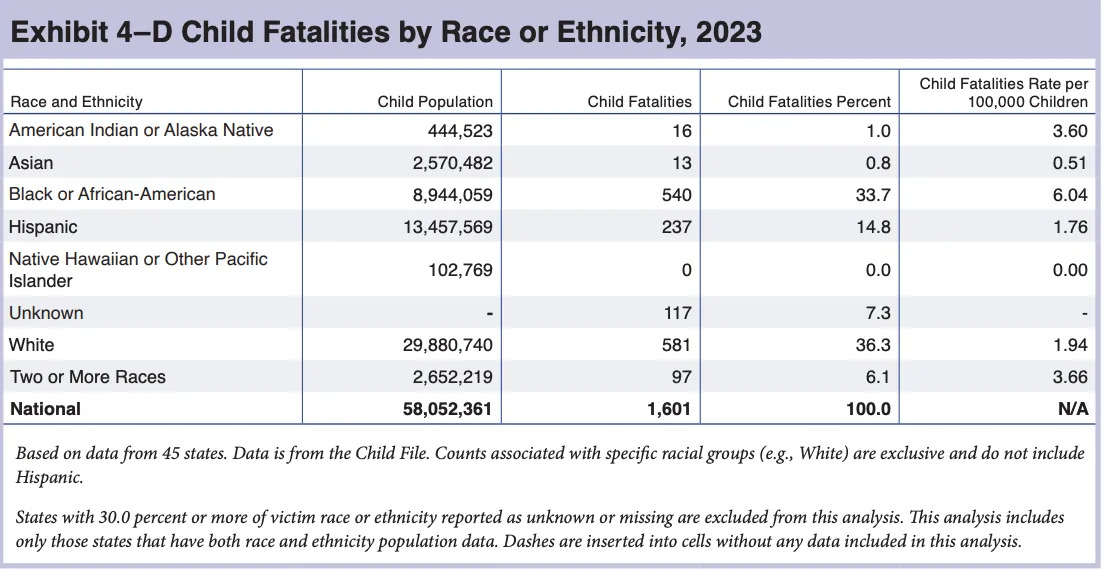
A few weeks ago, I sat with the latest federal Child Maltreatment report, and the numbers stopped me cold. The latest data shows that the child abuse fatality rate for Black children was 6.04 deaths per 100,000 children. For white children, it was 1.94.
That is not a small disparity, Y’all! It means Black children are dying from abuse and neglect at more than three times the rate of white children. The gap widens even further when you look across other groups. The rate for Asian children is 0.51, which means Black children are dying at nearly twelve times that rate.
Put plainly, in a single year, 540 Black children were killed by abuse and neglect. That is more than ten children every week. Every week! And yet we are still fucking debating whether hitting children is harmful.
And even those numbers are an undercount. Researchers and child welfare experts have long acknowledged that many abuse-related fatalities are misclassified or never identified as abuse at all. Some deaths are coded as accidents. Some are attributed to neglect without investigation. Some never make it into the system in a way that gets counted. So what you are looking at is not the full picture. It is the visible edge of it.
And beyond the fatalities, there are millions of children experiencing physical punishment and abuse that never rises to the level of a report, an investigation, or a case file. Kids are being hit with belts, switches, cords, and other objects. It happens in homes, behind closed doors, in ways that are normalized, minimized, and protected by silence. And not to mention, there still 18 states that allow kids to be paddled with wooden boards in schools.
Which means a lot of people grow up and never name what happened to them. They call it discipline. They call it culture. They call it “what I needed.” Because acknowledging it as abuse would require a level of honesty that disrupts identity, family loyalty, and the stories people tell themselves about their own survival.
So the cycle continues. Not because the harm isn’t there. But because we’ve built an entire language system to avoid calling it what it is . . . child abuse.
We are still arguing about culture, about religion, about whether it “worked” on us, while the data keeps telling the same story over and over again. Physical punishment is one of the most consistent risk factors in these outcomes. Not the only one, but one of the clearest, most preventable pathways into escalation.
And since the pandemic, the trend has not improved. The rates of substantiated abuse and child fatalities in Black communities have been climbing, not declining. Which means this is not a historical problem. This is not something we can file away as progress-in-the-making. This is happening right now.
There is an urgency to these numbers that we are not matching with our language, our policies, or our public health strategies. Because as long as we keep softening what is happening, we will keep failing to interrupt it.
And that is exactly why my talk is called From Belief to Biology: How Using Science Changes the Conversation on Hitting Children. So let me begin without softening it. If you hit a child, then you are a child abuser.
Not sometimes. Not only when it leaves a bruise. Not only when it “goes too far.” Not only when it crosses a legal line that was designed to protect adults more than children. If you hit a child, you are using physical force against a developing body that cannot defend itself, cannot leave, and cannot reinterpret that moment as anything other than what the body knows it to be.
Threat.
For years, we’ve been having the wrong conversations about hitting children. We argue about culture. We argue about race. We argue about religion. We argue about intention. We argue about whether physical punishment “works.” We argue about the so-called thin line between spanking and abuse. We argue about whether folks “turned out fine.” We argue about “these kids today . . . “ And those conversations go in circles because everybody is defending a BELIEF.
So I decided to change the question. Instead of asking what you believe, I started asking: what is happening inside the child’s body even if there are no signs of visible injury on the skin?
Because the body does not argue. The body does not care what you call the violence. The body does not respond differently because you say “spank” instead of “hit” or “whup” or “beat” or “pop” or “tap.” The body doesn’t do semantics or linguistic origami. The body does not care about cultural context or race or ethnicity. The body does not care about scripture. The body does not soften its response because your intention was loving or protective or trying to teach. The body responds to force. It responds to toxic stress. It responds to threat. A developing child’s body adapts to survive.
So we have to move from belief to biology. Because the moment we stay in belief, we get stuck. People defend what they were taught. They defend what they survived. They defend what they believe made them who they are. And once people feel like their identity is under attack, the conversation shuts down before it even begins.
But when we move into the body, something shifts. The conversation slows down. The temperature changes. People stop arguing and start listening, because now we are not debating opinions. We are looking at what the body is doing in real time.
So I’m gonna take them on a journey. Take them inside the body so they can see what happens when force is used against a child. When a child is hit, the brain does not interpret that moment as instruction. It interprets it as danger. The amygdala fires. Stress hormones flood the bloodstream. Cortisol rises. The nervous system shifts into survival mode.
That child is no longer in a learning environment. They are in a threat environment. The brain’s job is to keep the body safe. The child’s primary goal is to survive the violence. And what happens next is not about whether the child “gets the message.” It is about what the body has to do to survive in that moment.
The heart rate increases. The muscles tense. Blood flow shifts away from digestion. The stomach tightens. Some children feel an immediate urge to defecate. Others hold it in because the environment does not feel safe enough to release. The body is choosing survival over function.
Over time, this does not just pass. It accumulates. Those violent moments get stored as sensory memories. The stress response becomes more easily activated. The brain strengthens pathways around vigilance, anxiety, and rapid response. The child becomes more attuned to tone, facial expression, and unpredictability than to understanding behavior or building trust.
What folks are calling discipline is often the nervous system adapting under pressure. What folks are calling respect is often fear with good manners. What folks are calling obedience is often a child calculating how to avoid pain. What folks are calling good behavior is often compliance rooted in threat.
What folks are calling calm is often a shutdown response. What folks are calling a lesson learned is often a stress response encoded in the body. What folks are calling control is often a child losing a sense of safety. What folks are calling parenting is often power enforced through the body.
Because once you understand what is actually happening inside the body, intention stops being a shield. Because once you understand what is actually happening inside the body, racism is real, but it does not change how a child’s nervous system responds to being hit. Poverty is real, but it does not blunt the biological impact of force on a developing body.
Religion may justify it, but it does not translate pain into safety inside the body. Culture may normalize it, but it does not make the stress response disappear. Single parenthood may make everything harder, but it does not turn violence into regulation. Tradition may defend it, but it does not protect the brain from threat. Stress may explain it, but it does not prevent harm from being encoded.
Love may be present, but it does not override the body’s experience of fear. Good intentions may motivate it, but they do not soften the physiological impact. Survival may shape it, but it does not transform harm into healing.
Most people who hit children are not trying to harm them. They are doing what was done to them. They are relying on what they were taught. Nobody ever took them inside the body and said, this is what is happening underneath your child’s skin.
But harm does not require bad intentions. It requires impact. And the impact is measurable. Chronic activation of the stress response disrupts digestion, metabolism, and sleep. The immune system becomes dysregulated. Inflammation increases. Hormonal systems shift. The body may begin to store fat differently as a protective response to instability. The body is adapting to a world that does not feel safe. Even when that world is called home.
This is why public health has to move from belief to biology. Because belief will always create loopholes. Belief will always say, “not me,” “not my child,” “not my culture.” But biology does not negotiate.
Biology says: this is what happens when a child is hit. And once people see it, really see it, something changes. They cannot unsee it.
That is why I do this work the way I do. I want to make the invisible visible. I want people to never be able to look at hitting children the same way again. I want folks to recognize that what looks like compliance might actually be a body in survival. That what looks like silence might be suppression. That what looks like discipline working might actually be the nervous system adapting under pressure.
And once you see that, you have a choice. You can continue doing what you have always done, now knowing what it does. Or you can pause. You can choose something different even if it is imperfect, or hard, or even if you are still figuring it out.
Because the most powerful thing we can do is not just understand harm. It is to stop passing it forward.
So yes, I am saying something stronger now. If you hit a child, you are a child abuser. Not because I am trying to provoke you. But because I am done protecting language that protects harm. This is what moving from belief to biology demands. It requires the willingness to tell the hard truth about what the body has been saying all along.
Thanks for reading. If this piece resonated with you, then please consider becoming a paid subscriber. Paid subscriptions help keep my Substack unfiltered and ad free. They also help me raise money for HBCU journalism students who need laptops, DSLR cameras, tripods, mics, lights, software, travel funds for conferences and reporting trips, and food from our pantry. You can also follow me on Facebook!
We appreciate you!