






There was a time in American political culture when being called before Congress, especially by a body like the House Oversight Committee, meant something close to ritual humiliation wrapped in constitutional gravity.
You showed up.
You raised your hand.
You swore an oath.
You sat there under them hot-ass lights while elected officials asked you questions designed not just to extract information, but to publicly situate you inside a moral and legal order. This was about accountability. It didn’t matter if you were arrogant or if you thought the process was partisan. The performance of accountability itself was part of the job.
But now?
Umph. Now folks are out here treating a congressional subpoena like it’s an Evite they never RSVP’d to. Just sittin’ there in the inbox like, “hmm . . . I’m gonna circle back,” knowing good and damn well they not comin’.
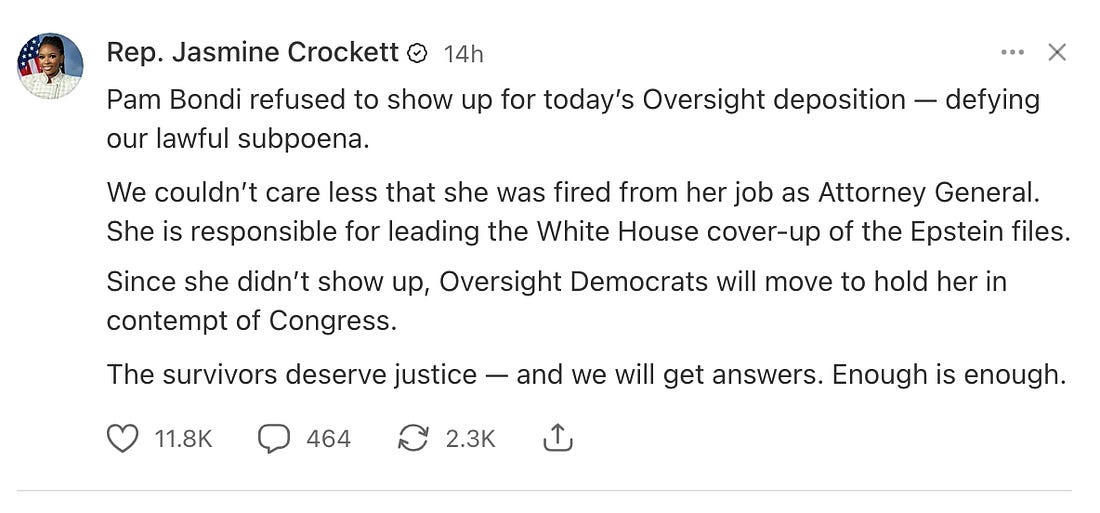
Now you have the recently fired Pam Bondi, who is no longer shielded by the formal constraints of her role, looking at a congressional summons and essentially saying: fuck Congress! And then not showing up yesterday for a deposition as part of the House Oversight and Government Reform Committee’s Jeffrey Epstein probe. And now, the Democrats are fumbling around trying to decide how seriously to take that refusal.
They say they’re gonna hold her in contempt but we’ve heard that before. We’ve seen that movie. And the ending is always the same. We see a strongly worded letter, a press conference, and then a long, slow fade into . . . nothing.
Because “contempt of Congress” used to sound like something. It used to carry some weight. Now it just sounds like one of them phrases politicians say to make themselves feel like they did something. Like putting “per my last email” in a subject line and hoping it scares somebody into acting right. But the people they’re dealing with are not scared because the threat itself no longer lands. It doesn’t interrupt behavior, doesn’t compel compliance, and it doesn’t even create urgency. It just exists and floats out there like a suggestion.
That is not a scheduling issue and or some legal gray area. That is a whole cultural shift. Because once upon a time, you didn’t have to respect Congress to fear it. The power was in the consequence and the spectacle. And in the understanding that if you refused, the system would move on your ass swiftly, publicly, and decisively.
But now? That fear is gone.
What we’re watching is the collapse of consequence as a governing force. The unwritten rules that used to hold this whole thing together and the quiet agreements about what you have to do, even when you don’t want to, are being stripped for parts right in front of us. This is what it looks like when accountability stops being an expectation and becomes a suggestion and when power learns it can outlast scrutiny.
And more importantly, this is what it looks like when defiance itself becomes the performance. Because this isn’t happening quietly. It’s not even being disguised. The refusal is the point. Be very clear, Pam Bondi is not some lone outlier freelancing her way into defiance. She’s part of a pattern that has been building for years, especially in the orbit of Donald Trump, where ignoring Congress is no longer shocking. It’s strategic.
Remember . . .
Mark Meadows refused to comply with a subpoena from the January 6 committee and simply didn’t show up. Congress voted to hold him in contempt. The Justice Department declined to prosecute. He walked.
Steve Bannon also refused a subpoena. He was prosecuted and convicted of contempt of Congress, but even that didn’t land the way it once would have. He delayed, appealed, turned it into a media tour, and remained a central political actor throughout. The punishment didn’t remove him from the ecosystem.
Dan Scavino resisted cooperation as well, engaging in prolonged legal maneuvering that delayed meaningful accountability.
Peter Navarro refused to comply, was convicted, and even there same story: delay, defiance, political framing. The consequence became just another chapter, not a deterrent.
And then you have people like Jeff Sessions, whose memory seemed to evaporate the closer questions got to anything consequential. Or Hope Hicks, who showed up but refused to answer entire categories of questions and sweeping privilege claims that turned her testimony into performance art.
There was Michael Flynn, who cooperated, then un-cooperated, then cooperated again and dragged the process deeper into confusion and delay. And Ivanka Trump, who sat for interviews but managed to remember just enough to avoid consequence and forget just enough to avoid clarity.
None of them technically pulled a Pam Bondi. They didn’t flat-out no-show. But they played a different version of the same game of partial compliance, selective memory, and endless delays. The choreography is different, but the outcome is still the same. The process gets stretched, diluted, and dragged out until whatever urgency existed at the beginning quietly dies on the vine.
People are looking at the track record and realizing that you can refuse, delay, and litigate. And the consequences are inconsistent enough that it might be worth the gamble. Enough people have refused, survived it, and in some cases thrived afterward, and so refusing to show up is no longer a scandal. It’s a strategy.
The message is that there is nothing you can make me do. That’s not just disrespect. That’s a recalibration of the entire relationship between government and the governed. It is also a signal to every future official watching that oversight is optional, subpoenas are negotiable, and that if you push back hard enough against the system nothing will happen to you. And once that lesson sets in, you’re no longer operating inside a democracy that enforces its own rules.
This is where we are, Y’all.
But what makes this moment more disturbing, and even more revealing, is what is happening at the same time. While a former official refuses to answer for her actions, the Department of Justice is moving to dismiss the charges tied to the Proud Boys in connection with the January 6 Capitol attack.
Now sit with that contradiction.
On one side, accountability is being evaded. On the other, accountability that already happened is being reconsidered, softened, or undone. It suggests that accountability itself is no longer a fixed principle. It is becoming conditional and something that can be enforced, ignored, or reversed depending on who holds power and who benefits.
And here is where the mainstream coverage is failing. They are treating these as separate stories. A missed hearing here. A legal appeal there. A partisan disagreement over January 6 convictions. But they are not connecting the dots. They are not asking what it means when all of these things happen at once, in the same political climate, following the same administration.
They are not asking what it does to a system when enforcement becomes selective and memory becomes negotiable. Because once you put these pieces together, the picture is not subtle. Instead, it is a slow, steady erosion of the expectation that anyone, especially anyone powerful, has to answer to anything.
And let me close by saying that the Democrats are so freakin’ feckless. What we are actually watching is a mismatch in governing philosophies. The Republicans have demonstrated a willingness to treat norms as disposable, to ignore and violate them, and dare the system to respond.
The Democrats are still operating as if those norms are intact, as if the rules still carry their old weight. So you get this lag, procedural hesitation, and this insistence on doing things “the right way” even as the meaning of “the right way” is being hollowed out every damn day in this country. And that lag does not read as integrity to the people pushing the boundaries. It reads as opportunity.
Because it works.
Thanks for reading. If this piece resonated with you, then please consider becoming a paid subscriber. Paid subscriptions help keep my Substack unfiltered and ad free. They also help me raise money for HBCU journalism students who need laptops, DSLR cameras, tripods, mics, lights, software, travel funds for conferences and reporting trips, and food from our pantry. You can also follow me on Facebook!
We appreciate you!