






The United Nations General Assembly has designated Nov. 27 as the International Day for the Elimination of Child, Early and Forced Marriage, aimed at safeguarding children from marriage before adulthood.
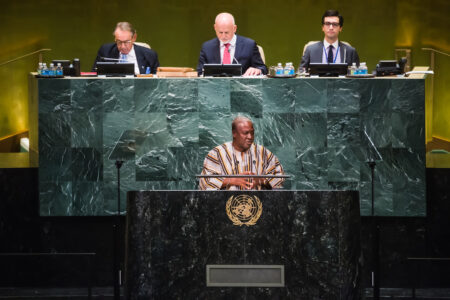
The General Assembly adopted resolution A/80/L.99 by consensus on Sept. 4. Introduced by Sierra Leone, it calls on governments, U.N. agencies and civil society groups to use the day for education, advocacy and national action.
Sierra Leone First Lady Fatima Maada Bio called the resolution a “call to action” and a reminder of the world’s “collective responsibility to protect childhood and defend the dignity and rights of every girl.”
“Behind every statistic, a child, early and forced marriage is not merely a number,” said Bio. “There is a child, there is a name, there is a dream, and there is a future.”
Child marriage has continued for generations in parts of Africa, steered by factors including poverty, gender inequality and customary practices.
Attempts to eradicate the practice have spanned decades.
The African Children’s Charter, adopted in 1990, and the Maputo Protocol, adopted in 2003, established 18 as the minimum marriage age. The African Union launched its Campaign to End Child Marriage in Africa in 2014. Sierra Leone outlawed child marriage in 2024. The year prior, according to UNICEF, West and Central Africa had the highest child marriage rates in the world. Sierra Leone was reported to have had 30% of women aged 20 to 24 years who were first married or in union between 15 and 18.
The practice remains legal in parts of the United States. Thirty-four states, including California, Florida, Georgia, North Carolina and Texas, currently allow marriage before 18 under some circumstances. Sixteen states and Washington, D.C., prohibit child marriage without exceptions. Oklahoma has passed a ban scheduled to take effect Nov. 1.
![This Organization Is Trying to End Child Marriage in the U.S. [INSIGHTS]](https://i.ytimg.com/vi/PKy4NL_X23Y/hqdefault.jpg)
Bhuwan Ribhu, founder of Just Rights for Children, first proposed the international observance in March.
“Now is the time for governments to provide decisive leadership to end child marriage by 2030,” Ribhu shared at the time.
Bio noted that international recognition must be followed by action.
“An international day itself cannot by itself end child marriage, but political attention can, strong laws can, effective institutions can, education can … and above all, sustained political will can.”