



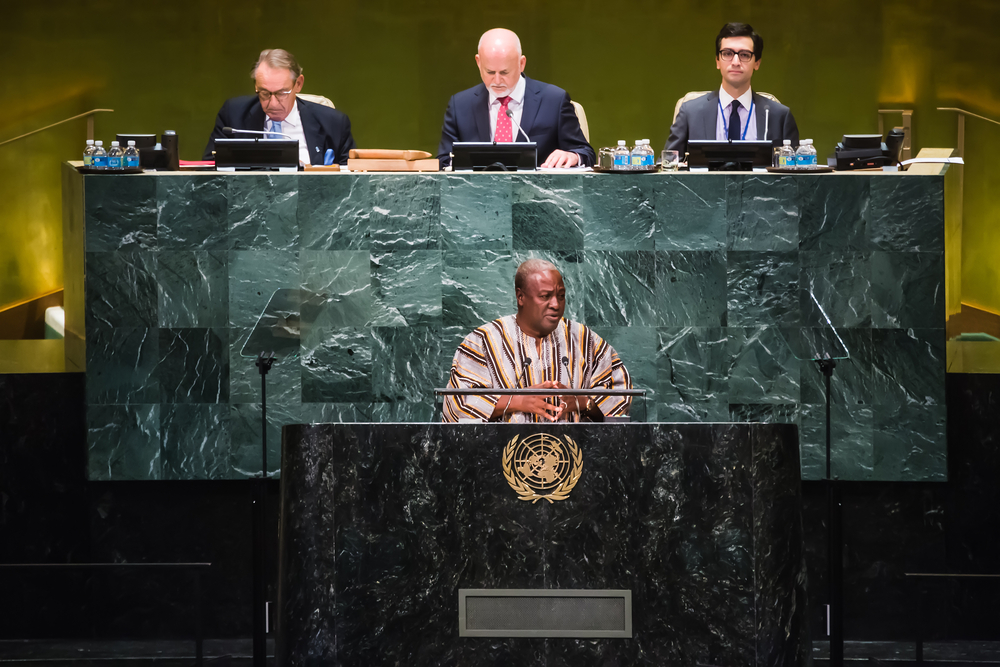
Ghana is set to propose a United Nations resolution calling for the identification of transatlantic enslavement as the “gravest crime” in all of human history.
First reported by Reuters, the Foreign Ministry said the proposal could be made this month at the U.N. General Assembly. With the resolution, Ghana is also calling for reparations as they push for the lasting impacts of enslavement to be acknowledged.
President John Dramani Mahama says the resolution is rooted in international law. All 40 African members of the African Union have already reportedly expressed support, according to Ghana’s officials. Earlier this week, at the 26th Commonwealth Foreign Affairs Ministers Meeting, Foreign Affairs Minister Samuel Okudzeto Ablakwa appealed to fellow ministers for support for the proposed voting date of March 25.
With the passage of the proposal, Ghanaian officials hope to open up conversations about reparative justice on a global scale.
“The proposed resolution seeks to recognise the transatlantic slave trade as the gravest crime in the history of humankind, taking into account its scale, duration, legalisation and enduring consequences,” said Ghanian government officials per Reuters. “A backlash against truth is one that we hope would not occur. Ghana is not seeking to reopen old wounds but to heal those wounds with truth. We remain optimistic that others would equally be able to do so.”
Late last year, in December, the United Nations Economic Commission for Africa made similar calls for reparations.
As a representative for the African Union, the institution called for reparations for governing laws that have kept Africa from prospering on global value chains. The commission specifically referred to laws that demand that Africa export cocoa, lithium and crude oil instead of finished products such as chocolate, electric batteries and crude oil.
FRFT Responds to Ghana & the African Union
— American Freedmen Legal Fund (@realAFLF) February 17, 2026
The Freedmen Reparations Fund Trust has formally sent notice to Ghana and the African Union.
We support historical truth. We support acknowledgment of slavery as a crime against humanity.
But reparations must be legally precise.… pic.twitter.com/DtnFmWh4I5
The transformative reparations specifically call for a change in how land is sourced in Africa, paving the way for the continent to prosper.
Caribbean nations also have an ongoing initiative dedicated to holding European nations accountable for enslavement. Created in 2013, the CARICOM Reparations Commission was tasked with developing an official reparations plan.
Published in 2014, the 10-point reparations plan included a formal apology, a resettlement program, a development program, cultural institutions and assistance with current public health crises. The plan also included calls to increase literacy, teach African history, provide psychological help, expand technology and cancel debt.
Although it has been over a decade since the plan was published, no reparations have been paid to Caribbean nations. Earlier last year, officials reaffirmed their commitment to pursue them. Later in the year, the CARICOM Reparations Commission met with UK parliament leaders, Caribbean and African Union diplomats and academics to discuss the impact of the transatlantic slave trade, calling for more investment in public education on this topic.
The CRC once again presented its 10-point plan with updates implemented. Although the UK will not provide financial compensation, its government is reportedly interested in providing non-financial reparations.