


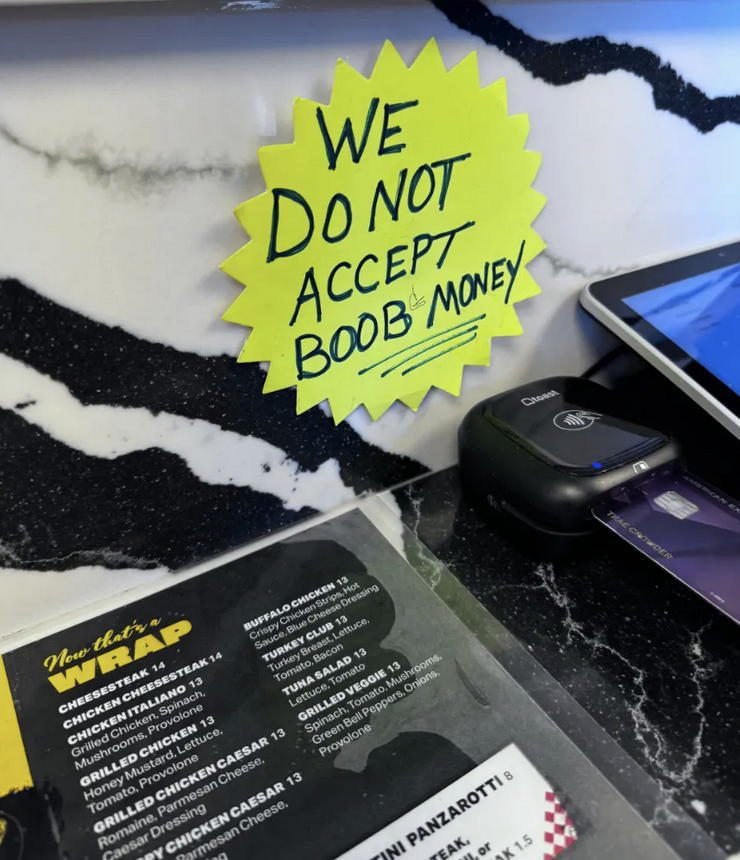
So I was scrolling Substack when I saw this photo above: a neon yellow sign taped to a counter that reads, “WE DO NOT ACCEPT BOOB MONEY.”
I cackled and decided screw the piece of political commentary I had planned to write for Y’all. Instead, we need to gather here today as a people and discuss one of the oldest, dampest, most fascinating financial institutions in all of Black America: titty money.
Real talk, some humanities scholar out there needs to write their doctoral dissertation on this phenomenon. Let me propose at least six titles:
“Under the Breast and Beyond the Bank: Titty Money, Black Women’s Informal Economies, and the Moist Architecture of Ancestral Financial Security.”
“From Bosom to Bodega: A Study of Titty Money, Thermal Currency, and Black Women’s Embodied Banking Practices.”
“The Breast as Vault: Titty Money, Domestic Sovereignty, and the Secret Financial Geographies of Black Grandmothers.”
“Warm Bills, Deep Folds: Toward a Black Feminist Theory of Titty Money and Emergency Liquidity.”
“Damp Capital: Titty Money, Underboob Security, and the Hidden Economies of Black Women’s Survival.”
“Pressed Against the Flesh: Titty Money and the Thermodynamics of Black Matriarchal Finance.”
Now before we proceed, let me explain why I choose to say “titty money,” instead of “boob money.” Because “boob” sounds like something whispered in a pediatrician’s office. It is too sanitized, too after-school special, too white mom explaining puberty in a minivan. “Titty” is more accurate. It is ancestral, humid, and mysterious. And it sounds like it came wrapped in a house dress with a peppermint stuck to it and folded under enough womanhood to defeat both pickpockets and gravity.
Listen, I see a social media post like this ever year. Always in the summer. Never January when everybody’s wearing wool coats. No, titty money announces itself when the temperature hits 87 degrees and somebody’s auntie walks into a corner store, reaches into the ancestral vault, and pays for a bottle of water with a damp five-dollar bill that has survived humidity and at least three layers of foundation garments.
As a lifelong germophobe since I was three, let me say this plainly for Y’all, I do not accept titty money. I do not want titty money. I do not want change from titty money. I do not want to be in the same zip code as a dollar bill that has spent the afternoon marinating under somebody’s left breast like a pork chop in a Ziploc bag.
And yes, I understand and deeply respect the tradition. My great-grandmother, Nana, had big titties. Not breasts. Not bosoms. Titties. Big, majestic, government-issued, front-porch-sitting titties. Titties that could rest on her thighs and calm a crying baby without a pacifier, a bottle, or a lullaby. Those were not body parts. They were institutions.
I used to visit her in Newark, New Jersey during breaks from boarding school, and at least once a day she would send me to the store for some cooking item. Cornmeal. Evaporated milk. A pack of chicken legs. Something that required me to cross the street and enter a store that smelled like floor cleaner, incense, lottery tickets, and cold cuts.
And every time, Nana would say, “Come here, litte one” and reach into her house dress, slide one hand beneath one of them titties, and pull out a few warm dollars. Warm. Not room temperature. Not slightly handled. Warm like a biscuit wrapped in foil. Warm like it had been waiting for me in a slow cooker.
As a young germophobe Black child. I had questions. Soooo many questions. Where exactly was the money tucked? Under the fold? Between the nipples? In the cleavage? Was there a system? Did she organize the ones under the left breast and the fives under the right? Was there a titty-based filing cabinet I was not old enough to understand?
Was the money folded lengthwise? Was it pressed flat against the skin? Did gravity hold it in place? Sweat? Faith? Was there a secret auntie origami technique passed down through generations? Could a woman lose a twenty under there and find it again at Easter?
I studied this practice from an anthropological perspective. Black women did this everywhere.
Maybe she’s at the gas station, standing at pump five, arguing with the card reader, then finally marching inside to pay cash. The cashier says, “How much on five?” and before he can finish the sentence, she reaches into the bosom bank and produces a ten-dollar bill so warm it still has a pulse.
Or maybe she’s at church. The choir is humming, Black women are fanning themselves and children with funeral home or MLK fans, the pastor is sweating through his second close, and the usher is coming down the aisle with the collection plate. That’s when Sista Somebody reaches into her bra and pulls out offering money that has been pressed against the Lord’s creation since Sunday school. The Lord may love a cheerful giver, but I always wondered if the Lord preferred dry offerings.
Or maybe she’s at the cookout, pulling some niece, nephew, or grand baby into her bosom for one of those hugs that feels like affection and temporary captivity. The child disappears into the floral blouse for three full seconds and comes out smelling like cocoa butter, Lawry’s, and purse peppermints. And then the child just stands there, silent and bewildered, while she reaches back into the same bosom that nearly swallowed them whole and peels off a folded bill like she’s removing evidence from a crime scene.
Or maybe it’s her grown child she’s trying to slip a little money to on the low. She’ll hug them goodbye, pat their back twice, then press a folded twenty into their palm like she’s transferring classified documents. And you already know where that twenty came from. That money has been riding shotgun under her left titty since the potato salad hit the folding table.
That breast was not just a breast. It was a mobile ATM. A soft-sided Brinks truck. A flesh vault with no monthly fees. Titty money was how somebody paid the spades debt at cookouts. At fish fries, it bought a plate. At beauty salons, it appeared when the stylist said, “That’ll be $65.” Somewhere in America right now, a woman is patting her chest and saying, “Hold on, baby, I got it,” and I know in my spirit that money is not in a wallet or change purse.
I have developed my own historical hypothesis for how all this began.
Long ago, one of our foremothers looked around and realized the world was full of thieves, trifling men, nosy children, church ladies with sticky fingers, and cousins who “just needed to borrow something until Friday.” She surveyed the available hiding places. Purse? Too obvious. Mattress? Too old-fashioned. Bible? Too many people pretend to read it. Then she looked down at the glorious architecture that the African orishas and genetics had provided and said, “Ah. My breasts.”
And thus, titty money was born!
It makes sense.
What were these women protecting? Their little emergency funds. Their bus fare. Their bingo money. Their offering money. Their “I wish somebody would” money. Money for cigarettes, hair grease, sweet potatoes, gas, or a secret lottery ticket. College textbooks. The titties became an ancient hiding place because nobody was gonna reach in there without permission unless they wanted to lose a hand, a future, and their standing in the family. The breast was security, privacy, and a safe deposit box with body heat.
But as a germophobe? Absolutely not. Because I know what that money looks like. Soft around the edges. Slightly curled. A little limp. The ink looks tired. The paper has absorbed things. That money has seen underboob moisture, perfume, Gold Bond powder, cocoa butter, church sweat, hot flashes, bra lint, and the kind of summer humidity that makes the air feel like soup.
You hand me a damp dollar and I’m not seeing legal tender. I’m seeing a laboratory sample. I need tongs. I need gloves. I need a hazmat team. I need that money quarantined for fourteen business days and prayed over by a scientist. Do not hand me currency that looks like it has been through a baptism and a mammogram.
Now, to be clear, I will never have this problem personally. I’m only a B-cup, which means I do not have the infrastructure to hide money under my boobies. If I tried to store a five-dollar bill under there, it would slide down my stomach, fall into my waistband, and embarrass everybody. My titties do not have storage capacity. They are decorative, not administrative.
My Nana had a vault. I have a suggestion box. If I tried to pay somebody with titty money, I’d have to tape it to myself like a hostage note. There would be no elegant reach, no ancestral swoop, no dramatic retrieval from beneath the house dress. Just me fumbling around, trying to make a B-cup do big-titty labor. That is not my ministry.
Still, I respect the tradition. I really do. Titty money is nasty, yes, but it is also cultural history. It tells a story about Black women’s resourcefulness, secrecy, self-protection, and refusal to be caught without a little something on them. It is disgusting and brilliant. Unsanitary and ancestral. A public health concern with deep cultural roots.
But stores have rights!
So when I see that sign that says, “WE DO NOT ACCEPT BOOB MONEY,” I understand both sides. I understand the cashier who had finally had enough of moist currency sliding across the counter. And I understand the auntie somewhere saying, “Money is money. Take this damp five and mind yo’ business.”
As for me, I stand with the sign. I love my people. I honor my elders. I respect Nana’s legacy. But if your money comes from under your titty in July, please keep it, frame it, archive it, or donate it to science. Just don’t hand it to me.
Thanks for reading. If this piece resonated with you, then please consider becoming a paid subscriber. Paid subscriptions help keep my Substack unfiltered and ad free. They also help me raise money for HBCU journalism students who need laptops, DSLR cameras, tripods, mics, lights, software, travel funds for conferences and reporting trips, and food from our pantry. You can also follow me on Facebook!
We appreciate you!