





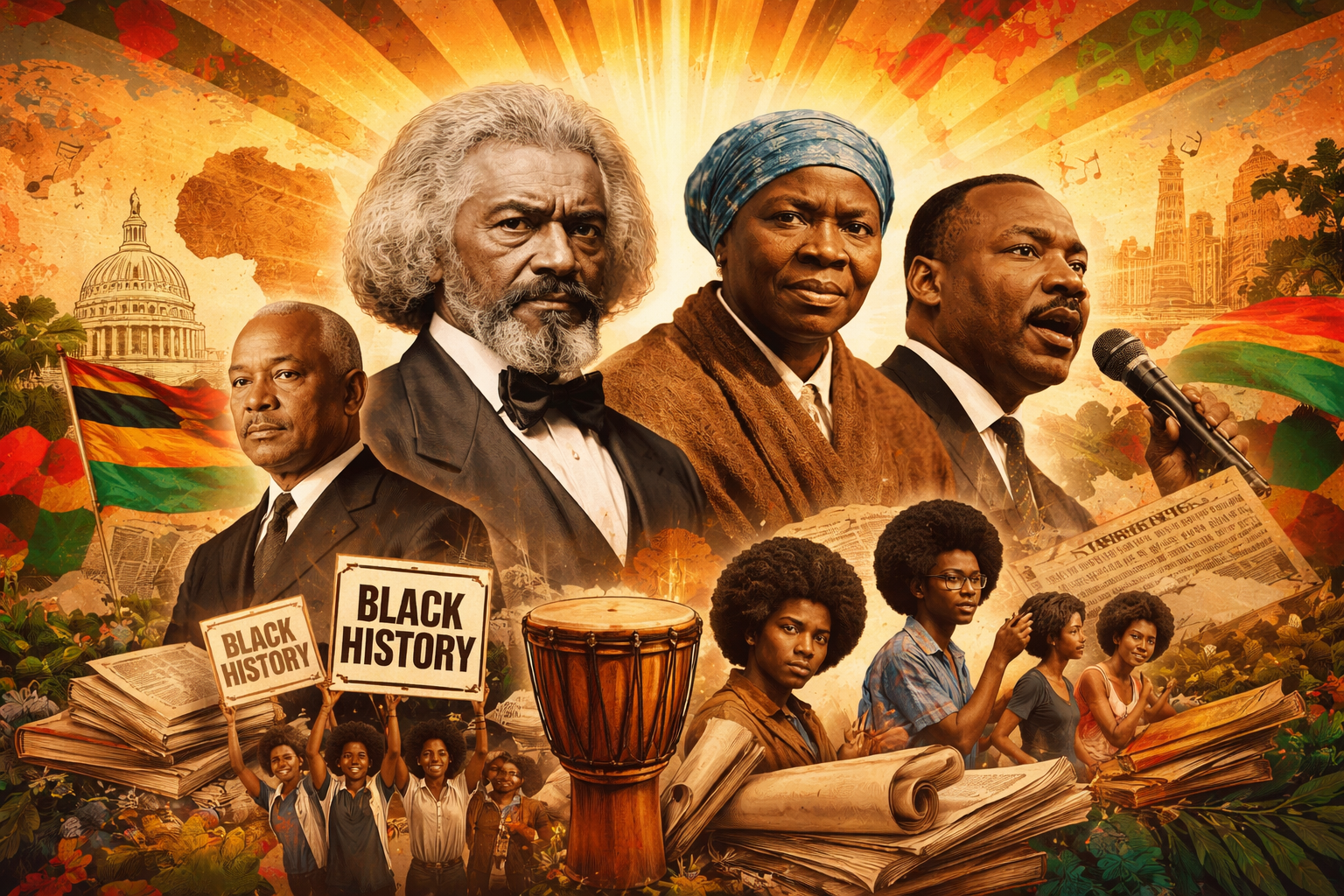
The beginning of February marks the start of this year’s Black History Month.
Here are five facts we should all about Black History Month to kick off the historic month.
- February was chosen to coincide with the birthdays of Frederick Douglass and Abraham Lincoln. According to the Association for the Study of African American Life and History, the group’s founder, Dr. Carter G. Woodson, first established Black History Week in February. It is said that the month was picked to symbolize “tradition and reform” through the celebration of Douglass’ and Lincoln’s birthdays, held on the 14th and the 12th, respectively. While Douglass was revered as a reformer and abolitionist, Lincoln’s birthday was largely celebrated by Black communities following his assassination in 1865.
- The first Black History Month was celebrated in 1970. Following a year of planning, the celebration of the month was pioneered by Kent State’s Black United Students organization. At the height of the Black Power movement, the BUS held multiple protests, social events and activities to celebrate Black culture. The celebrations came after the adoption of Black history courses. After decades of attempts to suppress Black history, California became the first state to mandate the teachings of Black history in public schools in 1951. Throughout the 60s, there was an uptick in public schools that adopted these courses.
They suggested extending the then-weeklong celebrations for a month, becoming one of the first campuses to adopt Black History Month. Six years later, in 1976, the month was declared official by then-President Gerald Ford.
- Each Black History Month has a theme. Declared by the Association for the Study of African American Life and History, each Black History Month has a theme to reflect changes in self-identity, racial ideologies and aspirations of Black communities. For the 100th celebration of Black History Month, the group has announced that the theme will be dedicated to “a century of national commemorations of Black history.” Amongst the figures that will be celebrated are Dr. Carter Godwin Woodson, George Cleveland Hall, William B. Hartgrove, Jesse E. Moorland, Alexander L. Jackson and James E. Stamps.
- All figures helped implement and cement the celebration of Black History Month throughout the past century.

- Black newspapers helped build support for Black History Month. When Woodson first announced his idea to celebrate Black history and culture, Black newspapers helped support his cause. Poet Langston Hughes urged Black Americans to write to Woodson with requests for Black history materials, sharing his home office address in the Chicago Defender so people could contact him. The Philadelphia Tribune had similar initiatives, providing support for people to write to Woodson. Eventually, it led to a nationwide initiative to collect and share “dates and data” on Black history, with Woodson leading the effort. The ASNLH leader eventually created his own newspapers, journals and books to help document what was shared with him. Black-owned newspapers continued to underscore the importance of chronicling Black history and to support the ASNLH’s efforts, reaching over 1.6 million readers. These newspapers included the Los Angeles Sentinel, the Baltimore Afro-American and the Pittsburgh Courier.
- Black History Month has expanded to different countries. Celebrated in October, the first Black History Month in the U.K. was honored in 1987. The year coincided with the 150th anniversary of Caribbean emancipation, the 100th birthday of Marcus Garvey as well as the 25th anniversary of the Organization of African Unity. According to Akyaaba Addai-Sebo, the creator of Black History Month in the U.K., October was chosen partly because it marked the start of the school year and partly because it was a time when African leaders gathered to discuss. Other countries that celebrate Black History Month include Canada, Jamaica, Germany, Ireland and France. Several African nations, including Burkina Faso, the Ivory Coast and Cameroon, also honor Black History Month.