




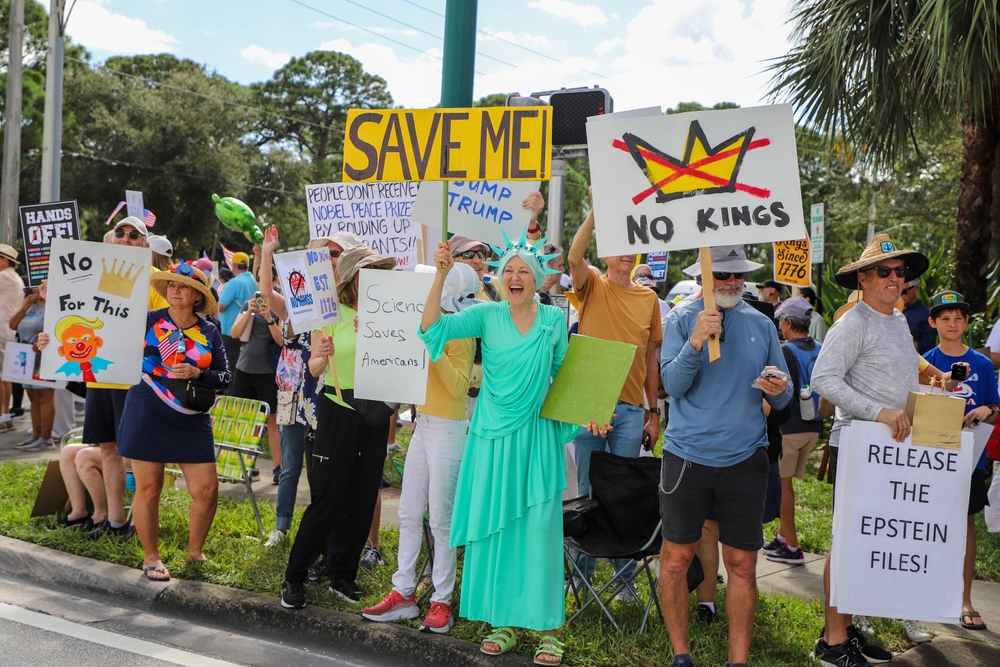
M’kay, Y’all. Let’s give credit where it’s due.
The No Kings protest this weekend did, in fact, deliver a devastating, historic, absolutely irreversible blow to tyranny.
We’re talking millions of people. Not a cute turnout, but eight million bodies flooding more than 3,000 protests across the country. The largest single-day protest in all of American history!
You may not have felt it, but trust me, power felt something.
Somewhere, deep inside a heavily gilded room, tyranny is pacing the floor in a silk robe, Diet Coke trembling in hand, whispering to itself: “Eight million? …No. No. That’s too many. Not the linen pants. All those signs with clever puns. The inflatable frogs! My God, “the people” have weaponized whimsy.
Listen, Donald Trump is pissed. And he’s not wrong. Because nothing strikes fear into the heart of entrenched power like a well-moisturized crowd in breathable fabrics holding rhyming slogans and biodegradable rage. You could practically hear the empire cracking under all that coordinated irony.
Somewhere, a billionaire paused mid-tax shelter and said, “Wait… are those matching fonts?”A senator glanced nervously at a sign that said “No Kings” and immediately reconsidered decades of imperial policy.
The Pentagon is shaken, Y’all. Absolutely shaken. Reports are coming in that they are still trying to recover from the psychological warfare of seeing a sunglass wearing, ten-foot, wobbling amphibian that looked like it just got radicalized at a pool party!
Because when history looks back on this moment, it won’t remember legislation, strategy, or sustained pressure. No. It will remember Chad in linen pants, sipping an oat milk latte, holding a sign that said “Democracy Is My Love Language” while an emotional support unicorn bobbed gently behind him like a spiritual guide.
Jokes aside, what really got me is the deluge of white liberal rage that followed the protests. Because as soon as the last inflatable critter deflated and Chad folded up his “Democracy Is My Love Language” sign, a whole parade of freshly activated white liberals came strolling into Black people’s social media feeds, mine included, not to listen, not to reflect, but to scold and cuss us out for saying anything critical about the protests.

“Well what are YOU doing?”
“So what’s the plan then?”
“Okay you ‘self-righteous Debbie Downer,’ how do we fix it?”
Oh, so now that your Fitbit says you hit 12,000 steps for democracy, you want Black folks to draft the next phase? Here y’all come, fresh off your protest glow, linen still crisp, asking us to architect the collapse of a system that has been collapsing on top of us our entire lives. Baby, the plan for us has been make it through the day, stay alive, stay sane, stay employed, stay housed, stay out of harm’s way in a country that keeps inventing new ways to make that difficult.
The same people who are demanding answers from us are the same people who have historically ignored them, watered them down, voted against them, or called them “too extreme” the minute they required actual sacrifice.
So let me go ahead and help y’all out. You want to know what’s next? Fine! Imma give y’all at least ten things white liberals can do after the protest. Ten actual things, not cute things, not Instagrammable things, but real, material, disruptive things. And I already know, most of y’all not ‘bout to do a single one of ‘em.
Let us begin, liberals!!!
First: Stop asking Black people what the fuck to do.
I mean really stop. Not performatively. Not for a week. I mean until Black Jesus comes to Earth again and parts the clouds, sandals hitting asphalt, and he looks around like “Lo . . .” Stop treating Black people like your personal strategy consultants for a system we didn’t build and have been warning y’all about for centuries. We don’t know how to fix this shit. Let me say that again slowly for the people refreshing my page looking for a blueprint: we. do. not. know.
Because we have been a little busy. Busy surviving. Busy navigating systems that were designed to chew us up every which way. Busy raising kids, paying bills, dodging harm, documenting harm, writing about harm, teaching about harm, healing from harm, and apparently now, fielding follow-up questions from people who just discovered injustice because it’s in they face now.
And while we’re here, stay the hell out of our comments. Because all most of y’all got is a lot of audacity, condescension, gaslighting, and tiresome questions. We don’t have time for that.
Our digital spaces are not your pop-up classroom. Not your field trip. Not your little anthropological “let me observe the natives in their natural habitat” moment. This is not where you wander in, shoes muddy with entitlement, asking for a tour, a lesson, and a personalized action plan on your way out.
Our spaces are for us. For thinking out loud. For telling the truth without translating it. For laughing, dragging, grieving, remembering, building, venting, and connecting without having to pause every five minutes to explain basic history to y’all. They are for community. For clarity. For relief. Not to be fighting with y’all.
Because what’s wild is that y’all will march all day against oppression and then log online and immediately try to manage Black people. Tone-police us. Correct us. Demand optimism. Demand strategy. Demand gratitude. Demand that we package our reality in a way that feels productive to you. It’s giving: “I oppose the system… but I would still like to supervise you.”
And if you have time to be in my space cussing me out, scolding me, and asking me to produce a five-point plan for the downfall of Empire, then what you actually have is free time. And if you have free time, then you have time to go read something, fund something, organize something, and disrupt something without needing a Black person to hold your hand through it.
Second: Give up something that actually costs you.
Not performance. Not a Saturday. Not a clever sign. I mean giving up something that actually touches your life. Something that makes you pause and think, “Do I really want justice that bad?” Because right now, a lot of y’all want justice the way you want a Peloton. That’s aspirational, aesthetically pleasing, and used just enough to feel like you did something.
I’m talking about money you actually feel. Not a quick $25 donation on the ride home so you can screenshot it like a receipt for righteousness. I mean recurring giving that cuts into the “just because” spending on fewer brunches, fewer Starbucks runs, fewer spontaneous flights you booked because a reel looked peaceful. If your giving doesn’t require a decision, it’s not doing anything.
I’m talking about access. Using your connections to open doors and then stepping aside. Not hovering. Not narrating. Not turning it into a mentorship arc where you’re still the center of gravity. I mean actually moving out of the way so somebody else can walk through without you attached to it.
I’m talking about opportunities. Saying no to things you know you’re going to get anyway so someone else has a real shot. Not “amplifying voices” while still keeping your name on the panel, your byline on the piece, your face on the flyer. That’s not redistribution.
I’m talking about your comfort. Where you bank, where you invest, where you shop, where you send your kids, where you feel safe. Some of y’all will boycott a chicken sandwich with discipline and conviction, but won’t touch anything that actually builds your wealth or protects your status.
I’m talking about labor. The boring kind. The kind with no signs, no chants, no vibes. Just organizing, calling, planning, showing up when nobody’s watching. Because if your activism only exists when it’s visible, it’s not pressure—it’s performance.
The problem is, most of y’all want justice as long as it doesn’t inconvenience your comfort, your safety, or your upward mobility. You want to oppose the system while staying fully protected by it. You want revolution with a return policy.
Third: Stop quoting Martin Luther King Jr. like he was a brand ambassador for politeness.
If your entire political imagination is “What would MLK say?” but you ignore what he actually did, which was disrupt, offend, get arrested, be surveilled, and be hated by the very white liberals who now quote him then you are not honoring him. You are using him as a shield to avoid becoming him.
And why don’t y’all ever quote other Black revolutionaries? Why don’t y’all print Nat Turner on a tote bag? Oh, is it because he didn’t ask for reform? Didn’t write polite letters? Didn’t wait for gradual change? Is it because his rebellion was a declaration that some systems are so violent they cannot be reasoned with?
I want you to stand in the middle of Whole Foods, grab you some turmeric root and a jug of Uncle Matt’s orange juice and quote Malcolm X and very loudly: “If you’re not ready to die for it, put the word ‘freedom’ out of your vocabulary.” Not “march for it on Saturday.” Not “tweet about it.” Die for it. That’s the level of seriousness he was talking about.
Quote Huey P. Newton: “You can kill a revolutionary, but you can’t kill the revolution.” Which means the work was never about optics. It was about building something that could outlive repression.
Quote Stokely Carmichael: “In order for nonviolence to work, your opponent must have a conscience. The United States has none.”
Quote Assata Shakur: “It is our duty to fight for our freedom. It is our duty to win.” Not perform. Not signal. Fight!
Quote Angela Davis: “I am no longer accepting the things I cannot change. I am changing the things I cannot accept.” That’s not a quote for your Instagram bio. That’s a mandate.
Fourth: I forgot to add one for this one. Folks noted this in the comments. I’m editing now. Use your imagination!
I’m not even about to sit here and spoon-feed you this one. If you can coordinate outfits, print matching signs, find a ten-foot inflatable frog, and locate the one protest where the lighting hits just right for your selfie . . . then I promise you, you have the cognitive ability to figure out what real disruption might look like in your own life.
Be creative. Be uncomfortable. Be inconvenient. Because what y’all keep asking for is a script. And what I’m telling you is: if it comes pre-written, it’s probably not radical enough. So no, I’m not giving you step-by-step instructions on this one.
Fifth: Quit confusing visibility with victory.
You were seen. Congratulations. The drones got great footage. But nothing about being visible guarantees change. Black people have been highly visible in our suffering for centuries. Visibility without leverage is just spectacle. And right now, a lot of y’all are very committed to being seen… and not at all committed to being effective.
Turn visibility into pressure. Pick a target like an institution, a company, or a policy and stay on it long after the cameras leave. Call them. Email them. Organize around them. Make ignoring you more inconvenient than responding to you. Attach your presence to consequences. If nothing happens when you show up, then showing up doesn’t matter. Figure out what creates disruption, be it economic, political, or reputational, and apply it consistently.
Build something that lasts. Not a moment, not a viral post but a structure. A fund, a network, a campaign that keeps moving when the crowd disperses. And most importantly . . . stay. Stay when it’s quiet. Stay when it’s boring. Stay when nobody is watching and there’s nothing to post. Because that’s where effectiveness lives. Not in being seen, but in being sustained.
Sixth: Build something that exists after the march.
Not a moment. Not a hashtag. A structure. An organization. A network. A fund. A pipeline. Something that continues when the crowd goes home. Because protests without infrastructure are like fireworks that are loud, pretty, and gone in seconds.
Pick one lane and you commit to it long-term. Start or join a local organization and give it real hours and actual labor every week. Build a recurring fund that supports people in crisis and keep it going after the headlines fade. Create a communication network like group chats, email lists, and neighborhood hubs that can mobilize quickly when something happens. Develop pipelines that move people into opportunities like jobs, internships, and resources, and track whether it’s actually working.
And most importantly, put systems in place so it doesn’t depend on your mood, your schedule, or whether it’s trending. If it can’t function without you feeling inspired, it’s not infrastructure, it’s a hobby.
Seventh: Stop expecting gratitude for doing the bare minimum.
You showed up. Great. That is the floor, not the ceiling. Black people are not obligated to pat you on the back, reassure you, or make you feel good about your participation. If your activism requires emotional validation from the very people most impacted, you’re not doing justice work.
Get your validation from the work itself. Set concrete goals for how many people you’re helping, how much money you’re moving, what policy you’re pressuring, and measure yourself against that, not against whether someone thanked you.
Build accountability with other white people who are also doing the work so you’re not constantly running back to Black folks for affirmation. And learn how to sit with discomfort without trying to fix it with praise. If nobody claps, nobody reposts, and nobody says “good job, Helen” or “good job, Bob,” but the work still moves forward, then keep going. That’s how you know it’s real.
Eighth: Get comfortable being disliked.
Real disruption will cost you socially. It will strain relationships. It will make you inconvenient in rooms you currently feel very comfortable in. And a lot of y’all would rather be liked than be effective. You want to be the “good one” in oppressive spaces instead of the one who actually challenges them.
Start using your voice in the rooms where it actually costs you something. Fuck up your family dinners, group chats, workplaces, donor circles, alumni networks. Interrupt the joke. Push back on the policy. Ask the question that makes the room go quiet and then don’t rescue it with a laugh.
Stop protecting your likability like it’s an asset more valuable than your integrity. And when the invites slow down, the vibe shifts, and people start calling you “too much,” “too intense,” or “not a good fit,” that’s evidence you finally stopped auditioning for approval and started doing some shit that matters.
Ninth: Stop retreating the moment things get tense.
The second the tone shifts, the second somebody Black raises their voice, the second you feel discomfort, you either disengage or start tone-policing. That is not resilience. That is fragility with a protest sign.
Stay in the conversation without trying to control it. Listen all the way through without interrupting, correcting, or softening what’s being said. Notice your instinct to defend yourself, explain yourself, or redirect the tone, and don’t act on it. Sit there. Take it in.
If something hits, reflect on why instead of trying to neutralize it. And when you do respond, respond to the substance, not the delivery. You’re not there to manage emotions. You’re there to understand what’s being said and what it requires of you. If you can’t stay present without trying to reshape the moment around your comfort, then you’re not ready for the work because you’re still trying to control it.
And finally—tenth: Sit with the possibility that this system cannot be “fixed” the way you imagine.
This is where I’m at. And this is the part that really terrifies people.
Y’all keep asking for a plan that preserves the thing you’re standing on. You want reform that doesn’t require rupture. You want transformation without loss. And history doesn’t work like that. Empires don’t gently pivot into justice because people asked nicely with matching fonts.
Start loosening your dependence on the system you say you want to change. Build parallel ways of living, supporting, and organizing that don’t rely on its approval to function.
Put your energy into mutual aid, local networks, and community-based solutions that can hold people when institutions fail. Prepare yourself, materially and mentally, for disruption, not just reform. That means thinking about what you’re willing to lose, what you’re willing to risk, and what you’re willing to build in its place. Because if your entire plan requires the system to remain intact, then you’re not planning for change, you’re just planning for comfort.
And that’s really the point of all of this. Because what you’re asking for is a plan that lets you keep everything like your comfort, your access, your safety, your status, and still call it change. And what I’m telling you is: that plan does not exist.
It has never existed. Not in any empire. Not in any moment of real transformation. Not in any history y’all love to quote when it’s convenient.
There is no next step that doesn’t cost you something. There is no strategy that doesn’t require you to give something up. There is no version of justice that lets you stay exactly where you are and still claim you’re against the system that put you there.
And that’s why so many of y’all are stuck. Because you want a revolution that feels like a vibe. You want resistance that photographs well. You want change that doesn’t rearrange your life. But the truth is the real work is quiet, it’s sustained, it’s uncomfortable, and it will ask more of you than you’ve ever had to give. Real change will rearrange your life and it will take something from you.
So stop coming into Black spaces asking for a blueprint you’re not ready to follow. And go sit with this one simple question: What are you actually willing to lose?
Because until you can answer that honestly, you ain’t ready for the answer you keep asking us for.
Thanks for reading. If this piece resonated with you, then please consider becoming a paid subscriber. Paid subscriptions help keep my Substack unfiltered and ad free. They also help me raise money for HBCU journalism students who need laptops, DSLR cameras, tripods, mics, lights, software, travel funds for conferences and reporting trips, and food from our pantry. You can also follow me on Facebook!
We appreciate you!