



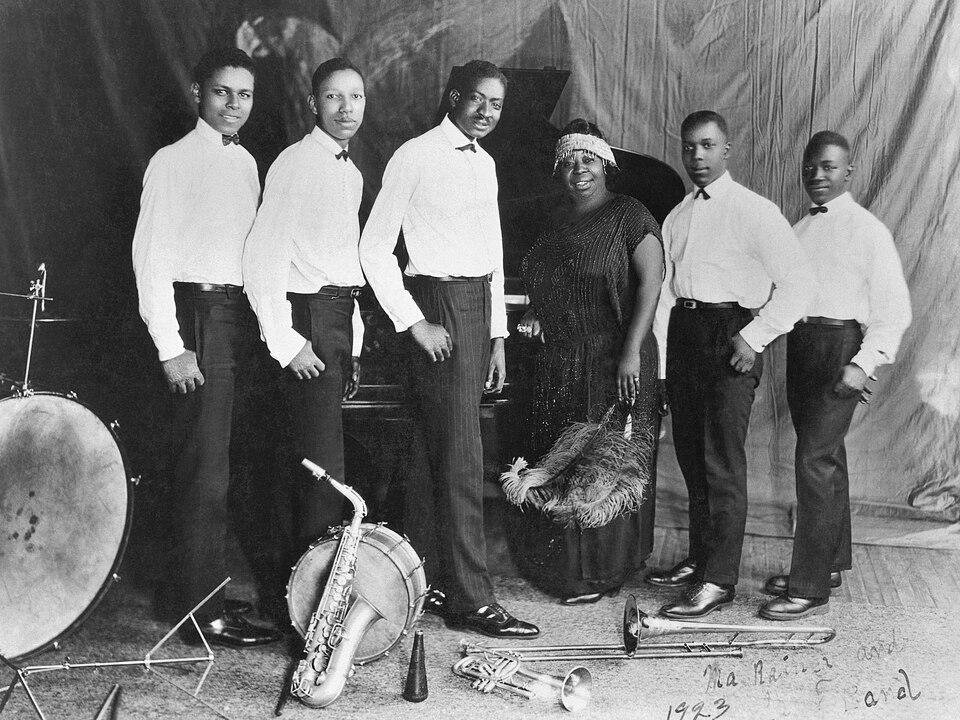
Ma Rainey didn’t just sing the blues – she invented the blueprint.
And now, thanks to a jaw-dropping deep dive into private collections, that blueprint is louder and clearer than ever.
We aren’t talking about another lazy remaster either. This is a full-scale archaeological dig.
Uncovered notes, secret takes and micro-details buried in old wax have finally surfaced. It is fierce, fresh and hits like a gold-toothed smile from the front row.
Released last week, a new, 5-CD boxed set offers a comprehensive look at Rainey’s incredible music career. Produced by Black Swan Records in collaboration with the George H. Buck Jazz Foundation, this collection spans all of her recordings from 1923 to 1928, exhibiting her unmatched talent and influence in jazz.
What makes this set particularly special is the inclusion of rare test pressings and alternate versions, along with a whopping 118 original recordings that took nearly a decade to curate from private collections and various jazz records. Whether you’re a longtime fan or just getting into her work, this collection is a treasure trove of music that highlights Rainey’s legacy in a way that’s engaging and informative.
In the early days of the recording industry, Rainey, often celebrated as the mother of the blues, turned the music scene on its ear when she emerged as a groundbreaking artist who blended the flamboyance of vaudeville with the deep emotional resonance of African American experiences just a generation after the end of slavery. Her performances captivated audiences, particularly within the Black community, offering a powerful voice that echoed their struggles and joys.
“She was the star of her time,” remarked Gaye Todd-Adegbalola, a contemporary blues singer who continues to honor Rainey’s legacy. Hits like “See See Rider” and “New Bo-Weavil Blues” not only became classics but also laid the groundwork for generations of musicians to follow. Despite her vivacious touring career and pivotal contributions to the genre, her influence seems to have somewhat faded in the historical record after her passing in 1939, a grim reality for many early Black artists whose legacies were often overlooked or diminished. So, with that in mind, it’s surprising that these recordings even exist.
According to The New York Times, Paramount Records, the recording label most famous for capturing Rainey’s raw energy, was actually a branch of the Wisconsin Chair Company, which primarily produced furniture. Their primary goal for making records was to sell phonographs rather than to create high-fidelity audio experiences, which is why they used cheap shellac for pressing. The decision often resulted in less-than-stellar sound quality, but it was a trade-off they seemed willing to make.
Doug Benson, a Grammy-nominated engineer who worked on the new collection of Rainey’s music, has said that dealing with this material was the toughest challenge he’s ever faced. Rainey’s voice was so strong that when she sang her highest notes, the sounds became distorted.
“The first time people played these songs on a Victrola with a heavy steel needle,” Benson said, “it’d skip right past them.”
You can now hear those notes in the new release.
In a recent interview with the news outlet, Benson shared that the restoration process revealed new information that was previously hidden in the records.
“We discovered a violin that is not in any of the other discographies,” he said. The strings, played by Leroy Pickett, can now be heard on “Little Low Mama Blues” and “Grievin’ Heart Blues.”
Famous jazz musicians like Coleman Hawkins, Fletcher Henderson and Louis Armstrong are featured in the collection too, reacting to Rainey’s powerful and emotional singing style.
Born Gertrude Pridgett in Columbus, Georgia, in 1886, Ma Rainey became a major player in the evolution of blues music. She cultivated her powerful sound through the rich traditions of field hollers, folk songs and the communal storytelling that characterized Black Southern life. As she rose to prominence on the entertainment circuit during the 1920s, her career coincided with the Harlem Renaissance. But what also set her apart was her unapologetic authenticity. She wasn’t interested in softening her sound or altering her message to fit the expectations of white audiences. Instead, she embraced the innate essence of her heritage, delivering music that connected deeply with the experiences of Black life.
“She wasn’t trying to be white and she wasn’t trying to appeal to white values,” noted Todd-Adegbalola, a contemporary blues singer who has both admired and paid homage to Rainey’s work. This intense commitment to her roots and artistry didn’t just carve out space for her in a predominantly segregated entertainment industry – it also inspired countless musicians who followed.
Rainey was part of a powerful wave of Black Americans who were pushing for more freedom and expression, even as Jim Crow laws loomed large. Her music beautifully captured the highs and lows of love, often reflecting the visceral feelings that came with it. One moment, she would be pleading with her partner not to leave; next, she would assert her independence, reminding everyone that she could stand strong on her own two feet. This duality in her songs resonated with listeners who were navigating their own struggles and desires in a society that often sought to keep them down.
Rainey stopped performing in 1935 and went back to her family home in Columbus, Georgia, which she preferred over being on stage. She passed away four years later and not many people remembered her outside of Black news outlets until August Wilson’s play “Ma Rainey’s Black Bottom” became popular on Broadway in 1982. A Netflix movie version was released in 2020, featuring the late Chadwick Boseman and Viola Davis and earned Davis an Oscar nomination.
After her passing, some of her biggest fans were record collectors in the 1940s who started accumulating reissues of early jazz, blues and country music. Their work was important because it helped keep her music alive, as families handed down her records, viewing her as an expert in her field.
Ma Rainey dazzled crowds in sequined gowns, gold coins and feather boas, yet history turned her into a myth. But listening past the static reveals the true artist, ferocious and real, waiting for us today. Because when you strip away the heavy makeup and the tall tales, her real magic was always right there in the grooves of her shellac records, delivering a jolt of pure, unfiltered power.
And we finally get to drop the legend and, again, meet the actual woman who started it all.