



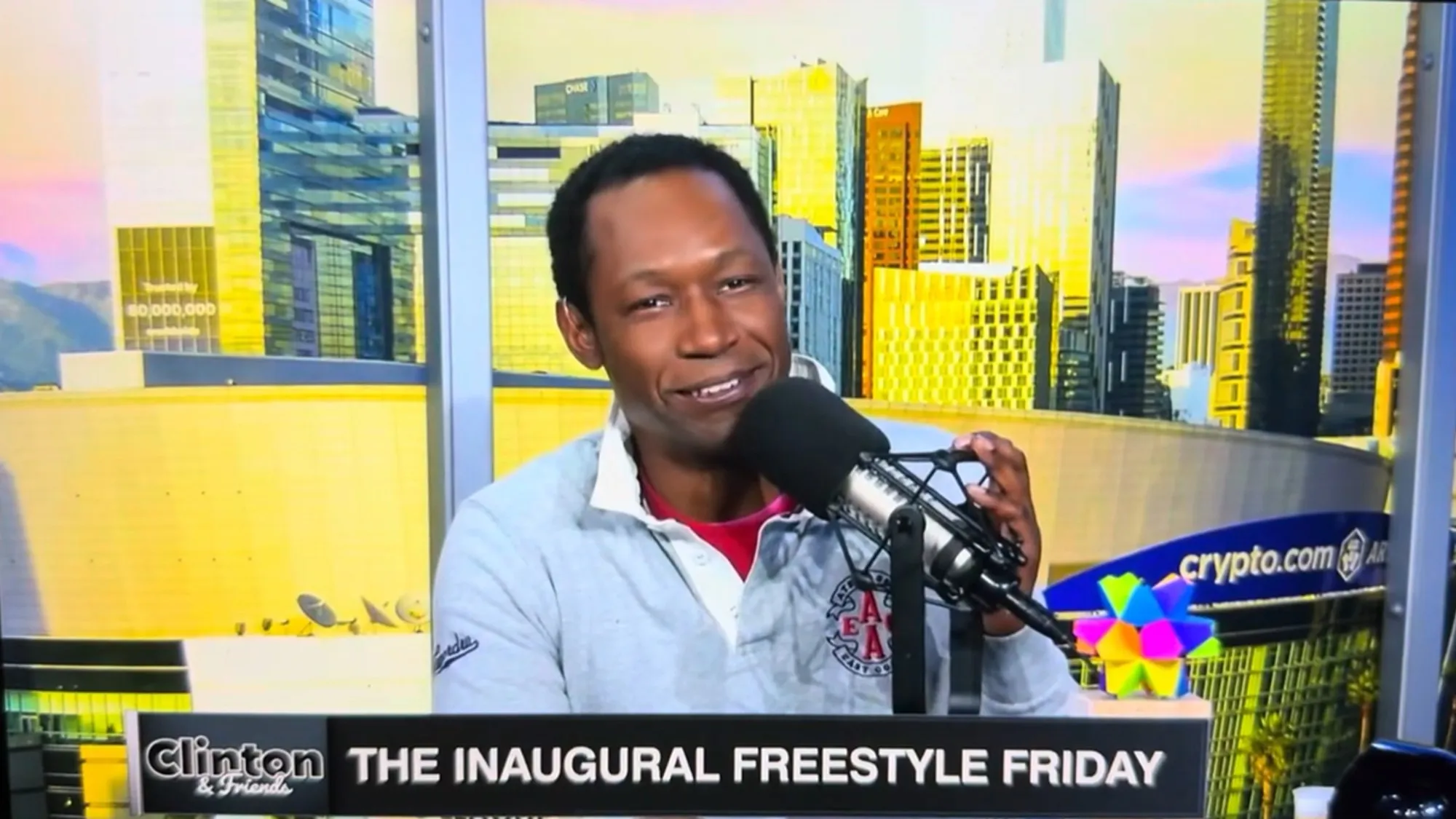
Late Friday afternoon, Awful Announcing posted the news that ESPN midday national sports radio host Clinton Yates was out at ESPN.
Clinton Yates out at ESPN, Andscape amid network programming changes https://t.co/tvpaA4xaw5
— Awful Announcing (@awfulannouncing) March 27, 2026
The news came as a surprise, particularly because Awful Announcing also reported that Yates was no longer part of Andscape.
“That’s showbiz, kiddos. Happy Friday,” wrote Yates in response to the news.
Yates joined ESPN in 2016 as part of the editorial team at The Undefeated, which rebranded as Andscape a few years later. His presence then grew across the network through shows like Around the Horn and ESPN Daily.
In late January 2025, ESPN announced Yates would host his own national radio show Clinton & Friends weekdays from 10 am – 12 pm ET. The network revealed Yates’ show would be followed by Joe & Q from 12 pm – 3 pm ET and the already successful Freddie & Harry, hosted by Freddie Coleman and Harry Douglas from 3 – 6 pm ET.
A little over a year later, Clinton & Friends and Joe & Q are both gone, the latter replaced by The Rich Eisen Show.
This news, coupled with the end of The JR Sports Brief Show on CBS Sports Radio this past December, exposes a serious issue.
What’s happening to the Black national sports radio host?
Aside from Freddie & Harry, Chris Canty on ESPN’s Unsportsmanlike and Fox Sports Radio’s The Odd Couple with Rob Parker and Kelvin Washington and LaVar Arrington on 2 Pros and a Cup of Joe, Black national sports radio hosts appear to be disappearing from the airwaves.
And that’s particularly true of those who aren’t former professional athletes.
There are strong Black voices across other genres such as politics, community affairs, health/wellness and entertainment, but sports is sorely lacking that same strong presence.
At one time, prominent Black sports voices could be heard on airwaves across the country.
Names like Sherman “Jocko” Maxwell, Art Rust Jr., Fred Hickman, Dave Simms, The 2 Live Stews and later Stephen A. Smith were prominent voices keeping sports fans, particularly Black sports fans, informed across the country.
Many moved on to successful television careers while others moved to local radio or play by play, all of which is great.
But with those moves came the loss of their well respected voices on national radio which has created a void in an area that was once a great training ground for Black sports journalists to cultivate their talents.
Radio used to be the most influential media platform in Black America, where trusted Black voices could be heard sharing information and having discussions crucial to the community.
It still remains an influential presence across the country, particularly through programming like Sirius XM’s Urban View channel, The Black Information Network, Urban One and community radio stations like Harlem’s WHCR 90.3 and Philly’s WURD.
There are Black sports radio hosts in local markets, but not nearly as many as there should be, particularly in major cities like New York, Boston and Philadelphia.
And the failure to have Black journalists in these seats is sometimes based on ridiculous and harmful assumptions.